Alan Johnson: I do not think that you can have your cake and eat it also: with the fog, also goes the shadow detail. Expose more. Read:
You have to remember that when using restrainers, the film speed drops. Think of it this way: age-fog is in the same category as the toe on the characteristic curve. Thus, emergent shadow detail becomes the target of suppression, as does the fog, itself. That is why routinely adding restrainer to developers can be self-defeating with fresh film. The negative's base will look great, but the speed (thus shadow detail) will be compromised. The ONLY way to separate such emergent shadow detail is to elevate that shadow detail upon the characteristic curve.
That said, old, foggy film needs this restrainer boost. If, ultimately, you can use such film, productively, and not have to throw it out, who cares if the speed drops? Here is what I do. I cannot prove that this is theoretically valid but, for me, it WORKS.
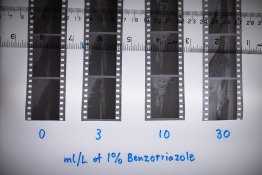
First, take either one gram of benzotriazole OR 18 grams of potassium bromide. Put that in 250ml of water. I put the water and chemical in a small, PET plastic bottle, cap it, and shake vigorously for a few minutes. THAT dissolves the BZ completely, (The PB, if you used that instead, is far easier to dissolve.) I have never used alcohol but that might also be a way to do it. To this, I add a little sodium bicarbonate: about 12 grams. That dissolves rather quickly after a minute of shaking.
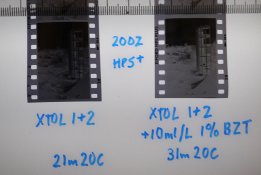
This is your restrainer stock, which I will call RS. I use the designation 'RSL' to indicate the amount of this RS i will add to each liter of developer working solution for film. I find that adding about 50 ml per liter is excellent with highly diluted developers such as D-76 1+3. The sodium bicarbonate slows things down (so fog is kept low) and I honestly believe that that baking soda aids the restrainer in its work. I have some Kodak 2484 film that is so fogged that anyone would discard it, but with this, I have no problem as long as I expose at about EI 16. You might have to add a bit of sodium carbonate if development gets too slow, but not much, maybe start with 1 gram per liter of developer working solution, and go from there.
The development time is tricky: you want adequate contrast (usually you will have to put up with a gamma of about 0.6) and still keep the fog low. Make clip tests, using only about one exposed frame, but I use highly diluted developers and the extra exposure kind of makes up for the reduction in develper energy. Try, at first, about the same normal development time.
Think of the needed extra exposure in this way; for such fogged film and development, the exposure must START about halfway up the characteristic curve, because, with such film, the first half is now fog. Thus, with really old, (formerly fast,) film, the highlights might get squeezed a bit, but you will be amazed how the film's latitude can save the day here.
For PAPER, I find that I can use the same RS but with far more (maybe up to ten times as much) baking soda added. This, for me, works wonders at times with bad paper: The baking soda slows development and seems to synergize with the restrainer in order to truly suppress fog. (Please do not ask me to post examples, as that is not feasible right now, but testing what I say with only small amounts of solution should not be too trying for you.) Start with Dektol diluted a bit more, maybe 1 + 3 and go from there. Bottom line: use a coin test and make certain that the unexposed area under that coin is not acquiring more than 50% density by the time you have finished developing the paper. Expose the image in order to get a full, dense picture. After fixation, use Farmer's Reducer to 'bring back' that coin area to whiteness. Now, that really dense image should be really good if you exposed properly. It will take much trial and error, but remember that the coin area must be pure white when you have finished with the Farmer's Reducer. This data will give you what you need to make further prints without the coin. Remember, the density under that coin determines your development time. The density of the print after that coin area becomes pure white, determines your exposure time. (Now you can see how lazy we become with fresh paper that cannot easily be overdeveloped!!!)
NB: if you do not have a scale, I do not know how you will measure the benzotriazole, as it is like 'feathers'. But to measure potassium bromide in milliliters simply measure 12ml (to equate to 18 grams). For baking soda, the volume needed is about 9ml (to equate to 12 grams). - David Lyga