• Welcome to Photrio!
    Registration is fast and free. Join today to unlock search, see fewer ads, and access all forum features.
    Click here to sign up

Label for Genuine Photographs

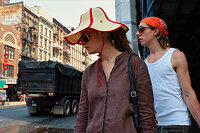
Dump Truck Hat Trick

D
Dump Truck Hat Trick

  • 0
  • 0
  • 19
Street-Lamp

A
Street-Lamp

  • 2
  • 2
  • 72

Recent Classifieds

Forum statistics

Threads
204,301
Messages
2,866,890
Members
102,218
Latest member
333Ford
Recent bookmarks
0
"There is a difference between a shaky or out-of-focus photograph
and a snapshot of clouds and fog banks."
Erwin Schrödinger

The difference here is REALITY.
 
I didn't say exactly what I mean: of couse the pictures are real (how could a picture not be real?). But they do not pretend to show reality. For me (just for me!) this is not photography but painting by using the tools of photography.


No picture pretends to show reality.
Only some people think that some black, white and various shades of gray markings on a bit of coated paper, or similar marks on paper in colour, represent reality.

But i don't think the genuine photograph thing is about representing reality (or pretending to do so).
It's about using photographic tools only. It is flawed in that it sets a limit to what tools it deems worthy of the classification "photographic", and in that it does not recognize that the reason why it holds that some tools aren't permissible also applies to the tools it says are permissible.

If you 'paint' a picture using the tools of photography instead of those of painting, you're not creating a painting, but a photograph. You're not painting, but 'photographing'. That picture would be a "genuine photograph".
 
Last edited by a moderator:
No picture pretends to show reality.

Well, since pictures are not a life form, I would have to agree with you!
:wink:
Nevertheless, many pictures are used by humans to represent certain aspects of reality.
Whether those attempts are successful and those representatons, honest, is a serious matter of concern for some people.
 
... i don't think the genuine photograph thing is about representing reality (or pretending to do so).
It's about using photographic tools only.

So you think that their "genuine photograph" is just another way of saying
a photograph made by... APUG? (Analog Photography User's Gear)
:smile:

That is certainly a key issue here, and one for the OP to address again.
I guess.
I still haven't read their links... too many other more important things to do.
 
Last edited by a moderator:
Then you should perhaps remove all use of the term.
It is at the core of your statement: not manipulated.

And you do indeed try to 'define' it. You list what 'manipulations' are allowed without affecting the "genuine" status ("What are the tolerable postprocessing steps [...]"), and what would be too much.
Completely arbitrarily: what you do not define indeed is where exactly you draw the line, and - more importantly - how and why.
As it is, it would be impossible to know what a "genuine" photograph would be. Impossible to know when to use the label and/or why.

Nothing is too bad not to serve a purpose at least not to serve as a bad example. Our statement may indeed serve as an example of failed communication.
You are perfectly right and we have to thank you for pushing us onto the issue. We had to reread our own statement to notice this at last. As we started to to discuss our goals our approach was not to rely on a definition of the term "manipulation". Unintentionally we did exactly that. We have to apologize for the thus caused confusion. Our mentioned examples for allowed steps of hmm ... treatment merely should serve as an incomplete list of techniques which show that indeed photographs must not in all respects be perfect representations of the real scene which they were made of. Our only aim is to make a difference between found pictures and artificially made ones that by the the every day experience of the broad public get taken as a picture of a found scene.
We have updated our statement -as we now hope- appropriately.

Ulrich
 
...i don't think the genuine photograph thing is about representing reality (or pretending to do so).
It's about using photographic tools only. It is flawed in that it sets a limit to what tools it deems worthy of the classification "photographic", and in that it does not recognize that the reason why it holds that some tools aren't permissible also applies to the tools it says are permissible.

I read one of their links... and while I think they are still struggling with taxonomy, you are correct.

... their "genuine photograph" is just another way of saying
a photograph made by... APUG? (Analog Photography User's Gear)
:smile:

While Greg's comment sounds rather harsh, I think that it is not untypical of how many may actually feel.
However, in all fairness, APUG sort of stands for the same thing, does it not? And, while I am not advocating any one name or label over another, I recogonize there is a perceived value in a such a label... and in as much as this is APUG, one could simply use "APUG Quality" or "Genuine APUG Photograph" to the same end. While these phrases do not convey any real weight at this point, they could grow in significance in the future....
 
I take my 8x10 (as I'm wont to do on occasion) and I make a black and white negative. I use a red filter, making the sky dark, when in fact it is in "reality" (my persoal visual reality in the spectrum I see in) much lighter. I develop the negative for expansion, rendering an altered and somewhat greater apparent tonal range than was discernible, or would be readily discernible in a true to life snapshot with whatever. I contact print the negative, pulling a dodge all the way across to even the density from what really went on the neg, and selenium tone the print long enough make the blacks black. Hand made from beginning to end, using 50 to 80 year old equipment made mostly of wood and leather, no batteries, no enlarger, even the timer is a metronome, using one of the oldest and most traditional of workflows. The photograph bear only a passing resemblance to the reality.

Does my photograph qualify as "real" ?

What about wetplate, that sees only blue-green?

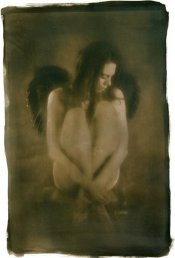
What about this toned cyanotype I painted with light in a pitch black room? Certainly not "reality" not even close. Does it qualify as genuine photograph?

I'm genuinely curious because I really want to be a photographer.
 

Attachments

  • photo.jpg
    photo.jpg
    34 KB · Views: 145
Since we are currently adding explanations to our website (mainly to avoid further discussions like this one), let me say 2 things:

1. We do not judge whether anything is a genuine photograph or not. But we do define what a Genuine Photograph (when this expression is used in the context of our website) is, and use this expression for our pictures. No one is forced to do as we do. We also do say how WE understand photography (and later define this as Genuine Photography, see above). Again, no one is forced to share our opinion. Who still hasn´t got that point, should please reread our posts and our website.

2. As we pointed out before, it is not our intention to discredit any form of art or artistic technique. But it is indeed our intention to point out why we have chosen a special working method, and that this indeed makes a difference for us. Further explanations later.

Finally: If someone shares our opinion and wants to support our idea by being listed on our website, we would appreciate if he let us know this (preferably by mail or PM).

Regards,
Jan
 
Since we are currently adding explanations to our website (mainly to avoid further discussions like this one)

Won't help because:

1 - The basic idea is just a gimmick based on your arbitrary line drawn in the sand.

2 - There is no need for a standard except in news and the news people already have that figured out.
 
Mark,

sorry, but you also did not get the point. We are not trying to create standards. We simply communicate how we work and why we have chosen to work like that. Your assumptions have no basis. And that´s exactly the reason why we are working on the mentioned explanations.

Regards,
Jan
 
Mark,

sorry, but you also did not get the point. We are not trying to create standards. We simply communicate how we work and why we have chosen to work like that. Your assumptions have no basis. And that´s exactly the reason why we are working on the mentioned explanations.

Regards,
Jan

Jan,

You are using your standard, that you developed yourself, to differentiate yourself, and those who choose to follow your standard.

That is nothing more than a marketing gimmick. Your trying to create credibility out of thin air.
 
If you spend time thinking about what you are allowed to do according to a set of "rules" - whether self generated or not- then I'd expect that focus to make your photography less interesting. Compliance is a poor substitute for imagination and doing what you need to do to get the results of that imagination down on paper.
 
Jan,

That is nothing more than a marketing gimmick. Your trying to create credibility out of thin air.

If "f64" or the "Straight Photographers" were just marketing gimmicks... than you are right, Mark.
But the try to create credibility is better than not even to care about it.

Nick
 
Well Mark, basically it´s like I said before: We use this expression to catch people´s attention - and of course, it´s somehow provocative. The creation of a "standard" would assume a general acceptance. We do not seek general acceptance for our project, but understanding of the ideas which lie behind it. But I see that our website might suggest that we are trying to create a standard.

The creation of our "rules" of course arouse from the fact, that we wanted to differentiate our working method - which to a big degree relies on photographic perception, a feeling for the moment and the ability to pre-visualize the final image, but mostly on the fact, that our photographs often show unique moments, conditions, scenes or whatever and are not conceptual work - from, for example, a postpro-orientated working method. Example: For us, it makes a difference if an image of an interesting detail of a landscape is being created by taking a photograph of this detail, because you have found this special detail while walking around, or if you create this image of a special detail from the bottom up (like a digital artist would do) or alter an existing photograph. I do not care if this is important for you - since it is important for me.

For my kind of work, it is in fact relevant how the pictures were created. I am not an artist, I am a photographer. To me, photographing is seeing, finding, and capturing.

Regards,
Jan

P.S.: The quote of HCB in your signature also is true for me. To me, seeing and capturing the moment is different than creating this moment from the cradle.

 
Last edited by a moderator:
If you spend time thinking about what you are allowed to do according to a set of "rules" - whether self generated or not- then I'd expect that focus to make your photography less interesting. Compliance is a poor substitute for imagination and doing what you need to do to get the results of that imagination down on paper.

David, at least for us there is no special need to pay attention to following those "rules".
For my kind of photography, those rules are irrelevant, because they are like physical laws: I do not have a compliance problem, I simply follow them automatically. Those rules are in fact not limiting my photography. Especially they are not relevant for me when I am outside taking photos. They are more a characteristic of our kind photography than rules.

I believe those rules actually do not form an obstacle for many kinds of photographers. Of course they do for many kinds of photography-related artists. Let me repat again: These rules are simply given to show how we work. They do not discredit or devalue any kind of art, they simply describe our working method.

Regards,
Jan

P.S.: Thanks for your post, David. I am now aware of the fact that obviously our descirption of our working method may be not well expressed - since so many people seem to understand them as rules which need to/should be followed. This is definitely something we will think about, because this is not intended.
 
Last edited by a moderator:
i'm pretty sure this is a big success in any german photo forums they might have posted this in.
 
i'm pretty sure this is a big success in any german photo forums they might have posted this in.
I can assure you that this is not the case, since we did not post it in any other forum but apug yet.

Apart from that, I would kindly ask you to keep your prejudices for yourself.

Regards,
Jan
 
I'm still waiting for an answer. Does my work in silver, platinum, and iron emulsion constitute a genuine photograph? I want to know if I make the cut. Then I'll have something fairy lucid to contribute to the discussion. :smile:
 
1. We do not judge whether anything is a genuine photograph or not. But we do define what a Genuine Photograph (when this expression is used in the context of our website) is, and use this expression for our pictures. No one is forced to do as we do. We also do say how WE understand photography (and later define this as Genuine Photography, see above). Again, no one is forced to share our opinion. Who still hasn´t got that point, should please reread our posts and our website.

I doubt the problem is people not reading your statement.

You just can't invent and promote a label, and then say it is not invented to distinguish some sort of something from another sort of something.

So yes, you are indeed judging.
By calling your own photographs "genuine" you are at least implying that other photographs are not.

That, or your statement above should read that all photographs are "genuine". Then we don't need such an empty label.

So if you really believe that some photographs are not "genuine" photographs, you just have to explain why. You must be able to answer, for instance, J. Brunner's questions and explain why his examples are not "genuine".
You can't shrug that off, saying things of the nature of "to each his own", or "we're just saying".


2. As we pointed out before, it is not our intention to discredit any form of art or artistic technique. But it is indeed our intention to point out why we have chosen a special working method, and that this indeed makes a difference for us. Further explanations later.

Rather now, i hope.
Again, that "difference" thing, right? "Special" even.
 
The creation of our "rules" of course arouse from the fact, that we wanted to differentiate our working method - which to a big degree relies on photographic perception, a feeling for the moment and the ability to pre-visualize the final image, but mostly on the fact, that our photographs often show unique moments, conditions, scenes or whatever and are not conceptual work - from, for example, a postpro-orientated working method. [...]

And as has been pointed out since the beginning of this thread: you cannot (at least i haven't seen a succesfull attempt) differentiate your working method from those you say you do not like. You don't do anything fundamentally different from what you say we should not.
So so far, all i see you do is say that you are different.
 
Photrio.com contains affiliate links to products. We may receive a commission for purchases made through these links.
To read our full affiliate disclosure statement please click Here.

PHOTRIO PARTNERS EQUALLY FUNDING OUR COMMUNITY:


Ilford ADOX Freestyle Photographic Stearman Press Weldon Color Lab Blue Moon Camera & Machine
Top Bottom