
• Welcome to Photrio!
    Registration is fast and free. Join today to unlock search, see fewer ads, and access all forum features.
    Click here to sign up

[Ideas for a curriculum for camera technicians] DIY is one thing, but shouldn't we support professional repair technicians just as much?

The Hot Waters

A
The Hot Waters

  • 2
  • 2
  • 90
The Hot Waters

A
The Hot Waters

  • 3
  • 1
  • 104

Recent Classifieds

Forum statistics

Threads
204,458
Messages
2,868,998
Members
102,283
Latest member
MTLMan
Recent bookmarks
1

Andreas Thaler

Subscriber
Joined
Nov 19, 2017
Messages
5,294
Location
Vienna/Austria
Format
35mm
To avoid overloading the forum as a frequent poster, I chose Fridays as the day for new topics - aside from repair projects. At the very least, I aim to post a new topic for reflection on the topic of repairs here every week 🙂


Today I’m asking myself and you, whether it wouldn’t make sense to do more for the preservation of SLRs, lenses, and accessories than just promoting DIY?

Doing your own maintenance and repairs isn’t an option for everyone who wants to get their equipment working again or have it overhauled.

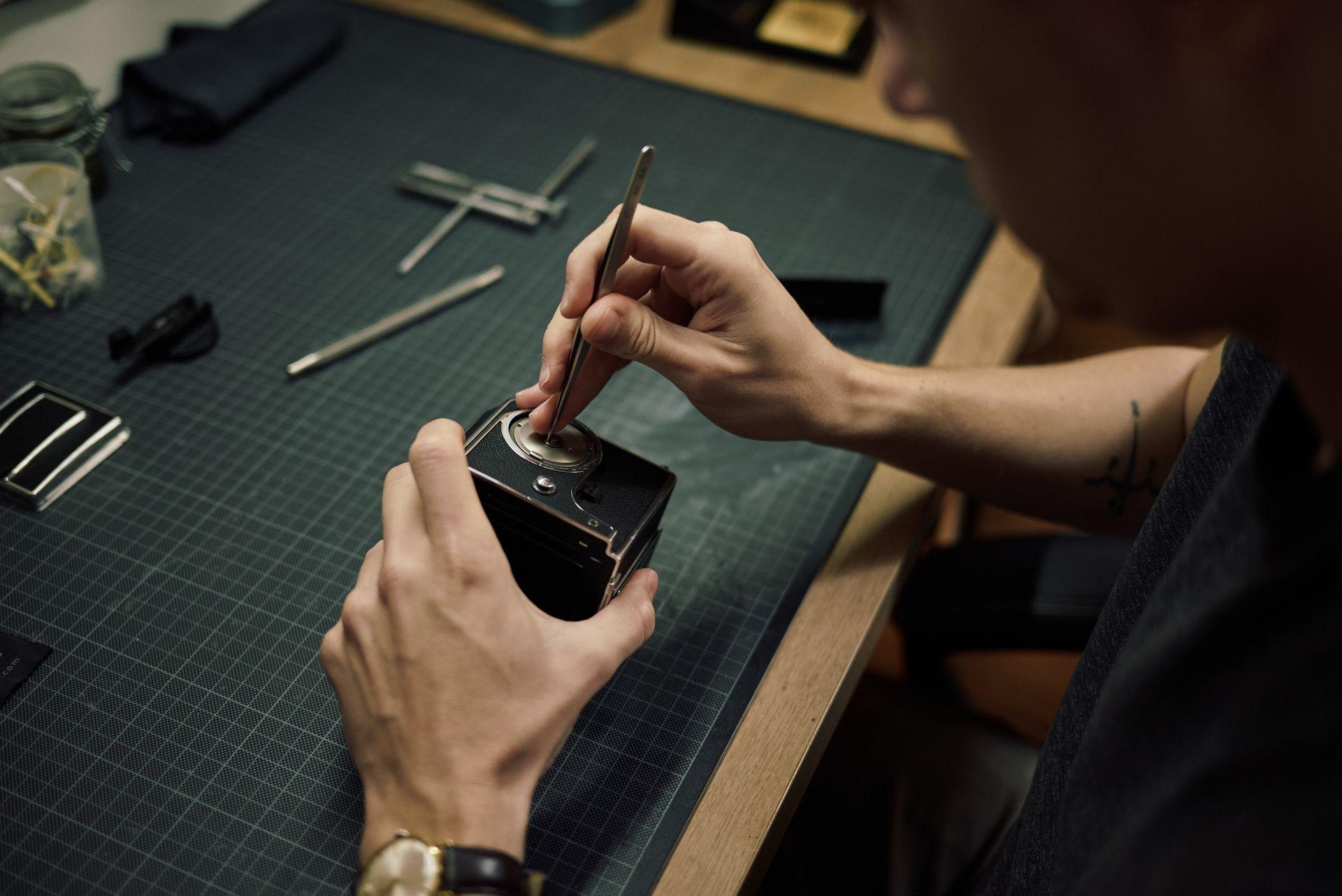
That’s work handled by professional repair technicians, whose numbers are thankfully growing again.

This includes equipment that was previously considered uneconomical to maintain, such as electromechanical SLRs.

See, for example:


Line of reasoning

I see it as the role of public relations - that is, communication - to raise awareness of this issue.

What we’re currently seeing in forums and on social media are two widespread attitudes that are taking a toll on the scarce resource of photographic equipment:
  1. If something breaks, get rid of it and replace it with something that works.
  2. Professional camera repair is often said to be uneconomical.
As a result, it is foreseeable that the supply of affordable, still-functional photographic equipment will become scarcer over time. New products are not currently on the horizon, even though open-source solutions are being discussed.

This weakens film and has consequences for film manufacturers, accessory suppliers, and everyone who wishes to continue working with film in the future.

What can help here is a new awareness of the scarcity of photographic equipment, which should be handled with care to secure the future of film.

Therefore, investing in professional service and repair by experts is a sound and sensible investment. That said, DIY always remains an option.

Do we need a large-scale, coordinated, expensive PR campaign to achieve this?

No, it’s enough to promote this mindset at every opportunity - in online discussions, face-to-face conversations, and by leading by example.

Because by doing so, we’re actually doing something to help preserve the limited supply of photography equipment and ensure affordable prices for professional services.

More demand, more supply, lower prices, or making a conscious investment in your own equipment to maintain its value.

This helps preserve film photography.


What do you think?
 
Last edited:
Up till now I had sent all my cameras, several Rolleiflexes, Olympus SLR and a Leica to professionals for repair or maintenance. The last one the Leica was half a year on holiday in England. It's not that there's an oversupply on repairsmen (and women). And a lot of them are going out of business due to their advanced age in the near future. Labor costs are a significant concern too.
I would never think about putting my hands on one of my cameras. They are too precious to me and some of them are expensive too. But for a young lady interested in film photography I got a little rangefinder camera from the 60s working again by replacing the light seals and soldering in a Schottky diode. That's my level of expertise in this sort of things and I would never think about sending in such camera for repair which I acquired for nearly nothing.
I think professionals are in high demand for preserving the high end part of the photographic heritage. The others will have to get cared for by skilled laypersons.
Getting spare parts is a serious issue BTW. For instance cds-LDR with a low resistance are not made anymore as it seems. This will make these little rangefinders of the late 60s and 70s unrepairable as far as they are strictly shutter priority automatic.
 
Or do professional repair technicians not need any help, since they’re already working at full capacity?

In that case, more could be added.

But who will train them?
 
There is a lot of thought packed into the reasoning; so much that I'm not too sure what to think. It seems that the remaining professional repair shops are not having difficulties getting customers. Recommending that folks use them is a good thing in the situations where that is the most appropriate option. Determining the best option, though, depends upon the motivation of the person requesting help and the motivation(s) of the people making suggestions. There is a lot of diversity of objective in both. I woiuld not even attempt to equate the topic at hand with impacts on film manufacturing or long-term changes in film camera usage, though.
 

Too indirect of an affect. Requires too many assumptions that can not be supported by objective evidence. e.g. One more repaired camera does not necessarily mean 1 more roll of film manufactured, purchased, used, or processed. All it means is that another camera is available for potential use.
 
I could feed that into the AI 😬

Finite equipment supply makes the shortage thesis valid, but the claim that higher demand lowers repair prices is economically flawed. Increased demand for labor-intensive, scarce skills will lead to higher premium pricing rather than a cheap mass market
Google Gemini


So we need to focus on training the next generation of technicians. Which brings me to my last question.

Because anyone joining the field today will have to teach themselves. I’m not aware of any formal training programs for camera technicians specializing in historical equipment.
 
  • BrianShaw
  • Deleted
  • Reason: Not discussing with Google Gemini
@BrianShaw

You're talking to me, Andreas from Vienna, not to Gemini 🙂

We can’t escape AI, but I think it can be put to good use.

But others feel the same way.

Here’s an excerpt from Austria’s most renowned daily newspaper:

Researchers dare not do without AI

A survey by the journal “Nature” shows that people are critical of AI research. Nevertheless, they feel compelled to use it


Unfortunately, however, AI does not solve the problem of a shortage of young camera technicians 😕

OT OVER
 
Even if we came up with the idea of creating a training program for camera technicians and were actually able to fund it, who would be there to train the people?

It would ultimately fail due to the age gap. The originally trained camera technicians—for example, those from NatCam—are either retired or no longer with us.

And anyone who runs their own workshop these days is unlikely to take on apprentices, except for their own needs—if they even have the resources to do so.

Now I, too, am starting to see things in a pessimistic light.
 
Even if we came up with the idea of creating a training program for camera technicians and were actually able to fund it, who would be there to train the people?

It would ultimately fail due to the age gap. The originally trained camera technicians—for example, those from NatCam—are either retired or no longer with us.

And anyone who runs their own workshop these days is unlikely to take on apprentices, except for their own needs—if they even have the resources to do so.

Now I, too, am starting to see things in a pessimistic light.

My first question would be: In a world where job tasks involving manual labor disappear more and more (and AI/robotics will accelerate this process), why should young people decide to become a camera repair man/woman? It's one thing that we do this as a hobby whenever we like (and postpone/stop it if we don't). It's another thing to make a decision to repair cameras for the next 40+ years. I doubt that you would find many applicants considering the current situation on the labor market, the actual working conditions in repair shops, and the wages paid. Although I like repairing cameras now and again I would never try to do this as a profession. There are much easier, better paid jobs out there.
 
My first question would be: In a world where job tasks involving manual labor disappear more and more (and AI/robotics will accelerate this process), why should young people decide to become a camera repair man/woman?

Because I don’t foresee a robot repairing our cameras anytime soon, and because craftsmanship is still seen as an antidote to job loss due to automation.

And because camera technician is such a rare profession, it thus offers plenty of opportunities.

And because, from what I’ve observed, young people want to step away from their virtual lives and do something „analog“. This group is also actively buying up old cameras and film.
 
Because anyone joining the field today will have to teach themselves. I’m not aware of any formal training programs for camera technicians specializing in historical equipment.

But a least in Germany there is a formal vocational training in mechatronics (if that may be the correct english term) and precision mechanics. I think these people could easily specialize in camera repair with a bit of training by a seasoned expert.
 
Last edited:
Because I don’t foresee a robot repairing our cameras anytime soon, and because craftsmanship is still seen as an antidote to job loss due to automation.

And because camera technician is such a rare profession, it thus offers plenty of opportunities.

And because, from what I’ve observed, young people want to step away from their virtual lives and do something „analog“. This group is also actively buying up old cameras and film.

I know that robots will not repair our cameras but this is an argument from the demand side. Of course, it would be better for us if there would be a repair shop in any town (like there was a watchmaker in the old days). But just because there is a demand for something does not mean that there are enough people willing to satisfy this demand by comitting to the necessary professions. In Germany, bakers become scarce and a lot of traditional bakeries have to close because they do not find a successor and employees/trainees. Still, Germans like good bread and there is really a demand for it.

I know that there is an idea of the "analog life" out there: becoming a carpenter, moving to the countryside to grow your own crop, etc. Often, this is an idealization of the manual work and the "simple life". If confronted with the reality, most young people still decide to try to get an office job with regulated working hours, work/life balance, home office, "no dirty fingernails". I do not blame anyone for this decision since I decided the same way.

In my opinion, buying a film camera and taking analog photos has absolutely nothing to do with making life-long decisions on your profession,
 
But a least in Germany there is a formal vocational training in mechatronics (if that may be the correct english term) and precision mechanics. I think these people could easily specialize in camera repair with a bit of training by a seasoned expert.

That's interesting. Can you tell me where I can find more information about that? Is it a vocational training program or a technical college?
 
I’d like to return to the topic of PR (Public Relations):
  • On the one hand, to raise awareness that vintage SLRs are a finite resource worth preserving.
  • And secondly—as a result of the discussion so far—to promote the work of camera repair technicians.
  • In other words, to encourage people to actively engage in camera repair and to support them as much as possible.
I think this gives repair reports on PHOTRIO an additional purpose here.

On the one hand, to showcase specific repair options and, on the other, to generally foster interest in the craft.

Perhaps this way, one or two readers might even discover talents they weren’t even aware they had.

Thus for my repair reports, I’ve decided that from now on they shouldn’t just focus on the technical aspects, but also on the broader context:
  • Why do I want to service/repair/document this particular SLR?
  • What motivates me to do this in the first place?
  • How do I fit it into my daily routine?
  • How much does a project like this cost me?
  • How can I learn what’s necessary?
  • How much effort does it require?
  • How can I motivate myself to keep going when I run into difficulties?
  • How can I overcome my shyness about presenting my work in public?
  • How can I turn my hobby into a career? etc.
I’ll incorporate this into the introduction to my “A Closer Look at Service and Technology” series wherever it fits. We already have answers to some of these questions in the forum.

And that gives me some topics for my new „The Friday Post from Vienna“ series too.

Additionally I’ll actively try to encourage interested parties to present their own projects here. That’s the most I can reasonably do.

In summary:

Repair reports giving guidance for specific repair projects and PR to spark interest in the topic/craft.

To achieve this, the reports need to be more accessible to lower the barrier to entry and not deter interested parties. But they must also be challenging enough to appeal to advanced readers.

I’ll take this as the briefing for my next project


By the way, the NatCam training materials and „The Camera Craftsman“ also include articles on self-management for camera technicians—that is, how to run your business, calculate costs, deal with clients, and so on.

This information should still be relevant today, or at least can be adapted to meet current requirements.

I’ll get back to you on that.
 
Last edited:
In a highly optimistic, enthusiastic, and confident scenario, we might be able to create an unofficial self-directed training program for camera technicians right here at PHOTRIO. In the tradition of NatCam.

We have proven expertise in all the necessary fields, bringing together experts in precision engineering, optics, electronics, mechatronics, and industry professionals.

Actually, it’s really just a matter of compiling the knowledge—some of which has already been published here—into a curriculum.

Is that megalomania, overconfidence, or wild fantasy?

No, because that’s exactly why PHOTRIO was created: to bring together excellence and expertise in analog photography.

Where else should this happen if not here?
 
Actually, it’s really just a matter of compiling the knowledge—some of which has already been published here—into a curriculum.
How about the didactic part of it? A training program is more than just the content, after all.

In terms of the content, I think it might be useful to distinguish between general technical knowledge and competence, and application-specific knowledge. The former is covered very well by the educational system. There's plenty of ways people can learn at a theoretical and practical level about precision mechanics, electronics and control systems, mechatronics etc. What would make a camera repair curriculum specific would IMO be a structured overview of principles and concepts commonly used in cameras. E.g. a shutter subsystem could be conceptualized as a range of architectural options, with each option relying on a set of concepts to realize specific functions within the subsystem. The same could be documented for other subsystems. At the level of the camera as such, a similar overview of architectures could be offered. So far, I've seen no attempts to document this in a structured and fundamental manner. I'm not sure whether anyone active on this forum is capable of doing this currently.
 
That's up to you of course! I'm merely pointing out where I believe the two main challenges / gaps are.

I am posting a proposal for a self-study curriculum for camera technicians here for discussion. The curriculum should cover all film formats. I believe we have all the necessary knowledge gathered here in the forum.

Once we reach a consensus on the topics and content, we can refer to existing resources, including external ones, such as the NatCam materials.

I believe that self-study requires a significant amount of personal initiative, just as it does with distance learning courses. In my view, therefore, there is no need for detailed, fully developed lecture notes, but rather guidance on how to help oneself: what is needed and where to find it.

Anyway, later, this could be turned into a set of lecture notes that incorporates our experiences to date.
 
Motto: Keep things simple—start with the most important points, and save the details for later. Anyone who wants to can join in on this process.
 
Learning a craft from theoretical instructions is a difficult thing. The strength of the German vocational system is the learning in two places. Learning the theoretical background in a vocational college and practical work as an apprentice instructed by an experienced master for which YouTube can not be a substitute. May be VR supported instructions for work on certain cameras will become useful in the future. But I doubt that learning all the secrets of and skills for the trade will not be possible that way. At present passing on the knowledge and skills from master to apprentice will be the only way.
 
I interpreted the term curriculum in the sense as it's commonly used in an educational setting. How do youdefine it in this context?

I believe we have all the necessary knowledge gathered here in the forum.
I honestly don't know. I see people reflect on various aspects of photography from a variety of angles and fields of experience. But the specific issues I highlighted w.r.t. architectural / conceptual descriptions, I have not seen many examples of on the forum, so I don't know whether someone here is capable of it. Yet, I believe it would be the most essential aspect of the content.
 
Photrio.com contains affiliate links to products. We may receive a commission for purchases made through these links.
To read our full affiliate disclosure statement please click Here.

PHOTRIO PARTNERS EQUALLY FUNDING OUR COMMUNITY:


Ilford ADOX Freestyle Photographic Stearman Press Weldon Color Lab Blue Moon Camera & Machine
Top Bottom