• Welcome to Photrio!
    Registration is fast and free. Join today to unlock search, see fewer ads, and access all forum features.
    Click here to sign up

What's your opinion on high contrast B&W?

The Hot Waters

A
The Hot Waters

  • 2
  • 2
  • 66
The Hot Waters

A
The Hot Waters

  • 2
  • 1
  • 76

Recent Classifieds

Forum statistics

Threads
204,446
Messages
2,868,828
Members
102,281
Latest member
ilovefilmcam
Recent bookmarks
0

Manaloge

Member
Joined
Feb 9, 2026
Messages
13
Location
Belgium
Format
35mm RF
Hi all,

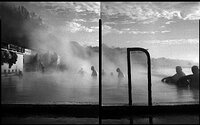
Recently came across a photographer I didn't knew about: Trente Parke.

His black and white pictures are literally just that: black and white. Extreme contrast.

This extreme case made me releaze that when I look around for pictures and information, most people today prefer a high contrast look with very dark blacks and high highlights.

They seem to seek film that deliver high, almost harsh contrast like Tri-X, modern lenses and developing methods to push the contrast.

My question is why?

Personally, I think, the real beauty are in the midtones, 50 shades of gray, so to speak.

High contrast pictures may be striking at first, but most look superficial, almost boring to me. Not a lot of depth and details to look at.

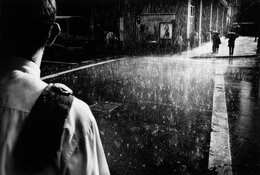
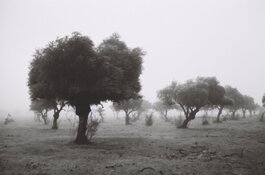
The 2 pictures attached are a totally different theme, but give an idea what I mean.

Not my work, btw
 

Attachments

  • lon38311-594x400.jpg
    lon38311-594x400.jpg
    73.5 KB · Views: 70
  • Screenshot_20260522_121223_com.flickr.android.jpg
    Screenshot_20260522_121223_com.flickr.android.jpg
    168.8 KB · Views: 72
I would not label these two photos as just black & white -- or extreme contrast.

High contrast does help some subjects/compositions, and some times it is not "made up". A night scene, like the one about, is high contrast "naturally" because it is at night. There's no need to increase the contrast any more than it is -- and decreasing it would not help at all.

The second shot, I would not label as high contrast. The whites are not white, and the blacks are not black, but I don't know how I could improve on it.

Sure some photographers like higher contrast shots, some don't. To each his own, but it's a personal choice -- just as some photographers add intense color saturation to their pictures -- and other don't.
 
Last edited:
Interesting subject for a discussion.
I've tweaked the thread title to differentiate it from run of the mill black and white imaging discussions, and moved it into the photographic aesthetics sub-forum.
By the way, there is a deep and varied history of photographers who've adopted this aesthetic.
 
I would not label these two photos as just black & white -- or extreme contrast.

High contrast does help some subjects/compositions, and some times it not "made up". A night scene, like the one about, is high contrast "naturally" because it is at night. There's no need to increase the contrast any more than it is -- and decreasing it would not help at all.

The second shot, I would not label as high contrast. The whites are not white, and the blacks are not black, but I don't know how I could improve on it.

Sure some photographers like higher contrast shots, some don't. To each his own, but it's a personal choice -- just as some photographers add intense color saturation to their pictures -- and other don't.

I Should have explained it more clearly. The 2 pictures are examples of the high contrast vs rich midtones (the tree picture)
 
Interesting subject for a discussion.
I've tweaked the thread title to differentiate it from run of the mill black and white imaging discussions, and moved it into the photographic aesthetics sub-forum.
By the way, there is a deep and varied history of photographers who've adopted this aesthetic.

Thank you for moving the thread to a more appropiate forum.

The rich midtones and variation is what I look for and strive to achieve in my (analoge) pictures. T max developed in XTOL gave me promising results, but think of switching to HC110 and explore more film with this developer.
 
The high contrast allows the composition to be more graphical, or insert your own artistic descriptor. Impressionist, whatever.

I appreciate the style when done well, but I can't do it well myself.
 
Bill Brandt.
Ralph Gibson.

(drops microphone, walks away)
😆

Pick up the microphone!
Daido Moriyama, as well as a whole bunch more.
I'm normally in the camp that prefers those midtones, but sometimes the subject, technique or equipment lead elsewhere:

44f-res 1400.jpg


Excuse the warm tones....
 
Add Moriyama Daido to AnselMortensen's list. [edit, Matt beat me to it!]

My opinions on high contrast printing? It's a tool that a photographer can use to manipulate the feeling of the print. The greats use it to great effect, the rest of us screw it up. :smile:

I have experimented lately with low contrast printing -- think grade 0 or lower on Ilford MG paper -- with the idea that the midtones are where the action is. As you might expect, results have been mixed, but there are instances where it has worked well for me. For years I have avoided going low, but am now more willing to print with lower contrast.
 
Maybe it was AA or one of my professors, but the idea was that a good photo usually should have at least a spot of true white or a spot of true black -- or both -- somewhere. That doesn't mean high contrast, however. It just means to use the full range of the paper -- but that doesn't work on all subjects -- like the above shot of the trees, for example. I just keep it in mind while printing.
 
As I sift through boxes of prints, I am more pleased with times when I made prints of slightly higher contrast and lighter overall tone. (We all go through phases, right?)
 
I lean toward higher contrast in almost all of my B&W work. I visually dislike mud. No true whites, no true blacks, it's just mud to my eye. This applies only to B&W, surprisingly, or maybe not, the opposite is true for me in color. I like muted colors, garish does not strike me the same. Give me Velvia 50 shot on a dismal day.
 
To actually achieve an inspiring level of nuance between extremes as depicted in the first post requires quite a mastery of film and printing. Brett Weston was just such a person. His prints are unforgettable. But what most people arrive at, attempting to do so, is apt to be that empty "soot and chalk" look characteristic of underexposure combined with overdevelopment, or simply due to the wrong kind of film to begin with.
 
To me, there's quite a bit of difference between using black as a graphic statement in hybrid or composite printmaking, versus using it graphically within "found" photography per se. Brett Weston and a couple of his younger disciples were expert at the latter. I've done a few examples in homage to BW, but prefer to leave that style unrepeated in honor of its heyday. My dealer once put one of my Cibachrome color equivalents in the gallery window, which I had also been meant as a BW tribute, even though he didn't work in color himself - and I'll be danged - he spotted it, walked in there, and bought a couple of prints and left me a kind note. I appreciated the cash, but it would have really been nice if I could have traded him for a couple of prints, which would be worth a lot today; but gallery policy wouldn't allow that. I could enter other galleries in town and instantly spot even a small print of his from clear across the room. They had a certain "glow" to them. As one of his biographers stated it, there was such a carefully balanced tension between dark and light in his prints, it almost makes you blink.

Atget had a quite different style and strategy, and didn't even have access to emphatically bold papers. But I endlessly admire his work too.
 
Last edited:
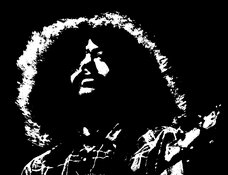
This is high contrast. 35mmm negative printed on 4x5 Kodalith and then contact printed to get 4x5 Kodalith negative.
 

Attachments

  • Santana.jpg
    Santana.jpg
    90 KB · Views: 5
The 2 pictures are examples of the high contrast vs rich midtones (the tree picture)
What you point out is more of a high-key vs. low-key difference.

There's a couple of things at work here and I think it's worthwhile separating them out as they easily get mingled and mixed up when they're hiding under somewhat problematic shortcuts like "high/low contrast."

The first is the continuous tone nature of an image. An image can have a continuous range of tones, hitting every value between pure black and pure white. The low-key image you posted answers to this. The high-key image probably also does this. I'll get back to this later. @Bob Merlin's example above is a nice one that shows the other extreme, with only two values - black and white.

The 'probably' in relation to the continuous-tone nature of the tree image relates to the black point, which is the only thing that keeps this image from covering the entire spread of possible values. It's a continuous tone image for sure, but the black point in the version we're seeing here is at a dark grey value. The reason I have some doubts about this is whether we don't know for sure whether this is the original image as intended by the maker. The shifted black point could be an artifact (accident) of a digital process. However, it may also very well be intentional. The same principle also applies to the white point, but on the tree images this isn't shifted down quite as far as the black point is shifted up.

Another characteristic is the distribution of value across the histogram. This is where the low/high-key difference really lies. If you compare the tree pic to the one of the rainy street, then what stands out is the large sections of (nearly) pure black in the latter, and the dominant (nearly) pure white sky in the latter.

Then the issue with contrast is I think a slightly tricky one, as it depends a bit on how you define it. We could define contrast as the difference in values in close proximity. A large difference = high contrast. The fuzzy bit here is what constitutes 'proximity'. If you speak of the image in its entirety, then it can still be 'high contrast' without necessarily involving abrupt or hard edges, whereas it's also possible someone calls an image 'high contrast' only if such harsh transitions are present. The rainy street image answers to both conceptions of 'high contrast'. For the tree-in-mist image it's a little more diffuse, as it depends also on the presentation and the extent to which the shifted black point (see above) is intentional.

I really don't know whether preferences today are so different from what they were in e.g. the 1950s or 1960s in this sense. There's such a lot of gritty work from the 'film noir' era (hence the name!) that the rainy street image visually refers to, and that's rather 'vintage' for sure. At a technical level, I think we all have to agree that images like the tree image could perfectly well be produced with TriX and a modern lens - and indeed, this exact type of image (there's plenty of them around) is routinely made with modern equipment that's optimized for producing high contrast in an objective sense (i.e. minimize 'bleeding' of light into adjacent dark areas). Evidently, people can and will choose in printing or post processing how they want to present the final image (or achieve the same through selection of in-camera profiles). Also here, whether there's a tendency towards image #1 and away from #2 - I don't know. Image #2 does seem to fit nicely in the pictorialist tradition dating back to the late 19th century. The rise of other styles to contrast with it (heh) happened so long ago that we really can't speak of a modern development.

What is desirable in an images is of course up to you to decide. There's no accounting for taste. Personally, I'd say, why choose across the board between either style? For some compositions, a graphic approach (with high contrast and harsh transitions) works well. For others, it's contradictory to the visual core of the image. Ultimately, I personally don't think the image is ultimately made by the presence of the tonal range - it's primarily made by things like composition, light, subject matter. Control of the tonal range can help or hinder the extent to which that essence is brought out. As a result, in my mind, it doesn't make a lot of sense to judge an image purely on the tonal distributions it exhibits. It's an important factor, but not the primary criterion, and it follows other, more fundamental choices.

 
What you point out is more of a high-key vs. low-key difference.

There's a couple of things at work here and I think it's worthwhile separating them out as they easily get mingled and mixed up when they're hiding under somewhat problematic shortcuts like "high/low contrast."

The first is the continuous tone nature of an image. An image can have a continuous range of tones, hitting every value between pure black and pure white. The low-key image you posted answers to this. The high-key image probably also does this. I'll get back to this later. @Bob Merlin's example above is a nice one that shows the other extreme, with only two values - black and white.

The 'probably' in relation to the continuous-tone nature of the tree image relates to the black point, which is the only thing that keeps this image from covering the entire spread of possible values. It's a continuous tone image for sure, but the black point in the version we're seeing here is at a dark grey value. The reason I have some doubts about this is whether we don't know for sure whether this is the original image as intended by the maker. The shifted black point could be an artifact (accident) of a digital process. However, it may also very well be intentional. The same principle also applies to the white point, but on the tree images this isn't shifted down quite as far as the black point is shifted up.

Another characteristic is the distribution of value across the histogram. This is where the low/high-key difference really lies. If you compare the tree pic to the one of the rainy street, then what stands out is the large sections of (nearly) pure black in the latter, and the dominant (nearly) pure white sky in the latter.

Then the issue with contrast is I think a slightly tricky one, as it depends a bit on how you define it. We could define contrast as the difference in values in close proximity. A large difference = high contrast. The fuzzy bit here is what constitutes 'proximity'. If you speak of the image in its entirety, then it can still be 'high contrast' without necessarily involving abrupt or hard edges, whereas it's also possible someone calls an image 'high contrast' only if such harsh transitions are present. The rainy street image answers to both conceptions of 'high contrast'. For the tree-in-mist image it's a little more diffuse, as it depends also on the presentation and the extent to which the shifted black point (see above) is intentional.

I really don't know whether preferences today are so different from what they were in e.g. the 1950s or 1960s in this sense. There's such a lot of gritty work from the 'film noir' era (hence the name!) that the rainy street image visually refers to, and that's rather 'vintage' for sure. At a technical level, I think we all have to agree that images like the tree image could perfectly well be produced with TriX and a modern lens - and indeed, this exact type of image (there's plenty of them around) is routinely made with modern equipment that's optimized for producing high contrast in an objective sense (i.e. minimize 'bleeding' of light into adjacent dark areas). Evidently, people can and will choose in printing or post processing how they want to present the final image (or achieve the same through selection of in-camera profiles). Also here, whether there's a tendency towards image #1 and away from #2 - I don't know. Image #2 does seem to fit nicely in the pictorialist tradition dating back to the late 19th century. The rise of other styles to contrast with it (heh) happened so long ago that we really can't speak of a modern development.

What is desirable in an images is of course up to you to decide. There's no accounting for taste. Personally, I'd say, why choose across the board between either style? For some compositions, a graphic approach (with high contrast and harsh transitions) works well. For others, it's contradictory to the visual core of the image. Ultimately, I personally don't think the image is ultimately made by the presence of the tonal range - it's primarily made by things like composition, light, subject matter. Control of the tonal range can help or hinder the extent to which that essence is brought out. As a result, in my mind, it doesn't make a lot of sense to judge an image purely on the tonal distributions it exhibits. It's an important factor, but not the primary criterion, and it follows other, more fundamental choices.

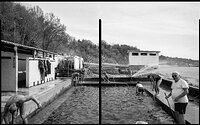
That's a very eye opening explanation. Also the other reactions give a lot of insights, thanks everyone.

I follow you. I named it contrast, not knowing any better word for it, but you've pointed out beautifully what I truely mean: the amount and intensity blacks, greys and whites.

I agree to not chose only 1 style in making pictures. That's what makes photography so interesting, all those different approaches, different visions. Why certain things work or what makes them possible.
 
Photrio.com contains affiliate links to products. We may receive a commission for purchases made through these links.
To read our full affiliate disclosure statement please click Here.

PHOTRIO PARTNERS EQUALLY FUNDING OUR COMMUNITY:


Ilford ADOX Freestyle Photographic Stearman Press Weldon Color Lab Blue Moon Camera & Machine
Top Bottom