


baachitraka
Member
The Minolta X-700 remained in production from 1981 until 1999, an impressive 18-year run in a highly competitive camera market...

The Minolta X-700 remained in production from 1981 until 1999, an impressive 18-year run in a highly competitive camera market...
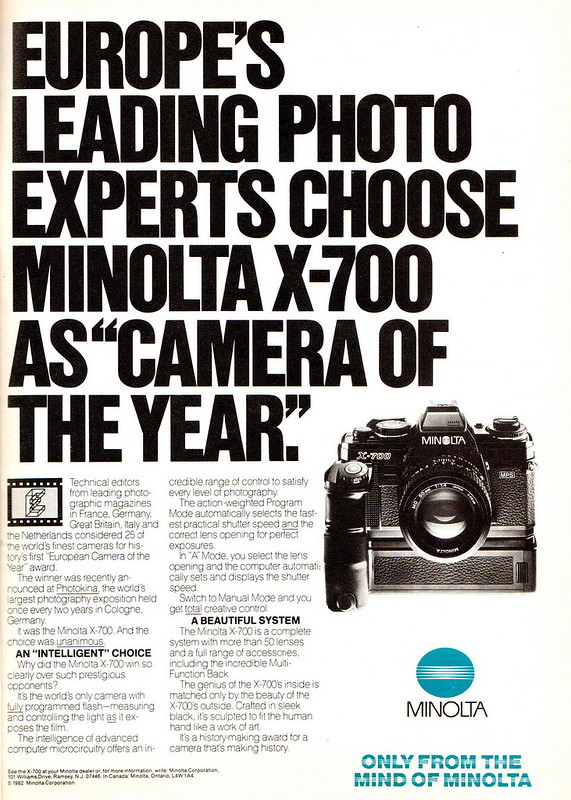 MP198306-006 by Les DMess, on Flickr
 x-700 Motor1 MFBack by Les DMess, on Flickr
I don’t know that there’s a camera I’ve had more times and sold off more times. Always forget that I don’t like it for some reason. Too plasticky maybe.
But IMO, X700 plastics aren't really a weak spot (they're mostly self-lubricating) but capacitors sure are. Plastic gears seem similar to the sorts used in H-P laser printers.

I still use the one I bought back in 1992 and it still works, but compared with the earlier SRT 101, not such a great camera from the photographer perspective. That period of time was a sort of malaise period for 35mm manual focus cameras as they were being phased out by autofocus. When I bought my X700, there was no Ebau, otherwise I would have bought a used SRT-101, the camera I had owned earlier and was very happy with.
The X700 was a sort of niche camera in its time. It was also an economy version of a camera that employed electronics in lieu of mechanical design. It was a good camera from a marketing perspective, not so much from a photographer perspective who owned previous SRT series Minolta's. Let me list its failings compared with the SRT-101. The only advantage was light weight, ushered in by the Olympus OM cameras, and automation level so that people with no knowledge cam use it easier.
1. Reliability was not as good due to electronic failures.
2. Focus screen were plastic rather than glass and much more difficult to use therefore.
3. Much harder to use for people with poor eye site.
4. Nearly useless in metered manual mode, the favored mode of many experienced photographers.
5. Viewfinder shows a smaller percentage of the image, and the image is smaller than previous models.
6. Cable release socket is way too close to body, making it nearly impossible to use.
7. Lack of mirror lockup yields fuzzy photos when camera is on tripod. This camera was designed for hand held use, and not for use on tripods.
Mine still works, but I use my more recently aquired SRT-101 cameras for important work, and the X700 is used for non critical things, like film testing where it's aperture priority mode is more useful. It made sense commercially for Minolta at that time, but like many other models, was not as good to use for those more experienced photographers who know what they want.
The X700 was a sort of niche camera in its time. It was also an economy version of a camera that employed electronics in lieu of mechanical design.
that said, if I start again I will start with SRT 101/303...
Show me a view camera that has automation at all, and I will eat my words. Today, I use my SRT101's like view cameras. Always on tripods, almost always hand held manual metering with frequent ttl meter checking for comparison. The x700 was clearly designed for hand held use and is no good on the tripod. Particularly the user interface for all the Xseries cameras is cheap and poor. The cutouts for the numbers with adjacent red led's is really poor. Need to point camera at sky to read numbers, which is useless on tripod. Need to point camera and hold meter reading is no good on tripod.It has always struck me as rather odd, and maybe just fashionable, to criticise a camera for including features that make photography easier, in spite of the fact that metered automation is included in just about every photographic tool since the 70s.

In many ways the Olympus OM cameras ruined 35mm photography, since all the manufacturers rush to miniaturize their models to copy them, which resulted in compromised performance and reliability.
Show me a view camera that has automation at all, and I will eat my words. Today, I use my SRT101's like view cameras. Always on tripods, almost always hand held manual metering with frequent ttl meter checking for comparison. The x700 was clearly designed for hand held use and is no good on the tripod. Particularly the user interface for all the Xseries cameras is cheap and poor. The cutouts for the numbers with adjacent red led's is really poor. Need to point camera at sky to read numbers, which is useless on tripod. Need to point camera and hold meter reading is no good on tripod.
Show me a view camera that has automation at all, and I will eat my words.
I agree that for landscapes and still lives a 101 work much better than a X700. Then again so does most all mechanical bodies with mirror lock work. The Nikon F is very good as you can use the waist level finder, one of the few uses that a WL finder on a 35mm is useful. I use my X700 for street and the occasional wild life day. On the other hand the Minolta 5 with a 50mm or short zoom is becoming my fav for street. Has both spot and matrix metering, the only thing is lacks is mirror lock up, but even at slow shutter speeds no excessive vibration.
18 years; likewise also the Mercedes R107 body style. 1971 to 1989. This is the 1989 model.
View attachment 427144
Show me a view camera that has automation at all, and I will eat my words. Today, I use my SRT101's like view cameras. Always on tripods, almost always hand held manual metering with frequent ttl meter checking for comparison. The x700 was clearly designed for hand held use and is no good on the tripod. Particularly the user interface for all the Xseries cameras is cheap and poor. The cutouts for the numbers with adjacent red led's is really poor. Need to point camera at sky to read numbers, which is useless on tripod. Need to point camera and hold meter reading is no good on tripod.
In the early 90's when I bought my x700, I already had owned two x370's, one of which had failed within only a few years time. At that time, I was doing color photography using 800 speed Fuji film and almost always hand held, so these cameras are fairly good for that. I always hated the cheap UI with those cameras. Today, I shoot like a view camera, like I did prior to the 90's on b/w film so strongly prefer my earlier cameras.
In many ways the Olympus OM cameras ruined 35mm photography, since all the manufacturers rush to miniaturize their models to copy them, which resulted in compromised performance and reliability. Bigger and heavier cameras have advantages on the tripod and are much easier to work on due to the extra space inside. Smaller and lighter is not always the best. It depends on the type of photography you do.
This has nothing to do with ego, it's all about personal experience and opinions. I really do not like the X-series cameras at all, mostly the cheap UI and plasticy feel others allude to. I had three of these, two of which failed after a few years use. The X700 still works. I believe those cheap capacitors were tantalums rather than electrolytic, but I could be wrong.
Another thing I hate about my x700 is that every time I replace the batteries the camera does not work until I clean the contacts again with an eraser. SRT does not do that.
| Photrio.com contains affiliate links to products. We may receive a commission for purchases made through these links. To read our full affiliate disclosure statement please click Here. |
PHOTRIO PARTNERS EQUALLY FUNDING OUR COMMUNITY:  |

