• Welcome to Photrio!
    Registration is fast and free. Join today to unlock search, see fewer ads, and access all forum features.
    Click here to sign up

Minolta X-700: 18 Years of Continuous Production One of the Greatest Cameras Ever Made?

Forum statistics

Threads
204,406
Messages
2,868,087
Members
102,254
Latest member
SaadSUN
Recent bookmarks
0

baachitraka

Member
Joined
Apr 6, 2011
Messages
3,654
Location
Bremen, Germany.
Format
Multi Format
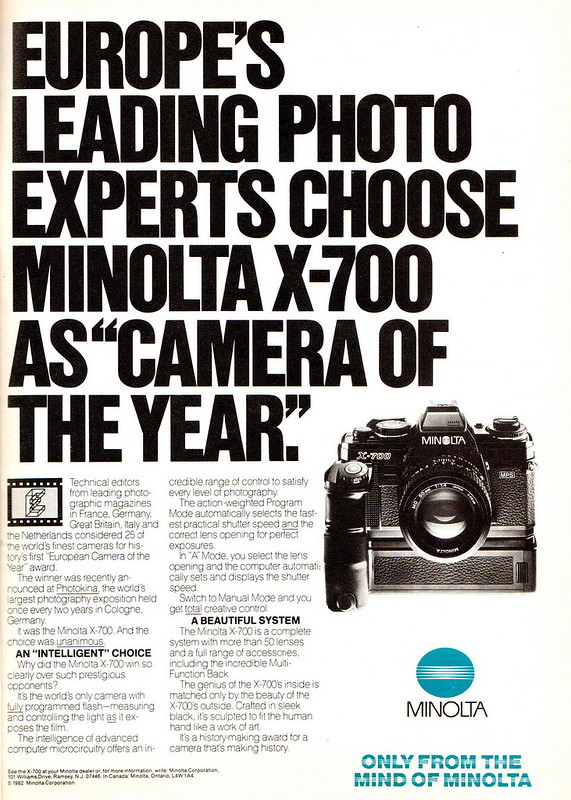
The Minolta X-700 remained in production from 1981 until 1999, an impressive 18-year run in a highly competitive camera market...
 
18 years; likewise also the Mercedes R107 body style. 1971 to 1989. This is the 1989 model.

560sl small.JPG
 
Some more approximate durations:

Nikon F: 13 years
Nikon F3: 20 years
Rolleiflex 2.8F: 21 years
Nikon FM 10: 23 years
 
The Minolta X-370 wasn't far behind with 16 years (1984-1999) -- and if you include the numerous Chinese clones (made on the same Minolta manufacturing lines after 1999), such as the Seagull DF-300, Phoexix DF-3000, Safari DF-300, Revue DF-300, Argus DF-300, Carena DF-300, Centon DF-300, Zenit DF-300, etc. it's probably more than 20 years.

Then there is the Minolta SR-1 with 13 years -- not far behind -- 1959-1971.
 
The Minolta X-700 remained in production from 1981 until 1999, an impressive 18-year run in a highly competitive camera market...

I still use the one I bought back in 1992 and it still works, but compared with the earlier SRT 101, not such a great camera from the photographer perspective. That period of time was a sort of malaise period for 35mm manual focus cameras as they were being phased out by autofocus. When I bought my X700, there was no Ebau, otherwise I would have bought a used SRT-101, the camera I had owned earlier and was very happy with.

The X700 was a sort of niche camera in its time. It was also an economy version of a camera that employed electronics in lieu of mechanical design. It was a good camera from a marketing perspective, not so much from a photographer perspective who owned previous SRT series Minolta's. Let me list its failings compared with the SRT-101. The only advantage was light weight, ushered in by the Olympus OM cameras, and automation level so that people with no knowledge cam use it easier.

1. Reliability was not as good due to electronic failures.

2. Focus screen were plastic rather than glass and much more difficult to use therefore.

3. Much harder to use for people with poor eye site.

4. Nearly useless in metered manual mode, the favored mode of many experienced photographers.

5. Viewfinder shows a smaller percentage of the image, and the image is smaller than previous models.

6. Cable release socket is way too close to body, making it nearly impossible to use.

7. Lack of mirror lockup yields fuzzy photos when camera is on tripod. This camera was designed for hand held use, and not for use on tripods.

Mine still works, but I use my more recently aquired SRT-101 cameras for important work, and the X700 is used for non critical things, like film testing where it's aperture priority mode is more useful. It made sense commercially for Minolta at that time, but like many other models, was not as good to use for those more experienced photographers who know what they want.

 
Sony A6000: ~13 years IIRC. They even introduced white and charcoal variants late in the product cycle. Sony can be very thrifty when it comes to engineering resources.
 
me personally is OM-1/2n fan but this X700 looks not so bad for point and shoot.

that said, if I start again I will start with SRT 101/303...
 
I have both X700 and SRTs, a 101 and 201, the X 700 is ok, good set of features, the motor drive is reliable, for street photography works well. On the other hand the simplicity of the 101 with mirror lock up is great for landscapes. The meters on my 101 and 201 are still accurate to a 1/2 stop. The X700 is still sought as it has A and P with later lens.
 
Last edited:
This is one of my favorite camera subjects. I have a fleet of X700 cameras and have used them for many years. I will differ from Alan's comments and explain why. It is known that X700 and other Minolta X series cameras have problems with capacitors. These are easily replaced by any competent repair person. No X700 which I have with replaced capacitors has acted up in this area again. It is true that the focusing screens are plastic rather than glass. They are more fiddly to change than screens in a Nikon F or Canon F-1 because they have no metal frames. Some X700s (I think the later ones) have a bracket which pulls down for changing screens. This is a little easier than in the X700s without the bracket. The screens themselves are excellent. They are bright and contrasty. They are also somewhat rare, except for the standard screen. I decided a long time ago that it was not worth fooling around with changing them with any frequency. I have a number of the rare screens (not the standard ones). One of my X700s has a grid screen and one has a plain matte screen. The rest all have the standard screen. I did a lot of macro photography with the body with the grid screen. I used the body with the plain matte screen for very close work. I have the whole Auto Bellows III system with all four lenses (and even the gel filter holder) and the plain matte screen was very useful with the 12.5 and 25 micro lenses.

I am very lucky at my age to have 20/20 vision in my right eye, the one I use for focusing. Do I consider the X700 difficult to focus through? I do not. The Minolta X series model made for manual metering is the X570. I find that between the exposure compensation dial on the X700 and tilting the camera up or down and using the exposure lock button, I do not miss regular manual metering. The meter itself is accurate but like any other in-camera metering system, you have to know what you are pointing the camera at and that meters of that time were all calibrated for 18% gray. Whether the finder shows 100% of the film area is another subject. For most uses this is not terribly important. Things like flat copy work are done today mostly by scanning. If it is really an issue I can use a Nikon F, F2 or F3. For most purposes, my Canon F-1 cameras are close enough. When I started taking pictures, color print film was not very good. My first color films were Kodachrome II and Agfachrome CT18. The slide mounts covered a small part of the picture area so a less than 100% finder was adequate for most users. If you don't like using the standard cable release socket you can use the Cord S or Cord L or the Multi-Function Back instead.

The lack of the mirror lock-up function is something you face with all of the X series Minoltas. For the shutter speeds I might typically use with the camera on a tripod, I have not experienced fuzzy photos. Some speeds are more of a problem than others. I also have a fleet of SRT cameras so if I need one with mirror lock-up, I can use one of them. The differences between the X700 and the SRT models stopped being an either/or proposition for me a long time ago. When the X700 came out in 1981 I thought it was a step back for Minolta from the XD-11. The XD had a vertical non-fabric shutter with a higher flash synch speed. It also had multi-mode metering options. Its focusing screens were "factory interchangeable" like those in the Canon A-1 (this is why I prefer the AE-1 Program to the A-1). The X700 had another important difference. It has TTL flash metering. This proved more useful for me in the macro range than mirror lock-up. I have all of the Minolta PX flash units and accessories. The X700 has hybrid construction. It has both metal and plastic parts. It has proven to be long lasting and reliable. For macro work, Aperture Priority is more useful than Shutter Priority. I say this as someone who started with Konica SLRs, which have Shutter Priority automation. By the time the X700 came out, Minolta would already be working on the Maxxum 7000. The Maxxum combined the vertical shutter of the XD-11 with the TTL flash metering and interchangeable focusing screens of the X700 and, of course, AF. For me, the X700 has been a very useful tool within the limits of its design parameters. My latest Minolta? An SRT 202 (2nd version) with a beautiful 50/1.4 MC Rokkor-X. The camera was just expertly serviced by John Titterington and I plan to use it later this week.
 
Photrio.com contains affiliate links to products. We may receive a commission for purchases made through these links.
To read our full affiliate disclosure statement please click Here.

PHOTRIO PARTNERS EQUALLY FUNDING OUR COMMUNITY:


Ilford ADOX Freestyle Photographic Stearman Press Weldon Color Lab Blue Moon Camera & Machine
Top Bottom