• Welcome to Photrio!
    Registration is fast and free. Join today to unlock search, see fewer ads, and access all forum features.
    Click here to sign up

Help planning a darkroom ~35 sq. m/367 sq.ft

Recent Classifieds

Forum statistics

Threads
204,282
Messages
2,866,572
Members
102,207
Latest member
gustavocf
Recent bookmarks
0

ScandiPhoto

Subscriber
Joined
Nov 8, 2025
Messages
68
Location
Sweden
Format
4x5 Format
Hi.
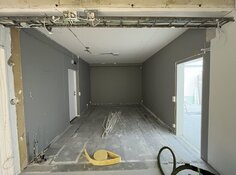
Im going to build a dark room ( 35 m², 367 ft² ish) and thought, that since a lot of people here, knows more then I do, it might be a good idea to ask how to do it. Im mainly thinking of workflow and placements of machines.

Lets assume I got a unlimited budget for this.

So far the idea of the space is to produce large 120 cm ra4 and similar sized Silver gelatin prints. ( I know its a hassel and so on, but I will do it anyway)

Film developing is all done in a separate space, so no need for that here.

Large equipment I got so far:
200x150 cm vacuum wall.
120 cm wide ra4 developer (Through the wall)
30cm ra4 developer
Durst L1840 vertical/horizontal enlarger
Durst 138 vertical mono led enlarger
2x Durst 1200 4x5" Enlargers

For the Black and White I figure a solution with a large tray will work, that I drain between the baths. But maybe a separate sink with tray would be good for smaller works. Each water inlet alos has a drainpipe. Electric power is everywhere.

If anyone would like to make a sketch of how you would do it, that would be very fun to se.
Thanks for reading.
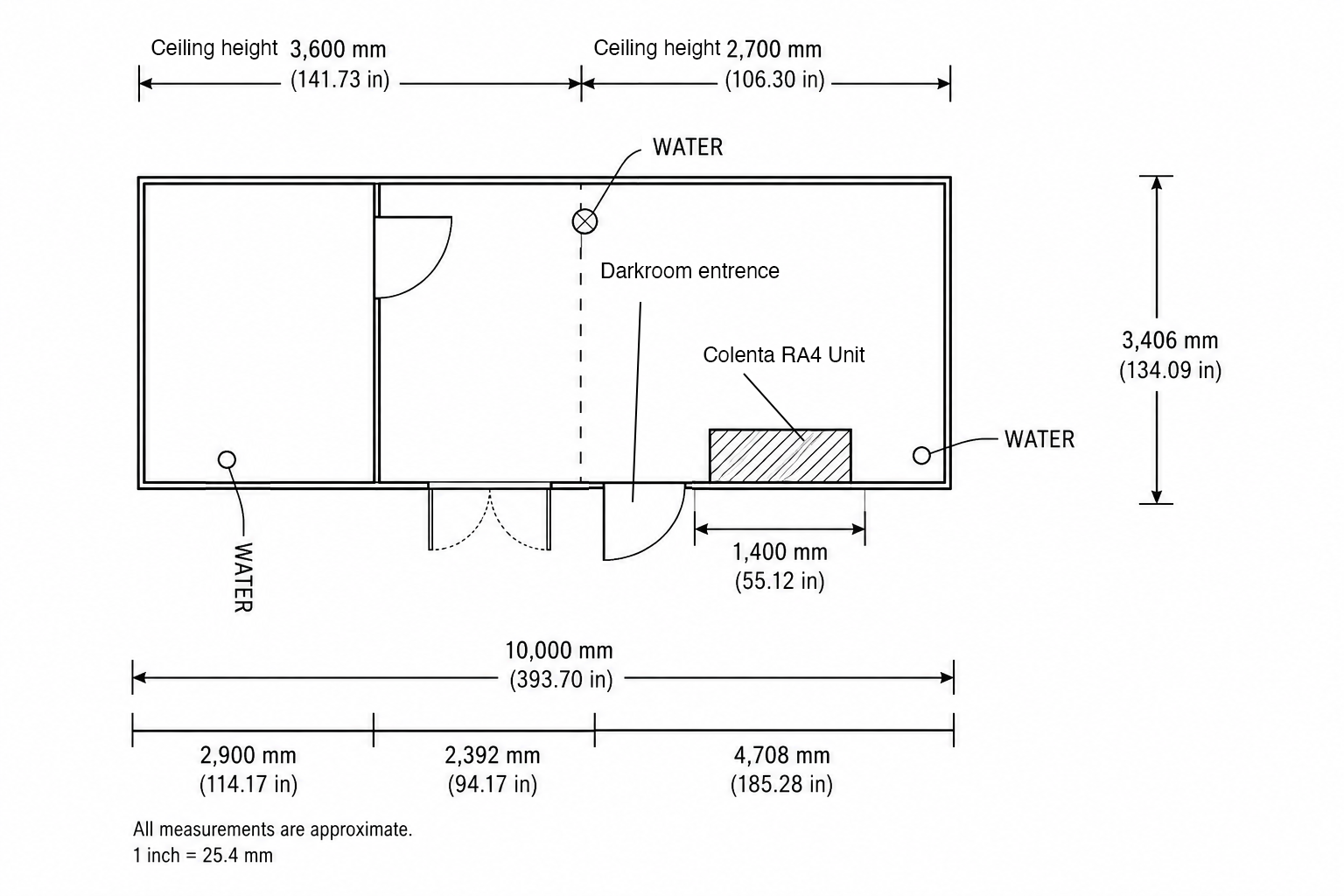
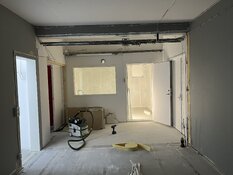
darkroom messuremnets.png
 

Attachments

  • Screenshot 2026-06-02 at 11.14.09.jpg
    Screenshot 2026-06-02 at 11.14.09.jpg
    289.8 KB · Views: 32
  • Screenshot 2026-06-02 at 11.14.02.jpg
    Screenshot 2026-06-02 at 11.14.02.jpg
    324.9 KB · Views: 31
L1840 on rails in the big room. Vac wall at one end, if clearances are ok. From recall, I think the column will go under the lower ceiling height, but you won't be able to raise the head to the top in vertical operation at that end. At the other end it should be ok, and you'd be using it in horizontal mode if you are down towards the vac wall end anyway. Remote/ CCTV type focusing devices will make the whole operation more pleasant if single operating.

The other enlargers could go into the smaller room with a sink.

Don't dismiss troughs for mural BW processing, and consider whether a narrower but longer sink in the big room might give you that - or with permanent subdivisions instead of troughs. Do also consider how far you may need to take your dripping wet mural print to view/ wash/ dry.

Lab flooring with an easy to clean surface etc will also make your life easier. None of this needs to be complicated, but it needs to work well, and you don't want to be walking kilometres when doing smaller prints.
 
This looks like it's going to be a great darkroom! I envy you for planning to run a wide Colenta....

I'd think about an entrance with a light-trap.
 
I would start with basics, Humidity, Heat/Cooling/ water/ floor drains/Ventilation
A good floor with rubber matts is helpful. and a super music system and a silver recovery system (you can rent)

In all my past and current darkrooms I do not hid any of the utilities , I want to see it all.

I like a dry side, and a wet side, unfortunately I have a long narrow space 980 sqft which has its issues.
I center on the sink- in my case I purchase racking which holds hand made sinks and levels for storing trays below , and screens for drying above. My sinks are 12 ft long by 44 inches wide, I would recommend a 6-inch front and 3ft back splash gaurd.
I do not use any copper or plumbing other than hot cold output where I regulate by hand the temp I want, I have a 40 ft red hose that is very durable that goes the length of the two sinks. I can do two complete different processes at the same time if I wish.
We do 30 x 40 inch silver gelatin and 30 x40 gum bichromates over palladium, I am not interested in larger prints .


I have racking (storage) on wheels to move around to suit my current needs. We change week by week
 
I tweaked your thread title, because initially I thought it was referring to the world's longest darkroom!
A fun and challenging project!
A couple of thoughts:
1) If I interpret things correctly, I think you will end up having to transport exposed prints quite a long way past the darkroom entrance to get to the Colenta processor. That would be concerning to me;
2) If I had to carry prints a long way, I would prefer to be able to do that with the aid of safelights - i.e. black and white;
3) is it possible to configure the Colenta to have its print output go through the wall into the adjacent, lighted room? The very most convenient commercial setups I worked in were configured that way.
 
I tweaked your thread title, because initially I thought it was referring to the world's longest darkroom!
A fun and challenging project!
A couple of thoughts:
1) If I interpret things correctly, I think you will end up having to transport exposed prints quite a long way past the darkroom entrance to get to the Colenta processor. That would be concerning to me;
2) If I had to carry prints a long way, I would prefer to be able to do that with the aid of safelights - i.e. black and white;
3) is it possible to configure the Colenta to have its print output go through the wall into the adjacent, lighted room? The very most convenient commercial setups I worked in were configured that way.

Thanks.

Im not sure how much throwing distance I need for a 120x150 exposure when doing horizontal exposures. Im calculation max 3 m for a 4x5" or bigger original. That would make it possible to use the small room for the 1840, and the vacuum wall. Then the large low space for a long wet bench, and a removable tray table. and the smaller 1200 enlargers.

To transport larger prints from the small room, might be ok, since they will be rolled?

I also have a Glunz & Jensen MultiLine Classic 550 developer with dryer standing around (for imagesetters and such). This could be maybe be used for rinsing and drying RC papers? Never seen anyone do that, and perhaps it will damage the paper. But it's a thought.

The plan is for the feeding side of the coloenta to be in the dark room. Then the baths/rolls will be in the adjourning studio space. The small one, will be in the dark..
I'd think about an entrance with a light-trap.
Yes, and if I cant find a revolving one I will build a maze. The large dual door is just to get machines in and out.
 
Last edited:
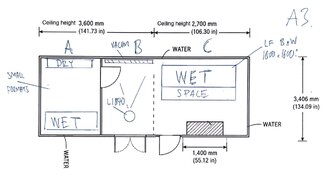
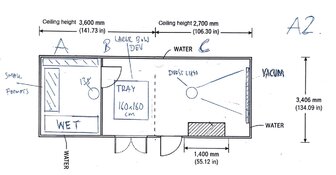
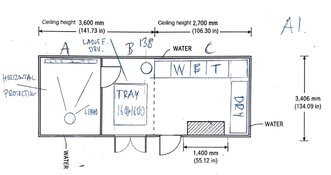
Maybe one of these.. I prefer the A1, since the L1840 can also do vertical, maybe it would be a bit of a waste to use in part C of the space. And for tray developing ofBlack and white it would make sense as well.
 

Attachments

  • Screenshot 2026-06-02 at 21.18.00.jpg
    Screenshot 2026-06-02 at 21.18.00.jpg
    127.1 KB · Views: 15
  • Screenshot 2026-06-02 at 21.17.52.jpg
    Screenshot 2026-06-02 at 21.17.52.jpg
    137.6 KB · Views: 15
  • Screenshot 2026-06-02 at 21.17.45.jpg
    Screenshot 2026-06-02 at 21.17.45.jpg
    135.6 KB · Views: 13
I would find a competent HVAC engineer. No different than a well designed laboratory, restaurant etc. If you are going to be running big processors, dryers, fume exhaust systems you'll need makeup air that is conditioned. Air out requires air in. Here in Iowa we have dewpoints -30 to +30°C, we run heat or AC 9 months out of the year.

A good engineer will be able to provide information on heat exchangers, humidity control etc.

I've got a large darkroom, it's OK to have multiple workstations for different tasks. Ideally the enlarger you'll use the most is directly across from the sink/trays or print processing machine you'll use.

Do spaghetti diagrams to understand most efficient, least steps for layout.

No permanent structure, as Bob said don't bury electrical, utilities etc.
 
Just a couple of suggestions. I would make the sink 10 inches deep which would be better to prevent an accidental splash. On the back splash guard have a ledge at the same height as the top of the front of the sink. Then you can have some removable tops that will give you that much more dry work surface when not using it as a sink. I painted mine with marine polyester. It has served me well with no leaks for fifty years. My faucets are on the opposite end of the drain with the bottom of the sink slightly sloped toward the drain end. The top edges are horizontal not sloped. The faucets are bar style so there’s ample clearance when the tops are in place. Rollout storage under the sink which also supports a dry mounting press.
 
I would make the little room totally wet for developing film and prints to 16x20 black and white in trays. Put the RA4 processor in there too.

I would make the big area for the enlarger and handling paper. Totally dry. Also to load film developer tanks.
 
Lot of good idas and inputs. Thank you all. I will continue thinking. Maybe its clever to do the small room as a wet room for the smaller prints. And keep the large prints to the bigger space, closer to the larger ra-4 developer.
 
I would find a competent HVAC engineer. No different than a well designed laboratory, restaurant etc. If you are going to be running big processors, dryers, fume exhaust systems you'll need makeup air that is conditioned. Air out requires air in. Here in Iowa we have dewpoints -30 to +30°C, we run heat or AC 9 months out of the year.

A good engineer will be able to provide information on heat exchangers, humidity control etc.

I've got a large darkroom, it's OK to have multiple workstations for different tasks. Ideally the enlarger you'll use the most is directly across from the sink/trays or print processing machine you'll use.

Do spaghetti diagrams to understand most efficient, least steps for layout.

No permanent structure, as Bob said don't bury electrical, utilities etc.

Thanks for the tip. We have quite good industrial ventilation in all spaces, and help from a ventilation expert. So it should be ok.
 
Thanks for the tip. We have quite good industrial ventilation in all spaces, and help from a ventilation expert. So it should be ok.

I have a residencial dehumidifier plugged in all year round, it only comes on when needed. Helps dry everything out after a large printing session. Inexpensive, plumbed to a floor drain.
 
Photrio.com contains affiliate links to products. We may receive a commission for purchases made through these links.
To read our full affiliate disclosure statement please click Here.

PHOTRIO PARTNERS EQUALLY FUNDING OUR COMMUNITY:


Ilford ADOX Freestyle Photographic Stearman Press Weldon Color Lab Blue Moon Camera & Machine
Top Bottom