
• Welcome to Photrio!
    Registration is fast and free. Join today to unlock search, see fewer ads, and access all forum features.
    Click here to sign up

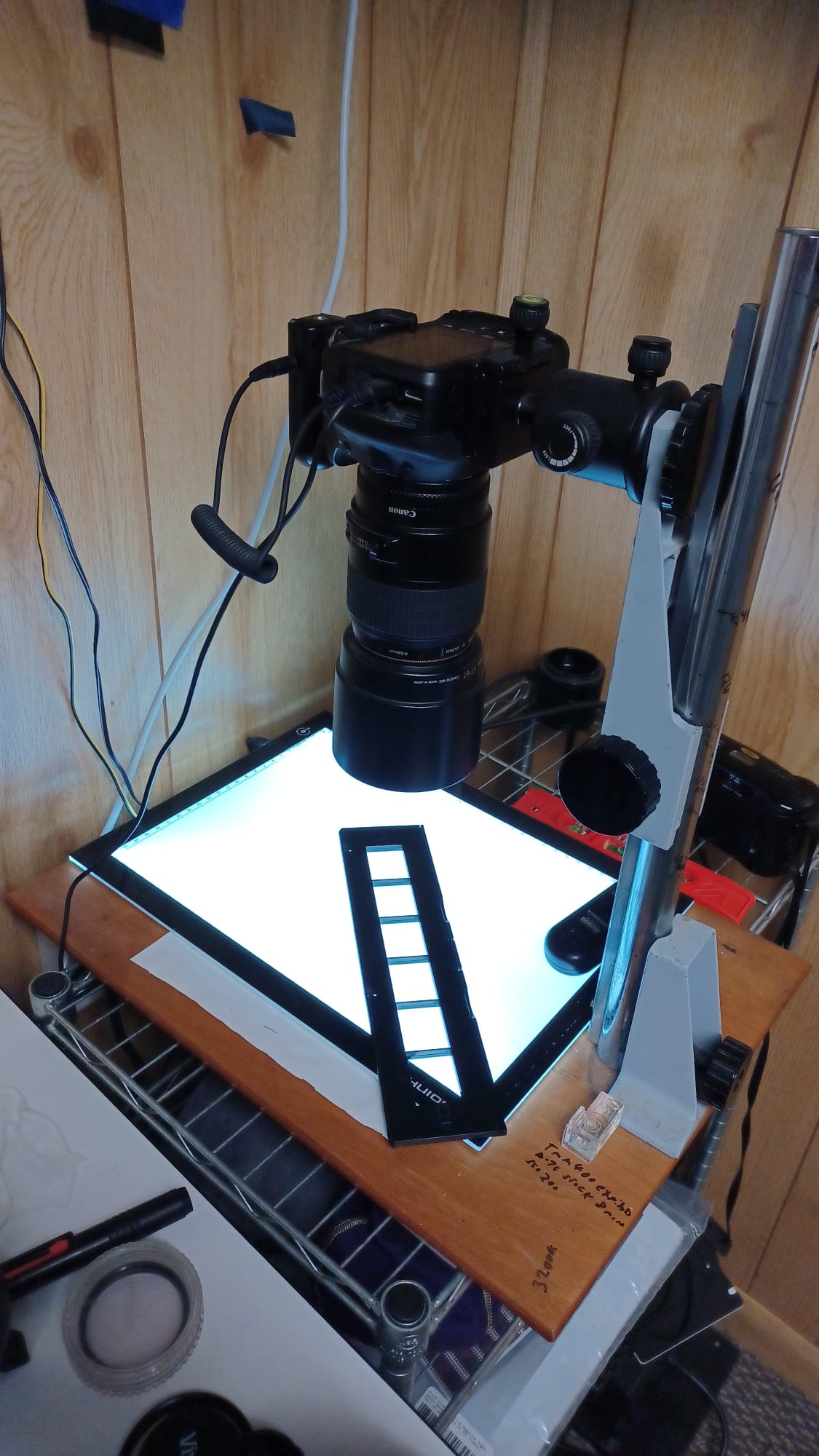
Where is everyone with your camera scanning setup for film?

Dump Truck Hat Trick

D
Dump Truck Hat Trick

  • 1
  • 0
  • 63
Street-Lamp

A
Street-Lamp

  • 3
  • 3
  • 102

Recent Classifieds

Forum statistics

Threads
204,309
Messages
2,866,975
Members
102,220
Latest member
iDavidoff
Recent bookmarks
0
the knob on my F60 turns "to infinity"

Witch knob? The Highness knob or the focus knob on the head? When you "infinity" are you meaning that it slips while adjusting? If that's what is happening you need to add a little oil to the friction wheel and adjust the respective pressure screws so it spins without much resistance but the friction wheel catches without slippage.
If you want, you can PM me some photos, or create a dedicated thread so I/we can help you out.
 
Witch knob? The Highness knob or the focus knob on the head?

The focus knob.

When you "infinity" are you meaning that it slips while adjusting? If that's what is happening you need to add a little oil to the friction wheel and adjust the respective pressure screws so it spins without much resistance but the friction wheel catches without slippage.
If you want, you can PM me some photos, or create a dedicated thread so I/we can help you out.

I can do that. Let me try to explain first. I've got a 1/4" <-> 3/8" converter, and the camera is then connected to that via the tripod screw. All good. The camera gets nice and tight, and will not twist anymore in regardss to the screw.

However, the focus knob can spin to the right ad infinitum. Looking this up, it's called a shoulder screw. So I can turn the focus knob to the right without ever getting tight enough to truly hold the camera in place. It takes quite a bit of finesse to get it just right (which is why I'm looking into ways to minimize this).

Does that make sense?

Here's a video: https://photos.app.goo.gl/UXnh3r14acgNaBi98
 
I lost my darkroom when I moved house in 2022, and it has taken me until now to start exposing film again. By using my motorized Rondinax tanks (35u and 60) I can go without actual darkness, but what to do about scanning? I sold my Hasselblad X1 just before I moved, and have resurrected my Nikon 9000 which is connected to a very old iMac (which has a FW port). I had forgotten how slow the process is! Also it took me a long while to remember how to use VueScan the first time I started it up.
I do have a Nikon ES=2 scanning adapter for the D850, and seeing how quickly I could scan 35mm with it I invested in a Valoi Easy 120. I have compared a scan done with it with one done on the X1, and I'm surprised at how close it comes. Definitely worth it for the time saved. If it stands up to repeated usage I may sell the 9000.
 
I have the following:

- PlusTek 8200i
- Nikon Coolscan 5000ED with full-roll-modified SA-21 strip feeder and SF-200 automatic slide feeder
- Epson V850
- Camera scanning setup with Fujifilm X-T4 and Negative Supply stand, light source, and holders for 110, 35mm, 120, and 4x5.

I use the camera scanning setup 98% of the time, with the other 2% reserved for batch scanning mounted slides with the Nikon, or scanning 4x5 with the V850.

Camera scanning is just so much faster than any of the other options.

That's interesting. What do you think about the scanning quality of the plustek vs camera setup?

I have the plustek 8100 and it scans really good, but takes a lot of time. 1 roll takes about 1 hour to scan for me.

 
The focus knob.


I can do that. Let me try to explain first. I've got a 1/4" <-> 3/8" converter, and the camera is then connected to that via the tripod screw. All good. The camera gets nice and tight, and will not twist anymore in regardss to the screw.

However, the focus knob can spin to the right ad infinitum. Looking this up, it's called a shoulder screw. So I can turn the focus knob to the right without ever getting tight enough to truly hold the camera in place. It takes quite a bit of finesse to get it just right (which is why I'm looking into ways to minimize this).

Does that make sense?

Here's a video: https://photos.app.goo.gl/UXnh3r14acgNaBi98

Ohhh! I See now! That happens due to the 3/8" to 1/4" adapter, for which the distance prevents any friction between the camera and the head. If you instead of the adapter use a tripod head (like a standart ball head) you will not have this problem. You can also use a small square of woodboard, slightly thicker than the adapeter, you may add robber to the surface to increase adhesion. Then, make an hole the size of the adapter, and use this new gig as a bushing!
 
Ohhh! I See now! That happens due to the 3/8" to 1/4" adapter, for which the distance prevents any friction between the camera and the head. If you instead of the adapter use a tripod head (like a standart ball head) you will not have this problem. You can also use a small square of woodboard, slightly thicker than the adapeter, you may add robber to the surface to increase adhesion. Then, make an hole the size of the adapter, and use this new gig as a bushing!

Doesn't it need to be a pretty sturdy (eg expensive) ball head to hold the camera and lens consistently? Also, doesn't the ball head give you 360 degress of movement, which I guess is good, but when trying to get this 100% flush, corner to corner w/ the negative, I would think you'd want as many axises "locked in".

I saw one setup on redit where someone used a macro slider to get the right distance. Older thread so couldn't reply to get the scoop on that.
 
Doesn't it need to be a pretty sturdy (eg expensive) ball head to hold the camera and lens consistently? Also, doesn't the ball head give you 360 degress of movement, which I guess is good, but when trying to get this 100% flush, corner to corner w/ the negative, I would think you'd want as many axises "locked in".

I saw one setup on redit where someone used a macro slider to get the right distance. Older thread so couldn't reply to get the scoop on that.

I always used my ball head and never had problems with c2c sharpness nor parallelism.
 
I have two old scanners, one for 35mm and one for MF. I'm waiting for one of them to die before deciding on camera scanning but those scanners seem uninterested on quitting!
 
EGmravp.jpeg


Canon 550D (T2i) 100mm Macro. Hooked up to Lightroom and Negative Lab Pro.

Scan everything from 16mm up to 4x5 with this, I had a Nikon Coolscan and sold it. The DSLR is faster, sharper and gets better results at a smaller size. The Nikon was better color correction though.
 
EGmravp.jpeg


Canon 550D (T2i) 100mm Macro. Hooked up to Lightroom and Negative Lab Pro.

Scan everything from 16mm up to 4x5 with this, I had a Nikon Coolscan and sold it. The DSLR is faster, sharper and gets better results at a smaller size. The Nikon was better color correction though.

Well... I see that Durst columns are quite popular!
 
After a lot of tinkering and swapping/upgrading, I finally settled on a nice system:

Sony A7RIV
Rodestock Apo-Rodagon 75mm 1x w/ extension tubes
Nisi Focusing Rail
Lobster Holder v2 (highly recommended)
Jack's Big Scanlight (mounted on top of the Valoi light adapter as leveling base)
LPL A4 copy stand
 
I always used my ball head and never had problems with c2c sharpness nor parallelism.

Okay. Just a couple more questions.
1: Does the ball head generally need to be on the higher end of things? Literally never shopped for one.
2: Do you use the mirror trick to get the edges of the lens in focus?
3: Once you've gotten it in focus, can you generally move it up and down w/o it falling out of focus? That's my main issue now.
 
Okay. Just a couple more questions.
1: Does the ball head generally need to be on the higher end of things? Literally never shopped for one.
2: Do you use the mirror trick to get the edges of the lens in focus?
3: Once you've gotten it in focus, can you generally move it up and down w/o it falling out of focus? That's my main issue now.

A ball head is a really hard way to do it. If you want to use a head at all, it should be geared for fine adjustments. I found that the easier and more stable solution is to do the leveling at the film plane instead. Based on a suggestion from this forum I bought a Valoi light adapter and put it under my light source.
 
Okay. Just a couple more questions.
1: Does the ball head generally need to be on the higher end of things? Literally never shopped for one.
2: Do you use the mirror trick to get the edges of the lens in focus?
3: Once you've gotten it in focus, can you generally move it up and down w/o it falling out of focus? That's my main issue now.

Let me try to answer all your questions:
1: I use the ball head 'cause is the one that came with my tripod, I like it and it works. But if you are going to buy a dedicated head (and have the funds to do soo) the post by @silvergelatin is the way to go (I use a geared head w/ a Sinar 4x5).
2: I have a mirrorless camera soo... but if was using an SLR I would definitely use such function.
3: No. You get used with time...
 
Color quality comes primarily from the light source. Your panel is likely not ideal for color film.

What panel should I upgrade too?

Also the Nikon was better because it was better at automating the color. I can get the same results it just take a bit more time.

Color is just fine once you dial it in. Being that I'm generally shooting outdated questionable film developed at home it's the not the weakest link in my chain.
NKyVhyU.jpeg
 
What panel should I upgrade too?

There has been a lot of discussion about this, but the current gold standard is RGB. Unfortunately, there are very few on the market. Jacks Scanlight and the Cinestill Spectracolor are the most commonly mentioned. I have the former, and haven't used the latter. Color correction became much, much easier for me after going from a popular "high CRI" panel to the RGB. It even beats flash, which I still found to be better than most white LED panels.
 
There has been a lot of discussion about this, but the current gold standard is RGB. Unfortunately, there are very few on the market. Jacks Scanlight and the Cinestill Spectracolor are the most commonly mentioned. I have the former, and haven't used the latter. Color correction became much, much easier for me after going from a popular "high CRI" panel to the RGB. It even beats flash, which I still found to be better than most white LED panels.

I just take a shot of a blank piece of film at the lead in and use it was my white balance point. 60% of the time it works 100% of the time.
 
I just take a shot of a blank piece of film at the lead in and use it was my white balance point. 60% of the time it works 100% of the time.

I do the same, but that is not the reason for the RGB light. It is more about color purity, crosstalk, channel separation, etc. There is a bunch of color science tech I don't fully understand, but the results are clearly better (which is all I care about). Take a look at the explanation on Jacks's Scanlight page, if you are curious.
 
A ball head is a really hard way to do it. If you want to use a head at all, it should be geared for fine adjustments. I found that the easier and more stable solution is to do the leveling at the film plane instead. Based on a suggestion from this forum I bought a Valoi light adapter and put it under my light source.

Okay. I'm kind of MacGuyvering that for Paper, washers, etc. real fun.

Let me try to answer all your questions:
1: I use the ball head 'cause is the one that came with my tripod, I like it and it works. But if you are going to buy a dedicated head (and have the funds to do soo) the post by @silvergelatin is the way to go (I use a geared head w/ a Sinar 4x5).
2: I have a mirrorless camera soo... but if was using an SLR I would definitely use such function.
3: No. You get used with time...

Okay, gotcha. I've got a tripod but it's kinda crap. I will play with this this week at some point to see what I can see, but just looking at it, I still think I will have the same rotational problem... being that touching anything at all (especially lowering or raising the camera) will cause it to move, and I'll lose the angle. Let me try it and take a video. But kind of slammed at work now.

I've gota mirrorless. I meant the trick where you use a mirror to gain focus (making sure the edges of the lens are in focus), then move the camera to the height needed to scan.
 
Photrio.com contains affiliate links to products. We may receive a commission for purchases made through these links.
To read our full affiliate disclosure statement please click Here.

PHOTRIO PARTNERS EQUALLY FUNDING OUR COMMUNITY:


Ilford ADOX Freestyle Photographic Stearman Press Weldon Color Lab Blue Moon Camera & Machine
Top Bottom