• Welcome to Photrio!
    Registration is fast and free. Join today to unlock search, see fewer ads, and access all forum features.
    Click here to sign up

Where is everyone with your camera scanning setup for film?

Depth-of-Field

A
Depth-of-Field

  • 0
  • 0
  • 9
Chilling

A
Chilling

  • 0
  • 0
  • 42

Forum statistics

Threads
202,642
Messages
2,843,476
Members
101,425
Latest member
circle
Recent bookmarks
0

DDTJRAC

Member
Allowing Ads
Joined
Oct 15, 2017
Messages
1,026
Location
L.A. - NYC - Rustbelt
Format
Multi Format
Are you thinking about getting into camera scanning? Have you already got a camera scanning setup perfected enough for you? Or are you still trying to perfect it?

I'm in the camp of working to switch from flatbed scanners to cameras. But only because of Epson's recent discontinuation of their film scanners. Otherwise, I probably would have stayed with Epson.

Where are you with your camera scanning setup for film?
 
I set mine up 2 years ago, it's still evolving. It performs very well for positive film, and high contrast B&W, most of the fine tuning centers around normal contrast negative. Due to space limitations, it all packs up into a box underneath my bed.
 

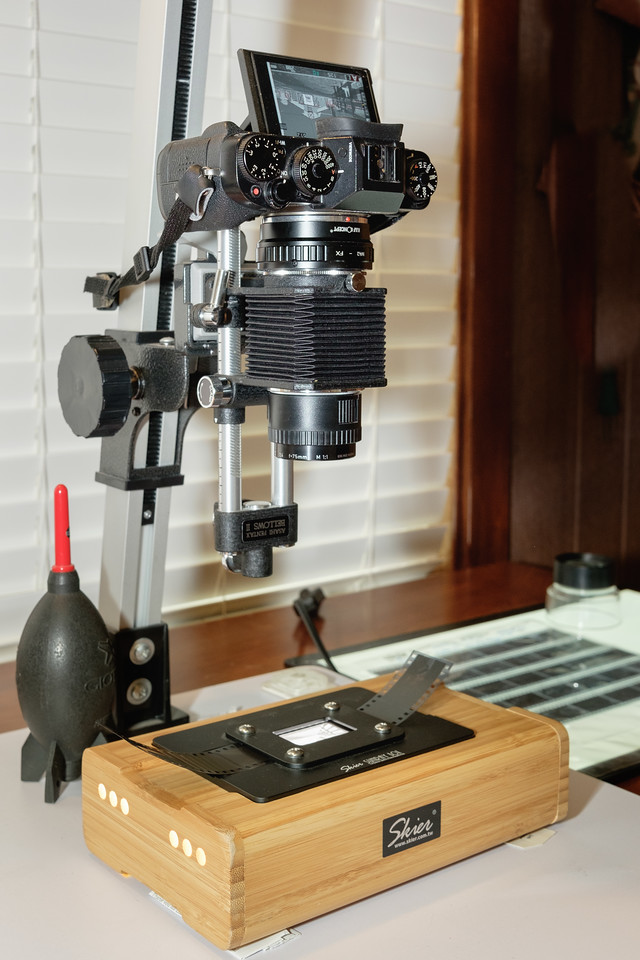
Presently, I am using a Fuji XT-1 camera mounted to Pentax screw mount bellows (K&F Concept M42>FX adapter), My lens is a Rodenstock APO-Rodagon D 75mm f/4.0-22 copy lens (39mm>M42mm adapter). All mounted on an ALZO Copy Stand. The light source is a Skier Sunray Copy Box II, which came with film / slide holders for both 35mm and 6x6-6x9 cm film.

I import the RAW files into Adobe Lightroom Clasic, and I use the Negative Lab Pro plug-in for Lightroom to convert my negatives to positive.

The Skier light and negative holders being sold now is version III, which has several improvements over my version II, BUT... I believe the present Skier 35mm negative holder is now redesigned to show the sprocket holes, which I think is a bad idea.

This is the third or fourth iteration of my setup, and I think it is now good enough for me. Sure, I am intrigued by the possibility of a flash as the light source, or a 3-color RGB LED, and maybe a higher pixel camera, or a more solid and rigid copy stand. But I am satisfied to copy my film with this rig for now. (plenty of my results can be seen here: https://garywright.smugmug.com/Photography)

I have slides from the olden days, and today I mostly shoot b&w. No issues when copying slides and b&w, but when camera-scanning color negatives it is somewhat challenging to get natural looking color on the inverted image. There are many software solutions, but I think it is still accurate to say all of them require a certain amount of time and skill. In other words, we might wish for a one-button presto-chango conversion from color negative to color positive, but as far as I know, we are not there yet.

 
Last edited:
I know everyone's secondhand market is different, but to me the pain in the behind aspect of this is copy stand prices. I would probably grab an old Leitz focomat and pull the head off these days.
 
In Canada the V850 Pro and the 1300XL plus the optional transparency lid are the only two offerings for film on the Epson Canada site.
The Epson USA site is similar.
 
They may decide not sell them in certain markets, however they are still being manufactured and available to professional markets.

Yes, I can see that. Anyway I'm sticking with my old Epson Perfection 3200 for MF, and use the Valoi 35 /Fuji X-T30 for 35mm. But converting the camera scans is a pain, I do not have Photoshop/Lightroom and have ended up using VueScan's neg-pos file conversion SW which is OK as a first pass.
 
  • wiltw
  • wiltw
  • Deleted
  • Reason: FS
I switched to camera scanning a few years back and picked up a used Sony A7Rii, Sigma 70mm Art lens, and the Valoi Easy35. I nearly returned the Valoi after discovering its design flaws, but since there no other viable on-lens film holders at the time, I decided to try to make it work by removing the little video light that is included and using it against a larger Viltrox panel. This has worked well, but I have recently moved to using flash as a light source for color negs, which gives better color and cleaner conversions. I have recently ordered Jack's RGB Scanlight, and just yesterday traded in my 70mm for the 105mm Art. Really liking the new lens so far.
 
But only because of Epson's recent discontinuation of their film scanners.

Where did you get that little chestnut from?

No, Epson have not discontinued their scanners and they continue to be available, albeit at considerably higher prices than when I purchased my V700 and V850 units.

Unless you have considerable baseline skills and experience in working to get the best results out of any scanning technique, the better option is to use a bureau to have your work prepared for you. As things stand, copy stands, digital cameras, scanners proper...nothing will be a magic bullet without a solid grounding in the science.
 

Presently, I am using a Fuji XT-1 camera mounted to Pentax screw mount bellows (K&F Concept M42>FX adapter), My lens is a Rodenstock APO-Rodagon D 75mm f/4.0-22 copy lens (39mm>M42mm adapter). All mounted on an ALZO Copy Stand. The light source is a Skier Sunray Copy Box II, which came with film / slide holders for both 35mm and 6x6-6x9 cm film.

I import the RAW files into Adobe Lightroom Clasic, and I use the Negative Lab Pro plug-in for Lightroom to convert my negatives to positive.

The Skier light and negative holders being sold now is version III, which has several improvements over my version II, BIT... I believe the present Skier 35mm negative holder is big enough to show the sprocket holes, which I think is a bad idea.

This is the third or fourth evolution of my setup, and I think it is good enough for me. Sure, I am intrigued by the possibility of a flash as the light source, or a 3-color RGB LED, and maybe a higher pixel camera, or a more solid and rigid copy stand. But I am satisfied to copy my film with this rig for now. (plenty of my results can be seen here: https://garywright.smugmug.com/Photography)

I have slides form the olden days, and today I mostly shoot b&w. No issues when copying slides and b&w, but when camera-scanning color negatives it is somewhat challenging to get natural looking color on the inverted image. There are many software solutions, but I think it is still accurate to say all of them require a certain amount of time and skill. In other words, we might wish for a one-button presto-chango conversion from color negative to color positive, but as far as I know, we are not there yet.

That's a beautiful setup. Can I ask what it cost?
 
I know everyone's secondhand market is different, but to me the pain in the behind aspect of this is copy stand prices. I would probably grab an old Leitz focomat and pull the head off these days.

Copy stand prices are crazy for what is a simple device. I have a welder and scrap steel, I built my own copy stand specifically around my Olympus E-M10 and a 7Artisans macro lens. If I ever change cameras or lenses, I'll have to get a new stand. In the current set up, it works great.

Chris
 
Re copy stand prices…
I too was looking for a sturdy copy stand but not wanting to pay so much.

I put together my own sturdy stand.
A 3/4 plywood base
A length of 3/4 or 1 inch threaded iron pipe mounted to the base using a pipe flange.
A Super Clamp with stud to mount the camera.
I tried a 3 way head but this seemed overkill so I just mounted my focusing rail to the clamp and mounted the camera to it.

It is very sturdy and cost way less than $100
 
Nice work on the diy stands. I think my surgery recovery kicks me out of welding for sure (can't lift the machine right now). I need to resist spending a paycheck on the 8020 website.
 
Where did you get that little chestnut from?

No, Epson have not discontinued their scanners and they continue to be available, albeit at considerably higher prices than when I purchased my V700 and V850 units.

Unless you have considerable baseline skills and experience in working to get the best results out of any scanning technique, the better option is to use a bureau to have your work prepared for you. As things stand, copy stands, digital cameras, scanners proper...nothing will be a magic bullet without a solid grounding in the science.

The V600 and similar models that are/were far more common and plentiful than the more expensive and advanced models do seem to be discontinued.
Which means that people who want to start scanning relatively low volumes of film, are basically either looking to the almost toylike options, the used (or refurbished) market, or starting out with camera scanning.
 
For 135, I use camera scanning with a custom rig from a Nikor 50 f3.5 macro + extension tube + holder mount directly into lens filter. Very fast and result are outage my V700 in any aspects
For 120 and larger format, I would rather stick with V700.
 
I have the following:

- PlusTek 8200i
- Nikon Coolscan 5000ED with full-roll-modified SA-21 strip feeder and SF-200 automatic slide feeder
- Epson V850
- Camera scanning setup with Fujifilm X-T4 and Negative Supply stand, light source, and holders for 110, 35mm, 120, and 4x5.

I use the camera scanning setup 98% of the time, with the other 2% reserved for batch scanning mounted slides with the Nikon, or scanning 4x5 with the V850.

Camera scanning is just so much faster than any of the other options.
 
The V600 and similar models that are/were far more common and plentiful than the more expensive and advanced models do seem to be discontinued.
Which means that people who want to start scanning relatively low volumes of film, are basically either looking to the almost toylike options, the used (or refurbished) market, or starting out with camera scanning.

The V600 — once the darling of the analogue-to-digital converts, is 17 years old — no surprise there it is not available (not here) NOS or NIB. The V850 is still available in Oz.

There is much to be said for buying pre-loved equipment (Iike cameas, and cars!). There is a plentiful supply of reconditioned and recalibrated scanner units on offer.

My concerns, over a very long period of time, is that people invest in a scanner but become mightily frustrated at not being able to achieve, with whatever level of help, the results they envisage. Do they come to APUG or Photrio, or do they throw up their hands and chuck the toy back in its box, never to be tinkered with again? Camera scanning could be an option (but to what end??), but that too is not without being fraught with frustration. What happens after the scan? It is a problem for the scanner manufacturers (lack of education insights) and for the users tugging at unrealistic expectations. I can tell you it honestly takes a lot of astute technical insight (gained over many years, most certainly not 20 minutes straight-off-the-bat!) to take an analogue photograph, scan it, profile it 2x or 3x, send it to printer, calibrate it and eventually the frame-up and hang it in a gallery (commercial or private home).
 
My concerns

Well, fortunately, most of us don't share your concerns and couldn't care less that some random guy believes we should all run to the nearest print shop to get our work printed because it takes 'astute' knowledge to get the job done. Most of us have loads of fun shooting pics, scanning and/or printing at home, within our own abilities and limitations, and no amount of Dismissive Cpt. Buzzkill can take that away from us.

What happens after the scan?
In my case, most of it goes into the archive for future reference. Some of it ends up here in the Gallery. For other people, I see much of their photos end up on Instagram, TikTok and sent to friends over text messaging etc. The vast majority of amateur photographers have little interest in printing their work and only a tiny percentage gets printed, ever. They seem to be enjoying themselves nonetheless. Their pleasure is valid. You'll have to accept that, sooner or later.

Where are you with your camera scanning setup for film?
Currently still using scanners, but my hands are itching to build a setup from bits & pieces I have lying around anyway. It won't be optimal, but it'll be fun to experiment with. Besides, one day, all three of my 20+ year old scanners will break and then I might want something else to get the job done. No doubt in my mind it's going to be camera-based. About a decade ago I was at a fair for heritage professionals, and I stumbled upon this camera scanning setup that was conceptually identical to what many of us use today; it just used a big Hasselblad digital cam and a heavy duty light box & frame. At that point it dawned upon me that scanners were about to be dead and buried, if they weren't already.
 
Where did you get that little chestnut from?

No, Epson have not discontinued their scanners and they continue to be available, albeit at considerably higher prices than when I purchased my V700 and V850 units.

Unless you have considerable baseline skills and experience in working to get the best results out of any scanning technique, the better option is to use a bureau to have your work prepared for you. As things stand, copy stands, digital cameras, scanners proper...nothing will be a magic bullet without a solid grounding in the science.

I appreciate that using a bureau works for you, but for some of us here photography is a hobby, and there is pleasure in doing things yourself, even if it may be slow and inefficient. My Epson Perfection 3200, now 20 years old, with VueScan SW, works very well for medium format but it is admittedly very slow getting those large tiff files. Likewise, the Valoi 35 with my Fujifilm camera and macro lens is perfect for my 35mm work which is largely B&W Leica IID/Summitar and Retina iic/Xenon. I think my scans capture most (I'm not claiming all) of the information of the original negatives ... everything is compromise after all.

Each to their own.
 
Photrio.com contains affiliate links to products. We may receive a commission for purchases made through these links.
To read our full affiliate disclosure statement please click Here.

PHOTRIO PARTNERS EQUALLY FUNDING OUR COMMUNITY:


Ilford ADOX Freestyle Photographic Stearman Press Weldon Color Lab Blue Moon Camera & Machine
Top Bottom