

• Welcome to Photrio!
    Registration is fast and free. Join today to unlock search, see fewer ads, and access all forum features.
    Click here to sign up

Working with a camera tester and a depth micrometer: Checking and adjusting a Nikon F3/T

Recent Classifieds

Forum statistics

Threads
204,282
Messages
2,866,593
Members
102,207
Latest member
gustavocf
Recent bookmarks
0

Andreas Thaler

Subscriber
Joined
Nov 19, 2017
Messages
5,151
Location
Vienna/Austria
Format
35mm
There are two ways to test an electromechanical SLR for correct functioning:
  1. Expose a test film with different settings and evaluate the result visually. If the result is satisfactory, the SLR can be used for photography. Whether the camera is correctly adjusted is irrelevant.
  2. The second option is to check the SLR on a camera tester. This allows you to check that the adjustment complies with the target values. Test stations include the curtains travel times (the time each of the two shutter curtains takes to run), the exposure metering system, and the automatic exposure, if available. This allows deviations from the target values to be determined that would otherwise not be visible or not clearly visible on the film.
Both methods are equally valid

the decision depends solely on the application.
  • Those who are not interested in camera technology can evaluate a test film showing their usual subjects. Any further processing on the computer or in the darkroom, which offers many possibilities for intervention, should also be taken into account.
  • Those who are interested in or need to know about camera technology—repairers and dealers, for example—will invest in a camera tester that provides precise information about the function of an SLR. On this basis, repairs can be carried out or sales made with confidence.
Today

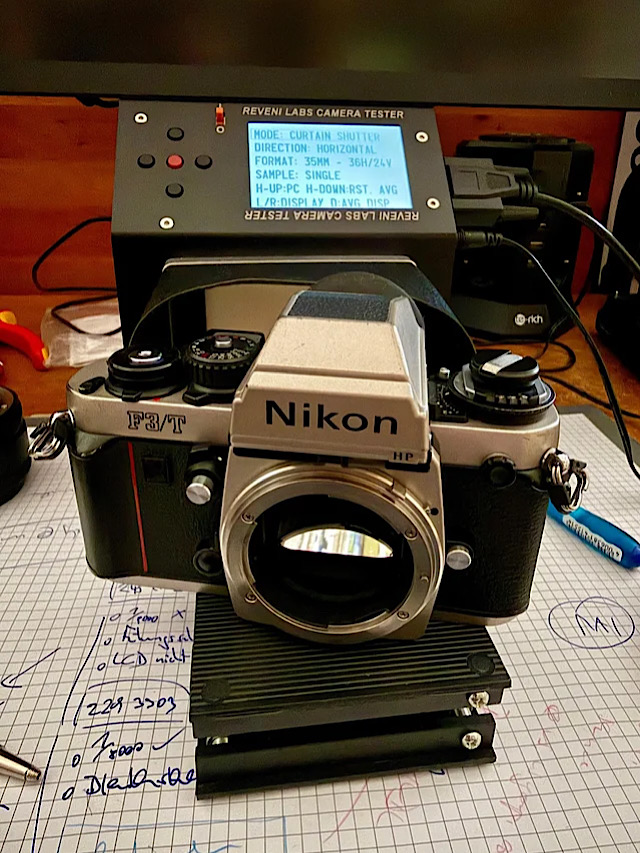
I put my Nikon F3/T, which I have been working with for many years, on the Reveni Labs camera tester.

About 18 years ago, the previous owner had it serviced. I don't know exactly what work was done. The F3/T always delivered flawless results and I was always satisfied.

What the camera tester showed me surprised me.

The shutter needs adjustment; the curtain travel times vary greatly. This means that the film is not evenly exposed, especially at short shutter speeds. I never noticed this fin my negatives, which I scan and edit in Photoshop.

Nevertheless, the exposure metering system works correctly and the automatic exposure is also within the normal range.

Here is my procedure

for testing the F3/T on the Reveni Labs camera tester:
IMG_6347.jpeg


IMG_6346.jpeg


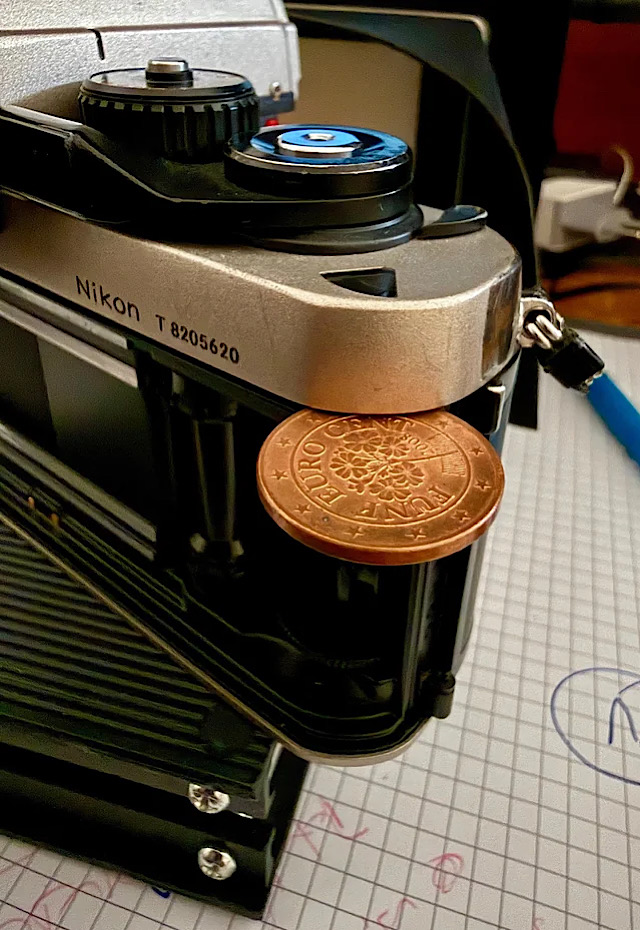
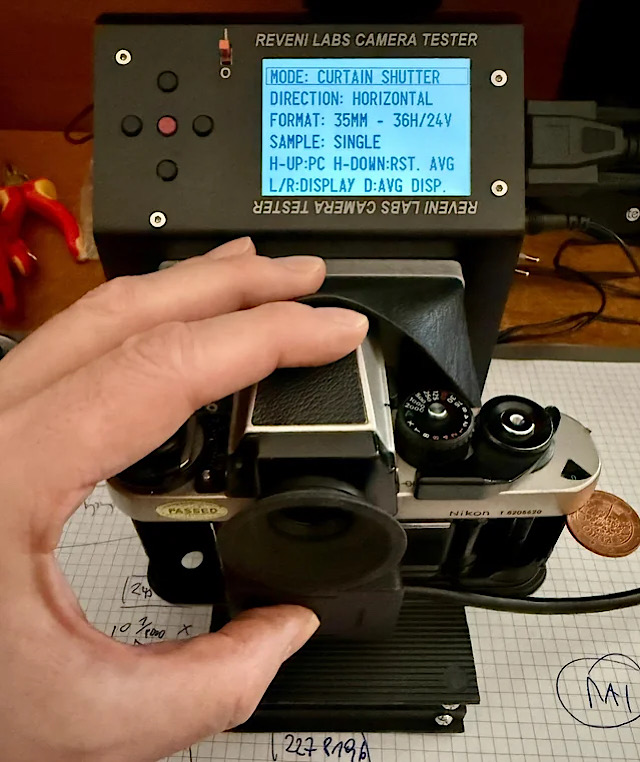
The back door is removed. I use a coin to block the small pin in the housing, which must be pressed in for the F3/T to be able to set shutter speeds.
IMG_6345.jpeg


IMG_6344.jpeg


IMG_6343.jpeg


IMG_6342.jpeg


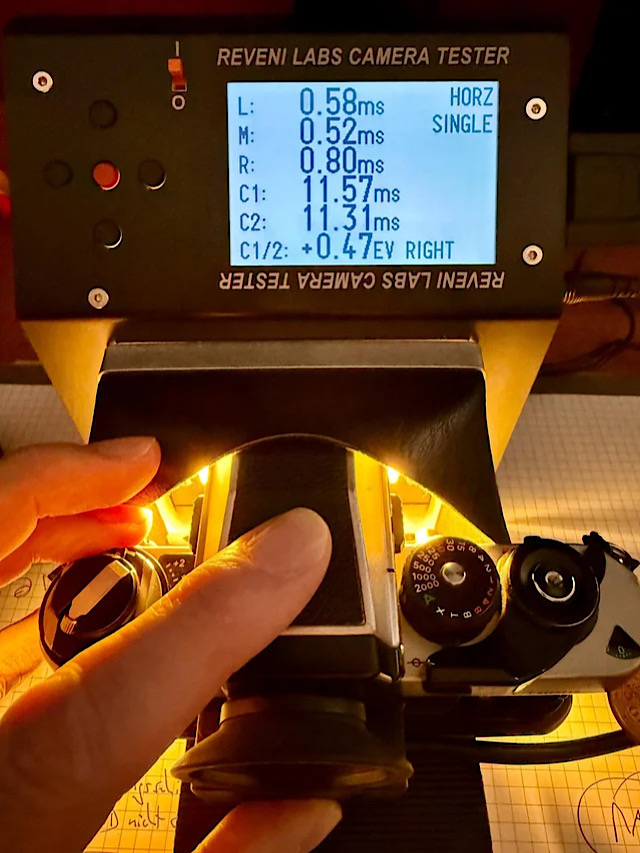
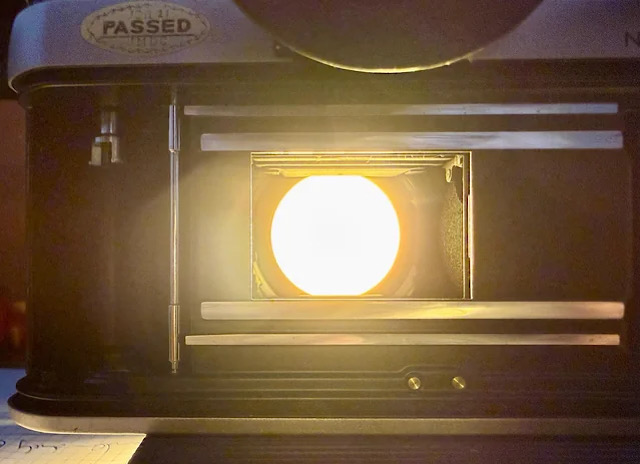
Checking the curtain travel times.

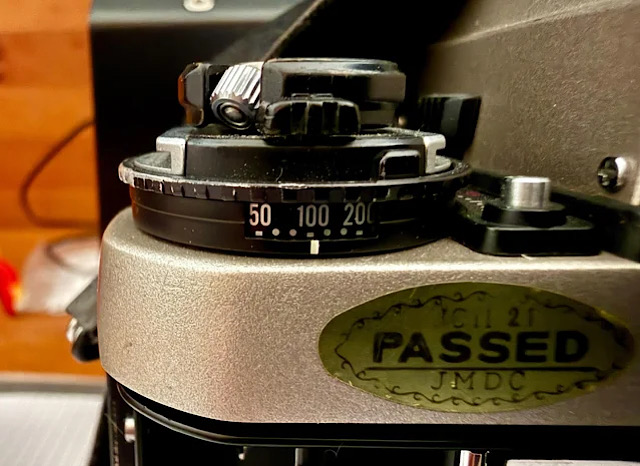
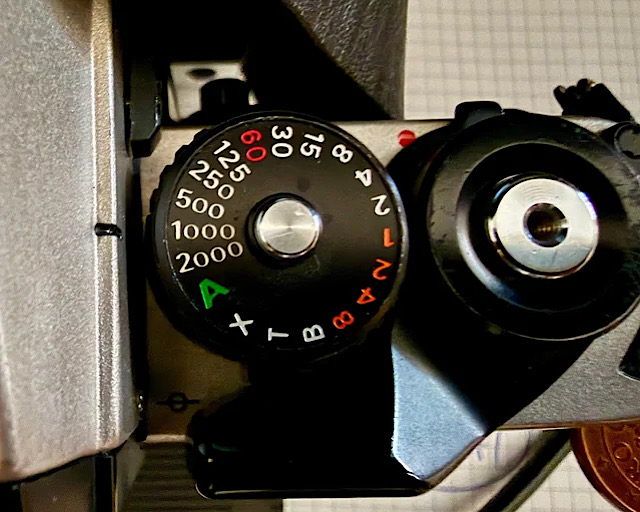
To do this, I set 1/1000 second. ASA to 100, which is important for the next test. Here we are only checking the mechanical function of the shutter.

The F3/T is triggered with the sensor attached.
The curtain travel times C1 and C2 should be the same, but here C2 runs 260 microseconds faster than C1. This causes underexposure of almost half an EV value on part of the image.

At 1/2000 second, the exposure error will be even more pronounced, as deviations have a proportionally greater effect on short exposure times.
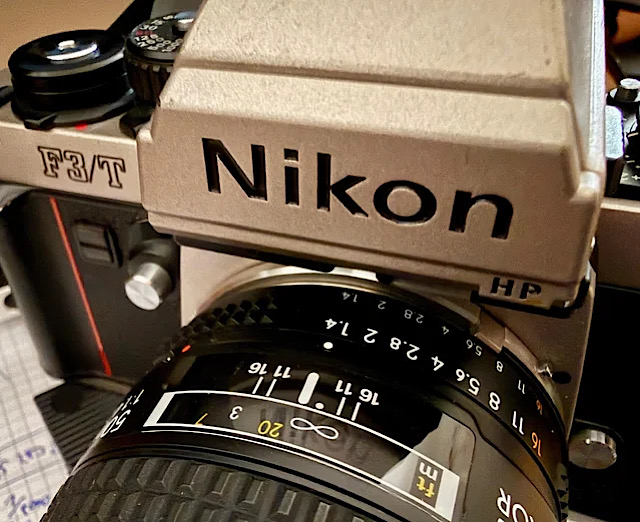
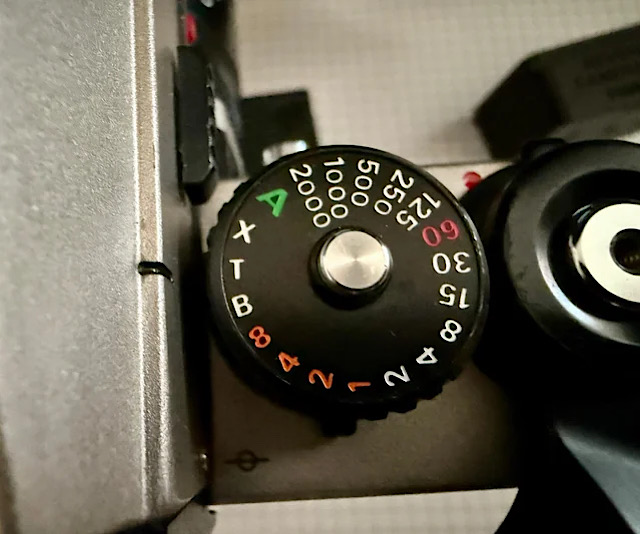
IMG_6341.jpeg


IMG_6340.jpeg


IMG_6339.jpeg


IMG_6338.jpeg


IMG_6337.jpeg


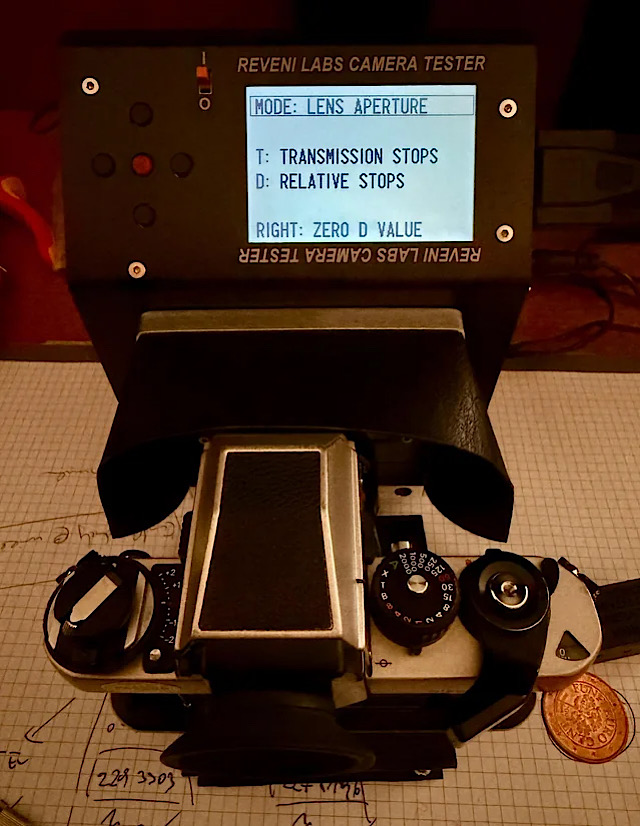
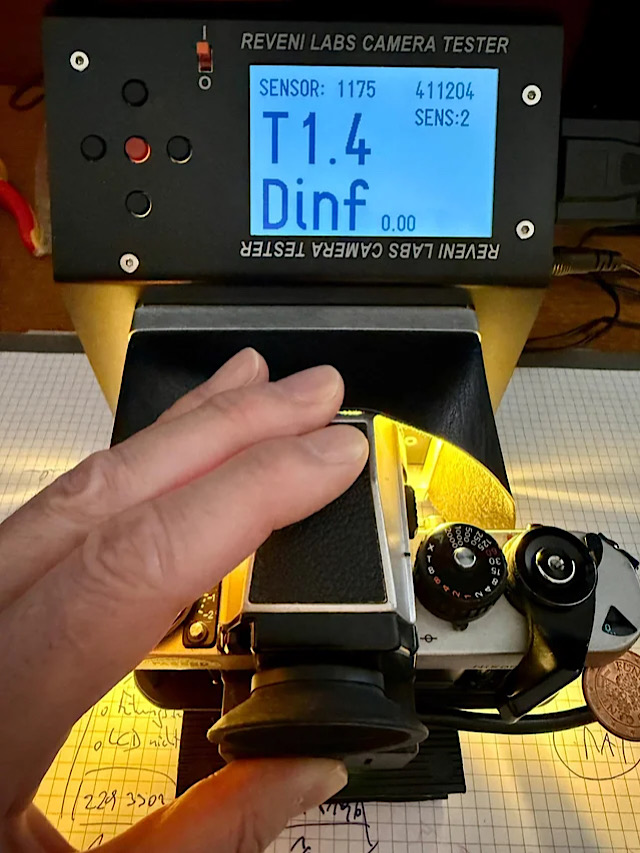
Measurement of the transmission of my Nikkor 50/1.4 AF. This is for demonstration purposes only.

In contrast to the aperture value (F-stop), the transmission value (T-stop) also takes into account the light absorption of the lens.

This is relevant when testing the exposure metering system.

Here, the transmission value with T = 1.4 corresponds to the aperture value F = 1.4.

Nevertheless, some light is retained by the lens. But that should not matter further.
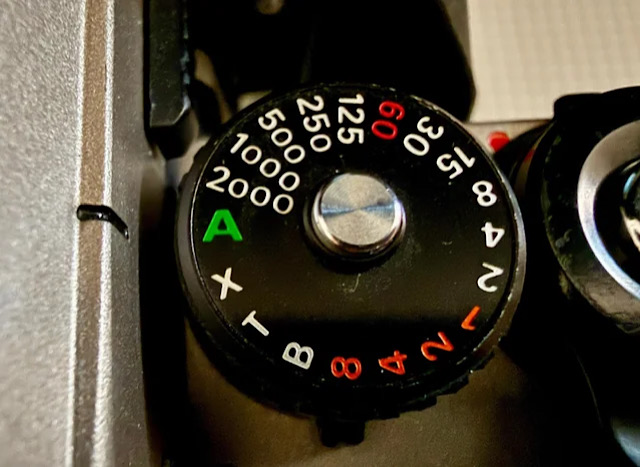
IMG_6336.jpeg


IMG_6335.jpeg


IMG_6334.jpeg


IMG_6333.jpeg


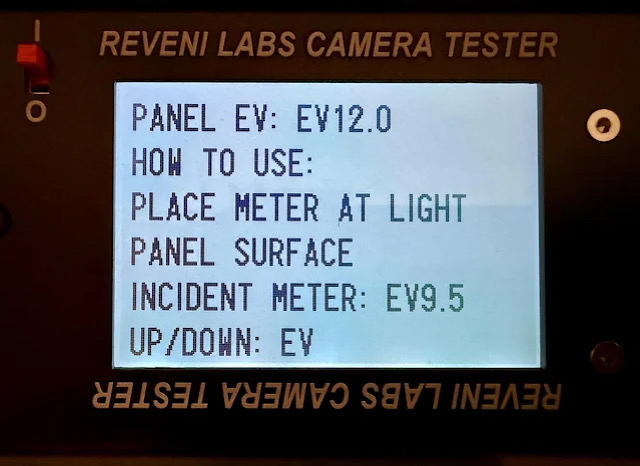
Measurement of the exposure metering system.

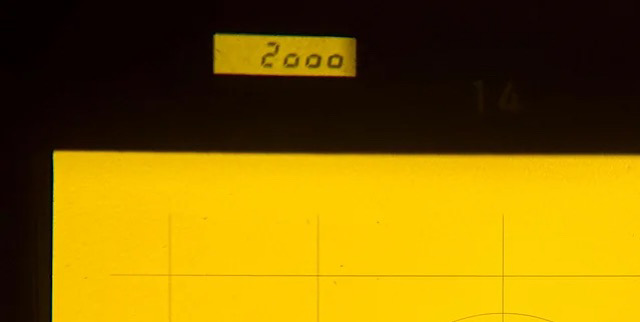
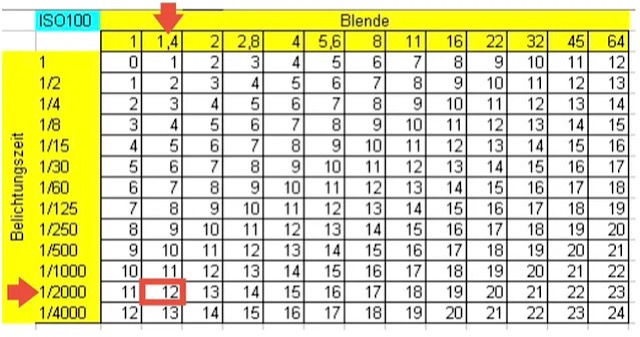
The F3/T is set to A (aperture priority). The largest aperture is set to F = 1.4 on the lens. At ASA 100 and EV 12, which is a defined brightness output by the camera tester, the camera must produce an exposure time of 1/2000 seconds at aperture 1.4 (see table).

This is correct.
 
Last edited:
IMG_6332.jpeg


IMG_6331.jpeg


IMG_6330.jpeg


Finally, I test the automatic exposure, again in mode A.

The result is an underexposure of 0.4 EV, which is an acceptable value.

This completes the test of the F3/T

It would still be possible to test more thoroughly. For example, with different brightness settings on the camera tester. But this is enough to give me an impression.

All that remains is to set the curtains travel times, which we will look at in a follow-up post.
 
Last edited:

Adjusting the curtains travel times - preparations​


IMG_6353.jpeg


In the previous post, we checked a Nikon F3/T on the camera tester and found that the curtains travel times differed from each other.
  • This means that the image is not evenly exposed, especially at short shutter speeds.
  • In this case, the second curtain (C2) is faster than the first (C1).
  • We therefore want to adjust both curtains so that they run at the same speed.
To ensure that the shutter speeds are correct, the specifications for the curtains travel times must be adhered to.

Information on this can be found in the SPT Journal May/June 1985.
  • Here, the curtains travel times are specified as 10 milliseconds (= 0.010 seconds).
  • This value applies to a camera tester with a sensor distance of 32 millimeters.
  • For the Reveni Labs camera tester we use, we convert this value to 36 mm: (0.010 s/32 mm)*36 mm = 0.01125 s = 11.25 milliseconds.
The measurement of the curtains travel times yielded the following values:
  • C1 = 11.57 milliseconds
  • C2 = 11.31 milliseconds
Since it is usually easier to tension the springs of the shutter curtains than to relax them, we align C1 with C2.


Excursus

The more tension the springs have, the faster the shutter curtains run. This is a purely mechanical process.

The triggering of the curtains is controlled electronically via solenoids and determines the shutter speeds.


This means

that the specified value of 11.25 milliseconds is not achieved exactly and the shutter times will therefore differ slightly.

But since the deviation is consistent, that shouldn't matter. 1/125 seconds might then be shiftet eg. to the longer 1/115 second or 1/102 second etc. We can then see how high the deviation is on the camera tester.

The two ratchet gears for adjusting the curtains travel times

IMG_6352.jpeg


IMG_6351.jpeg


are located under the bottom cover of the F3/T. They can be adjusted using a screwdriver with a narrow blade.

In the next post, we will take a look at the process and check the curtains travel times again on the camera tester.
 
Adjusting the curtains travel times - implementation and final check

After discussing curtain travel times and shutter speeds in our previous post, we will now put our findings into practice.

On the Nikon F3/T and other F3 variants

adjusting the curtains travel times is easy.

IMG_6373.jpeg


IMG_6372.jpeg


All you have to do is remove the base plate with the rubber cover, if present, and then you can adjust the two ratchet gears for the tension of the shutter curtains springs with a flathead screwdriver.

To adjust C1 to C2

I turn the ratchet gear nearer to the back door counterclockwise, click by click.


It is better to make fewer clicks than too many, as otherwise a faster time than intended can easily be set due to the higher spring tension. Then the ratchet gear must be unlocked, which releases the tension on the shutter curtain spring, i.e., a reset. Then it must be readjusted.


With about five clicks and checking the result on the camera tester in between, I was able to adjust the curtains travel times very precisely.

The mechanically formed curtains travel times always move minimally up and down, so I took the current time of C2 as my target and adjusted C1.

With 1/1000 second set shutter speed

IMG_6371.jpeg


IMG_6370.jpeg


there is now no more exposure deviation

IMG_6369.jpeg


IMG_6368.jpeg


and even the critical shortest shutter speed of 1/2000 second is also exactly on target.

The 1/125 second set shutter speed

IMG_6367.jpeg


IMG_6366.jpeg


shows a clear deviation from C1 and C2, but at +0.05 EV this has virtually no effect.


I cannot say why the curtains travel times differ here. They should always be the same for all shutter speeds. Perhaps there are minor irregularities in the camera mechanism. However, the only important thing is that the result is correct.


Now that we have taken care of the curtains travel times setting, let's take a look at the

Shutter speed of 1/125 second

Since we did not reach the target of 11.25 milliseconds for the curtains travel times, the actual shutter speeds will vary slightly.

IMG_6365.jpeg


The 1/125 second deviates towards shorter. The middle sensor on the camera tester shows 1/135 second, which makes no significant difference.

The other shutter speeds also deviate slightly, but everything is within tolerance.

The shutter of the F3/T is now adjusted

IMG_6364.jpeg


Now install the base plate and we can continue taking pictures 🙂


Conclusion
  • Working with the camera tester always requires careful consideration. You have to obtain all the necessary information and interpret the values displayed.
  • Depending on the design of the SLR, it may need to be dismantled to a greater or lesser extent for adjustments to be made.
  • The reward for your efforts is a precisely adjusted SLR.
  • Whether you want to go to the trouble is of course always up to you.
+++

⚠️ A word of caution

Please keep in mind that you’ll be using highly flammable solvents for service work, and their fumes are harmful to your health. Soldering also produces fumes that should not be inhaled. Dangerous high voltages can be present when handling electronics, especially in conjunction with electronic flash units and mains. Therefore, familiarize yourself with the safety regulations beforehand and ensure your safety. Depending on the activity, protective gear may be advisable.

All information provided without guarantee and use at your own risk.

Acknowledgments

Without the work of Master Larry Lyells, in particular, we wouldn’t have the detailed technical information we need today for service/repair of SLRs.

The SPT Journal and The Camera Craftsman, which he helped shape significantly as an author, and which contain all the necessary information and instructions are available for a fee through Learn Camera Repair.

We owe our access to them to Eugene Pate, the founder of Learn Camera Repair.
 
Last edited:
That's pretty amazing result! 1/2 EV!

I Wonder how digital cameras would do?

Unfortunately, we can't verify that using the camera tester, since the sensor of a DSLR is located behind the shutter. And that's why we can't use the camera tester's sensor there.
 
Last edited:
That's pretty amazing result! 1/2 EV!

I Wonder how digital cameras would do?

On one hand, I assume that the shutters of digital cameras are much more precise because they are much younger than those of our 70s/80s film cameras, contain less mechanical elements, and also technology has advanced since then. However, since you take 10x - 100x more photos with a digital camera than with a film camera this might increase wear of the shutter 🤔.

On the other hand, in my opinion it would hardly matter if the shutter of your digital camera would be off by 1/2 or 1 EV. Typically, the dynamic range of these cameras is high enough to not clip any relevant information if the exposure is off by this amount. And if you think your picture is a bit dark or bright it needs only a second or so to correct this in post production. Also, if you look at the histogram after you took the picture and you don't like its shape you usually just take another shot with adjusted settings.
 
On one hand, I assume that the shutters of digital cameras are much more precise because they are much younger than those of our 70s/80s film cameras, contain less mechanical elements, and also technology has advanced since then. However, since you take 10x - 100x more photos with a digital camera than with a film camera this might increase wear of the shutter 🤔.

On the other hand, in my opinion it would hardly matter if the shutter of your digital camera would be off by 1/2 or 1 EV. Typically, the dynamic range of these cameras is high enough to not clip any relevant information if the exposure is off by this amount. And if you think your picture is a bit dark or bright it needs only a second or so to correct this in post production. Also, if you look at the histogram after you took the picture and you don't like its shape you usually just take another shot with adjusted settings.

Looking at the latest Sony flagship. Ai autofocus etc, who knows how the machine is modifying your intent.

All the more important the work of Andreas to keep film cameras in shape. Where the photographer is in control.
 
What are the latest shutter technologies? What electronic options are there? LCDs that dim in certain areas? I have no idea.
 
Looking at the latest Sony flagship. Ai autofocus etc, who knows how the machine is modifying your intent.

They’re fantastic cameras. I also shoot digitally and am a big fan of Photoshop. But once the manufacturer’s warranty expires, they’re as good as lost if they need repairs. DIY isn’t an option here.

I have two small PowerShot cameras with electronic viewfinders that are no longer in production. In one of them, the backup battery or capacitor no longer works, and it loses the date and time when the battery is replaced. So that’s a weakness—you could fix it yourself, but I don’t do that; the risk is too high for me.

Spending thousands of euros on a current system camera is out of the question for me. The loss in value would be too drastic. And I don’t have a clear picture of which cameras are currently the stars in the camera world.

All the more important the work of Andreas to keep film cameras in shape. Where the photographer is in control.

Here and there, we’re already seeing more in-depth repair reports on service/repair of electromechanical SLRs. I’m glad to see that, because every one of them helps ensure that these wonderful cameras have a future. And not just the top-of-the-line models.
 
I don't know, 66mpixel, 30 frames per second, computer capability is unrivaled. It's all beyond me. Not sure it even has a shutter. It's just too much for me. I have a Nikon D6. What was a flagship is a dinosaur. It's a dinosaur that will take a beating but it's definitely the last of the breed.
 
What are the latest shutter technologies? What electronic options are there? LCDs that dim in certain areas? I have no idea.

I think the latest shutter technology is "no shutter" 😉. See the Nikon Z8. Readout speeds of sensors have become fast enough to get rid of a mechanical shutter and still have (almost) no rolling shutter effect. However, which amateur will ever be able to fix a Nikon Z8?
 
I think the latest shutter technology is "no shutter" 😉. See the Nikon Z8. Readout speeds of sensors have become fast enough to get rid of a mechanical shutter and still have (almost) no rolling shutter effect. However, which amateur will ever be able to fix a Nikon Z8?

A whole new dimension. Fascinating technology. Are there any internal views of these cameras available anywhere?

There probably won’t be any mechanical parts inside anymore—just electronics in modules, similar to smartphones. Repairs will involve replacing components, so the challenge will be opening the casings without damaging them.
 
I don't know, 66mpixel, 30 frames per second, computer capability is unrivaled. It's all beyond me. Not sure it even has a shutter. It's just too much for me. I have a Nikon D6. What was a flagship is a dinosaur. It's a dinosaur that will take a beating but it's definitely the last of the breed.

On their way to me in Vienna are several Larry Lyells (LL) repair manuals for 1990s SLRs. I’ve relieved camerabooks.com of these gems—no one wanted them, and they’d been sitting there for years.

This brings me up to that decade, but that’s as far as I’ll go technically.
 
A whole new dimension. Fascinating technology. Are there any internal views of these cameras available anywhere?

There probably won’t be any mechanical parts inside anymore—just electronics in modules, similar to smartphones. Repairs will involve replacing components, so the challenge will be opening the casings without damaging them.

You can have a look at the service manual of the Z8 that is available for download here: https://ssr.downloadcenter.nikonimglib.com/en_US/products/28/Z_8.html

I was a bit surprised that this manual is free and available to everyone. Also, I was surprised by the quality of the manual. For example, the excellent description on how to disassemble the camera. Maybe my statement that no amateur will ever be able to fix a Z8 was wrong. If you are good at SMD-size soldering it should be possible as long as you can get spare parts.

Beside the physical controls of the Z8, its IBIS mechanism might be one of the very few mechanical parts inside the camera.
 
I was a bit surprised that this manual is free and available to everyone. Also, I was surprised by the quality of the manual. For example, the excellent description on how to disassemble the camera. Maybe my statement that no amateur will ever be able to fix a Z8 was wrong. If you are good at SMD-size soldering it should be possible as long as you can get spare parts.

I believe there is now a legal requirement in the EU that manufacturers must provide spare parts and repair manuals.

But how do I adjust a Z8 at home on my kitchen table?
 
But how do I adjust a Z8 at home on my kitchen table?

I browsed through the complete manual and there is no indication that anything on this camera can be adjusted at all (other than by software customizing). It's always just disassemble - replace part - assemble. No error analysis or measuring equipment whatsoever is mentioned. There are a couple of very brief test procedures described at the end, like for the autofocus. However, their advice when you find the autofocus not working correctly is just:

"If the focus position is significantly different from what it was before disassembling, we recommend that you disassemble and repair the Product again" 😂

Although you seem to extend your field of work to the 1990s now, I'm not sure if you want to extend it further to the 2020s 😉. Doesn't sound like much fun for camera repairers. Also, I question that it will be worth the effort to save all the millions of digital cameras that are thrown on the market now but are outdated within a couple of years.
 
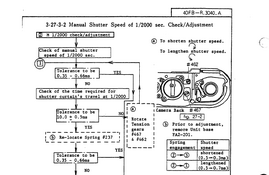
Thank you for the report. I checked my documents on the F3 and, unfortunately, I do not yet have the SPT Journal for this camera. However, I do have the official Nikon repair manual. I think it is quite interesting that Nikon specified the tolerance for 1/2000 s as 0.35 to 0.66 ms, which corresponds to roughly half a stop. The tolerance for the curtain travel time is given as 10.0 ± 0.5 ms.

As an owner of the Reveni Labs Camera Tester myself, I am convinced that it is entirely possible to use it to adjust a camera to stay within the limits defined by the manufacturer.

By the way, with the latest firmware, the tester offers measurements at 32 mm, so there is no longer any need to calculate the travel times manually.
 

Attachments

  • Screenshot 2026-05-28 210617.png
    Screenshot 2026-05-28 210617.png
    73.8 KB · Views: 12
Thank you for the report. I checked my documents on the F3 and, unfortunately, I do not yet have the SPT Journal for this camera. However, I do have the official Nikon repair manual. I think it is quite interesting that Nikon specified the tolerance for 1/2000 s as 0.35 to 0.66 ms, which corresponds to roughly half a stop. The tolerance for the curtain travel time is given as 10.0 ± 0.5 ms.

As an owner of the Reveni Labs Camera Tester myself, I am convinced that it is entirely possible to use it to adjust a camera to stay within the limits defined by the manufacturer.

By the way, with the latest firmware, the tester offers measurements at 32 mm, so there is no longer any need to calculate the travel times manually.

Thanks, good to know!

In practice, minor deviations should not matter as long as the curtains travel times are as consistent as possible.

As I mentioned, I never noticed a problem with this F3/T when exposing color negative film, developing it myself, and scanning it.

What we're doing here is often practically irrelevant. Of course, every SLR should be adjusted to its target values as much as possible. But at this level, it's almost purely theoretical work ☺️


Nikon F3 SPT Journal
 
What we're doing here is often practically irrelevant. Of course, every SLR should be adjusted to its target values as much as possible. But at this level, it's almost purely theoretical work ☺️

Right. Although we could consider the values printed on the shutter speed dial as our target values, the relevant industry norms are much more relaxed. For example, for the nominal shutter speed of 1/500sec (= 2msec), the German DIN norm requests an actual value in the range of 1.43...2.67msec and the American ASA norm even an actual value in the range of 1.40...2.90msec. Thanks to our test equipment, we can measure the shutter speeds exactly enough to try to reach the nominal value. However, if we deviate a bit (like 1/900sec instead of 1/1000sec) we shouldn't worry too much. For me, the even exposure across the frame and the repeatability of the shutter speed is more important than the exact nominal value.

For example, for the Canon A-1s I repaired I noticed that the even exposure and the repeatability is a bit better when the curtains are a bit slower than Canon asks for. When slower, I also noticed less problems with bouncing of the curtains.

Probably, we hobbyist camera repairer put more effort in adjusting our cameras (and worrying more then they are not spot on) than was done back then at the factory 😉.
 
🤠

Tomorrow is my day off. I'm surprised I'm still finding posts from my six months on Reddit. As always, I'm posting too much.

Greetings from Vienna 🙂
 
In one of them, the backup battery or capacitor no longer works, and it loses the date and time when the battery is replaced. So that’s a weakness—you could fix it yourself, but I don’t do that; the risk is too high for me.

Depending on which PowerShot you have, that might be a consumer-replaceable item. A couple of the Powershots have a standard CR1220 (maybe; it's been a while) tucked away in the battery compartment.
 
Depending on which PowerShot you have, that might be a consumer-replaceable item. A couple of the Powershots have a standard CR1220 (maybe; it's been a while) tucked away in the battery compartment.

Thanks, this applies to the PowerShot G5X.

I charge the battery directly in the camera via a USB port. That’s a workaround. And if I still have to change the battery, I reset the date and time.

I need to look into this again; the power buffer on this camera is probably located deeper inside the unit.
 

Measuring the flange focal distance with a depth micrometer​


IMG_6551.jpeg


Depth micrometer with interchangeable extension rod and gauge blocks for calibrating the meter.


Servicing and repairing electromechanical SLRs is never boring. It involves precision engineering, electronics, and, of course, optics. Each of these specialist areas is vast, so there is always something new to learn.

Today, we're looking at precision mechanics with a measurement that has to be very accurate and requires some effort: the distance between the lens mount—that is, the lens bayonet—and the film plane of an SLR.

This distance is the flange focal distance.

In order for a lens to produce a sharp image on the film in the infinity position, the flange focal distance must be correct. It is usually specified to within +/- 0.02 millimeters (= 20 micrometers) and is typical for a camera manufacturer's lens mount.

Here, I would like to check the flange focal distance of a Nikon F3/T.

No deviation is to be expected, as the camera delivers sharp images with different lenses in the infinity position. But I am interested in how accurately the specification of 46.50 mm +/- 0.02 mm is adhered to.

Depth micrometer

For measuring, I use a depth micrometer with a digital display that shows readings accurate to 0.001 mm (= 1 micrometer). In practice, this precision is rather theoretical, as measurement errors can distort the result. But the process is accurate enough for our purposes.

Extension rods of different lengths are inserted into the depth micrometer. For the F3/T, I use a rod that covers the range from 25 mm to 50 mm.

The extension rod is turned out during measurement using a screw and ratchet for fine adjustment via a spindle.

Calibration

Before the depth micrometer can be used, it must be calibrated, as it does not have a fixed scale. For this purpose, high-precision gauge blocks are used, which are available in graduated lengths.

IMG_6550.jpeg


The gauge blocks I use are made of steel and require care. Before use, I clean them with isopropyl alcohol to remove oil that has been applied to prevent rust.

IMG_6549.jpeg


IMG_6548.jpeg


The gauge blocks can be stacked for different lengths. To do this, the polished measuring surfaces are placed on top of each other and twisted against each other until they are parallel. Adhesive force holds the blocks together. This is called “wringing“.

IMG_6547.jpeg


Here, the depth micrometer is placed on a 50 mm gauge block (right) and two stacked blocks, each measuring 20 mm and 30 mm, for calibration. When the extension rod reaches the stop at the bottom, the digital display is set to 50 mm. The device is now calibrated.

IMG_6546.jpeg


The base is a flat granite surface plate, which provides a high-precision ground reference surface.

IMG_6545.jpeg


Instead of a film, a gauge block is placed on the film guide rails. This defines the film plane and makes it measurable.

IMG_6544.jpeg


A smaller gauge block is placed under the larger one to create distance from the surface plate.

IMG_6543.jpeg


IMG_6542.jpeg


This allows the F3/T to be placed on the gauge blocks without colliding with the plate.

IMG_6541.jpeg


Here you can see the larger gauge block behind the film window. This is where the film would normally be located.

The shutter of the F3/T is permanently open in T (time) mode. With other SLRs, you set the camera to B (bulb) and lock the shutter with a lockable cable release.

IMG_6540.jpeg


The depth micrometer is placed on the lens mount and the extension rod is turned via the screw until it touches the gauge block.

Now it's time to use your fingertips, because we're talking micrometers here! Even the slightest deviation when holding the device can distort the measurement result.

The extension rod is brought to the stop with the ratchet, which generates a certain amount of pressure.

The result is within the target range. 26 micrometers too much, but I'll accept that within the tolerance range of the measuring method. The depth micrometer can probably be more accurate, but I can't 😉

IMG_6539.jpeg


A second measurement for comparison, 12 micrometers better 🤗

This completes the measurement of the focal flange distance on the Nikon F3/T.

IMG_6538.jpeg


I apply a thin layer of Ballistol oil to the gauge blocks and wrap them in cling film for food. This is to prevent rust.

IMG_6537.jpeg


Storage of the gauge blocks in the elegant wooden box.
 
Last edited:
Photrio.com contains affiliate links to products. We may receive a commission for purchases made through these links.
To read our full affiliate disclosure statement please click Here.

PHOTRIO PARTNERS EQUALLY FUNDING OUR COMMUNITY:


Ilford ADOX Freestyle Photographic Stearman Press Weldon Color Lab Blue Moon Camera & Machine
Top Bottom