• Welcome to Photrio!
    Registration is fast and free. Join today to unlock search, see fewer ads, and access all forum features.
    Click here to sign up

Danziger Gallery Exhibits "AI-generated color version" of Ansel Adams' "Moonrise, Hernadez, New Mexico" at AIPAD

Dump Truck Hat Trick

D
Dump Truck Hat Trick

  • 0
  • 0
  • 19
Street-Lamp

A
Street-Lamp

  • 2
  • 2
  • 72

Recent Classifieds

Forum statistics

Threads
204,301
Messages
2,866,887
Members
102,218
Latest member
333Ford
Recent bookmarks
0
In any case, why should they ask the Trust in the first place, since the Trust doesn't own the copyright? Who made the Trust the ethical keeper and decider of what happens to Adams' photos not copyrighted?

Repetatively repeating this does not necessarily make it true.
 
Just because you can doesn't mean you should.
I can afford not to care what this "gallerist" did with the Adams photo, but it's ultimately just parasitizing Adams work. But I still don't care. There will always be "art parasites".
 
Danziger have scrubbed clean all comments for their IG Moonrise post and others, and now disallow comments of any kind. Marketing geniuses they most certainly are not, but they now know they have touched several raw nerves with this stunt and people are not happy with them.

"All press is good press" is a myth and always has been. Turning off comments should help to stop the bleeding after a deeply unpopular project, at least on their rather minor IG presence. They have also uploaded the Moonrise defense statement from their website as a fresh IG post today, and of course turned off comments because they already know what the comments will be.

Comments are allowed everywhere else in the art world though, and you can imagine they are not favorable to this gallery at all. Danziger was apparently smart enough to hire a lawyer for this project, but now needs to also hire a PR firm to navigate next steps.
 
Your argument, Alan, lowers a personal work of art to the level of a mere mechanical commodity. Of course, that does seem to be the mentality of a lot of art dealers, even some artists. It might or might not be illegal theft, but just because 70 years or so have past, that doesn't morally justify the misappropriation someone else's work. Nothing was improved in this case, rather it was warped. And we're not talking about movies here. AA isn't alive to give permission to do so, but at least his heirs are. Common decency would have sought their consent first. Where I came from, someone doesn't climb over a barbed wire fence and going fishing in their bass pond without permission.

Art students for centuries have gone to museums and made copies of famous works as part of their training. That is all winked at provided that it's all up front, and they don't try to sell as those in fashion of forgeries. At least some work goes into it. But now someone could just walk up and take a digital shot and reissue the image after a bit of PS futzing. The quality would never match the original, and for that reason, nobody gives a damn how many
thousands of cell phone shots have been taken of the Mona Lisa. But if they started asking 10K apiece for them,
and claimed those restored to sight the actual person in DaVinci's presence when he painted her, that would no doubt raise a lot of eyebrows (plus contemptuous laughs).

AA did give permission for select students to work with some of his original negs, under certain supervised auspices. But in this case, they took an actual print of his and scanned it, then reworked (colorized) that. That's a gray zone (pardon me, if that sounds like a pun). This isn't about using negatives under express permission and controlled circumstances as a learning tool. Seemingly nobody was asked up front except his lawyers, implying he already knew he was doing something controversial. That's just Noi Yoik Joik rude behavior as far as I'm concerned. And if shaming turns out to be the only tool we've got to stop that, it will probably work if enough voices are involved.

You ask, Where will it end, Alan, if restriction are in place? Well, if there are no restrictions, someone could make a very high quality scan of a Moonrise print and reissue millions of them if they wanted to, in direct competition with his Trust.

 
Last edited:
Collectors who can afford to drop ten grand on a photo don;t do their own photos.
...
The trust was set up by the Adams family...for general info,

Collectors generally look for art the will increase in value...an easily reproducable piece will not likely increase in value.

Personally, I dislike colorizations and 'improvenents' to old films. As far as I am concerned it destroys the work of the artists involved with the film's making as much as showing the movie with a different sound track.
 
The trust was set up by the Adams family...for general info,

It was always my understanding, since the Trust was initially established in the 1970's, that AA himself set it up.

 
1779814400787.png


There's the found work of Marcel Duchamp like Fountain (1917), which was a signed urinal.


Danziger clearly states his process. There is no subterfuge. It's clearly conceptual.
1779815002329.png
 
Last edited:
It;s being sold at AIPAD in NYC, America. Actually, you raise an interesting point. What happens if the lawsuit starts in Canada? Can you be sued in another country if their laws vary?

Yep - but you have to sue using laws of the applicable jurisdiction, and as part of the suit you have to "prove" the applicable law and educate the court about it. It is really complex - far easier to initiate the case in the applicable jurisdiction.
And you can only do this if there is a nexus between where the suit is initiated and the damages for which the suit seeks a remedy - say the locus of the Trust was now in Canada,
 
Last edited:
Brian - It's probably better to phrase it, that the trust was set up largely for the sake of Adam's heirs and family. The complex nature of it, including not only prints and negatives, but publication rights involving books and postcards and the whole nine yards, needed some form of Trustee oversight. It's essentially a corporation; that's often the only way to keep things intact, and save it from the vultures.
 
Brian - It's probably better to phrase it, that the trust was set up largely for the sake of Adam's heirs and family.

"the Ansel Adams Gallery, the Adams family owned NPS concession," The gallery is a private company/corporation that is very separate and distinct from the Trust being discussed. It's really not that complex. Both serve his legacy in very different methods and ways, from vultures and for legitimate folks.
 
Last edited:
  • BrianShaw
  • Deleted
  • Reason: It stands on its own...
Your argument, Alan, lowers a personal work of art to the level of a mere mechanical commodity. Of course, that does seem to be the mentality of a lot of art dealers, even some artists. It might or might not be illegal theft, but just because 70 years or so have past, that doesn't morally justify the misappropriation someone else's work. Nothing was improved in this case, rather it was warped. And we're not talking about movies here. AA isn't alive to give permission to do so, but at least his heirs are. Common decency would have sought their consent first. Where I came from, someone doesn't climb over a barbed wire fence and going fishing in their bass pond without permission.

Art students for centuries have gone to museums and made copies of famous works as part of their training. That is all winked at provided that it's all up front, and they don't try to sell as those in fashion of forgeries. At least some work goes into it. But now someone could just walk up and take a digital shot and reissue the image after a bit of PS futzing. The quality would never match the original, and for that reason, nobody gives a damn how many
thousands of cell phone shots have been taken of the Mona Lisa. But if they started asking 10K apiece for them,
and claimed those restored to sight the actual person in DaVinci's presence when he painted her, that would no doubt raise a lot of eyebrows (plus contemptuous laughs).

AA did give permission for select students to work with some of his original negs, under certain supervised auspices. But in this case, they took an actual print of his and scanned it, then reworked (colorized) that. That's a gray zone (pardon me, if that sounds like a pun). This isn't about using negatives under express permission and controlled circumstances as a learning tool. Seemingly nobody was asked up front except his lawyers, implying he already knew he was doing something controversial. That's just Noi Yoik Joik rude behavior as far as I'm concerned. And if shaming turns out to be the only tool we've got to stop that, it will probably work if enough voices are involved.

You ask, Where will it end, Alan, if restriction are in place? Well, if there are no restrictions, someone could make a very high quality scan of a Moonrise print and reissue millions of them if they wanted to, in direct competition with his Trust.

My comments were mainly legal but let;s talk about the ethical. First off, I never said there should be no restrictions. I;m in favor of patents and copyrights and the restrictions they impose. First, the purpose of Copyright laws, and patents as well, is to encourage people, artists, scientists, etc to create things that are useful in a practical, industrial, or artistic way. The founders of our Republic thought it so important that patents and copyrights were included in the original US Constitution as a right of the people. The rules regarding them are to be regulated by Congress. However, Congress (the people) recognized that copyrights and patents in perpetuity are not helpful to society. We want to protect financial rights which is why copyrights were extended to 70 years after death, which now protects descendants and estates as well as the originators. But once copyrights (or patents) are over, society wants the public to build on the creative work of others and not allow them to lay dormant. Think of all the beautiful music that has been created with arrangers using Bach and Mozart to create new songs, operas, etc or new medicine that build on the earlier patented medicines created by others. If someone wants to colorize a print or a 1905 BW video on NYC streets that;s in the public domain, we want to allow them to do it. They shouldn;t need approval by some committee we don;t vote in. We don;t want patents or copyrights to become dead ends, hence the limitations in years they are in effect. You appear to want to change patents and copyrights to perpetual protection, something that is neither ethical, practical, or legal, nor something favored by the general public.
 
The trust was set up by the Adams family...for general info,

Collectors generally look for art the will increase in value...an easily reproducable piece will not likely increase in value.

Personally, I dislike colorizations and 'improvenents' to old films. As far as I am concerned it destroys the work of the artists involved with the film's making as much as showing the movie with a different sound track.

Not everyone has the same taste. I thought the colorized Adams by Danziger was interesting. More interesting was the colorized version of the 1905 movie of NYC streets. Seeing in 4K HDR what New York looked like more realistically back then, rather than seeing it in grainy, blurry, flickering BW, was a treat. What if the movie could not be colorized if it wasn't in the public domain and kept "sacred" in perpetuity? How would society benefit?
 
For some reason Brian, I can;t quote your post. It says the requested post can no longer be found.

In any case, copyright rules are complicated. But once the work is legally in the public domain, arguing an ethical reason to not use it should be directed to Congress to change the rules. The country wants to put an ending to patents and copyrights at some point. Having to check with the dead artist's grandchild second removed to use an old work, is not something the country wants to do. Let the grandkid get a job and stop sponging off his dead grandfather's work.
 
Not everyone has the same taste. I thought the colorized Adams by Danziger was interesting. More interesting was the colorized version of the 1905 movie of NYC streets. Seeing in 4K HDR what New York looked like more realistically back then, rather than seeing it in grainy, blurry, flickering BW, was a treat. What if the movie could not be colorized if it wasn't in the public domain and kept "sacred" in perpetuity? How would society benefit?

I question the concept of that 1905 movie being colorized as becoming more realistic. I believe in this case, the brain can do a more accurate recreation of the times based on the B&W film than with the colorized version. Colorization just creates another layer of mis-information to wade through. What Jackson did with the WWI film to avoid a lot of that was researching the true color of some of the equipment from the time.

But I was referring to creative movies rather than early documentaries. Sorry for the confusion. The movie-makers working in B&W used lighting and colored sets to pull the most they could out of the material they were using to create. Colorization ends up hiding much of that creativity, IMO.
 
Well, Alan, if the copyright begins when the photograph was taken, in my case, the heirs of my estate might have only 10 or so years left after inheritance before it is hypothetically in the public domain and free for anyone to pirate as they please. Thankfully, I'm not on anyone's radar. But what if you or I, or anyway else, was? How would you feel? And there have been three times in my own lifetime when a dedicated gallery was serious proposed by others
than myself, including relatives with the means. Nowadays pirates don't even seem to care about the visual quality of their ripoffs; they just want a piece of the monetary pie. They could offer a discounted "copy" online or whatever, and at the same time, ruin the quality reputation of the original if people had never actually seen it.

I already told the story of how one of my aunt's works was plagiarized just ten years after she painted it. Nobody back then spoke about some "transfomational" appropriation; they just stopped giving that particular artist new commissions, since he hadn't bothered to coming up with his own composition anyway. Who can trust someone like that? It ended his career, and should have.

In this Moonrise incident, the offender should at least be made aware he smells like a skunk.
 
Last edited:
Sorry, djdister - Peter Lik would sue you for that one, except in his case, the moon would be five times bigger, and there would be a beach and palm trees in the foreground.
 
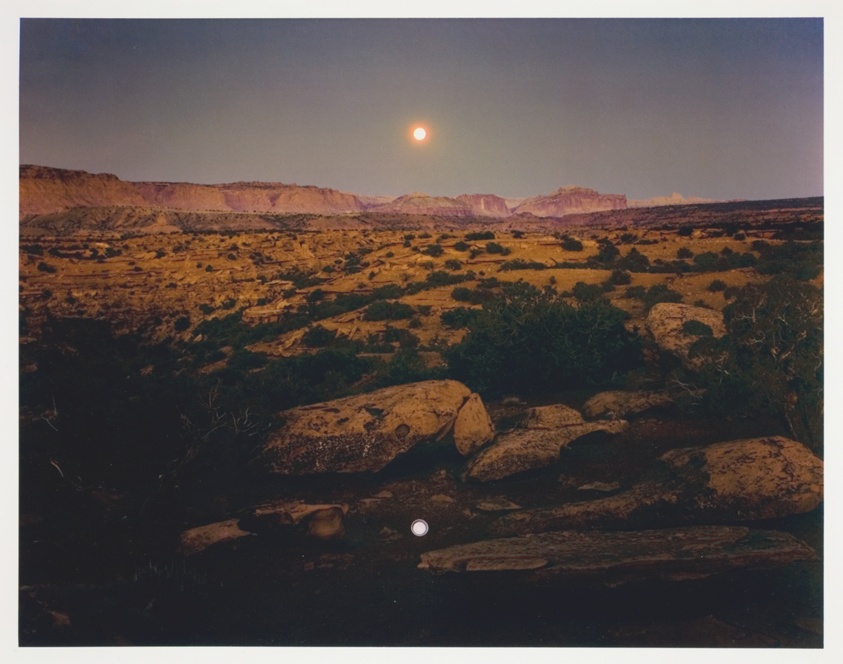
I've actually seen that Pfahl "pie pan" version in person, not long after it was made. It was an 8x10 contact print, so Pfahl must have been completely unfamiliar with how to correctly focus a view camera, given the ludicrous amount of unsharpness. Every print I ever saw of his was miserable done, and utterly blaah, perhaps intentionally,
perhaps not. Pure gimmickry like much of the artsified color work back then; but the Ektacolor 74 prints are probably all faded out by now. Meyerowitz was the only one among that 70's Vericolor L genre who knew how to print well. Shore might have been a distant second place. An interesting phase, half-pretentious, half-serious.

What was beautifully shot and classically printed dramatic f-64 style, was McDowell's "Moonrise Over Rolls Royce". That was a much more effective spoof, because it was apples to apples technique-wise, and quite compelling in its own right.
 
Last edited:
Photrio.com contains affiliate links to products. We may receive a commission for purchases made through these links.
To read our full affiliate disclosure statement please click Here.

PHOTRIO PARTNERS EQUALLY FUNDING OUR COMMUNITY:


Ilford ADOX Freestyle Photographic Stearman Press Weldon Color Lab Blue Moon Camera & Machine
Top Bottom