• Welcome to Photrio!
    Registration is fast and free. Join today to unlock search, see fewer ads, and access all forum features.
    Click here to sign up

Where is everyone with your camera scanning setup for film?

Dump Truck Hat Trick

D
Dump Truck Hat Trick

  • 1
  • 0
  • 67
Street-Lamp

A
Street-Lamp

  • 3
  • 3
  • 105

Forum statistics

Threads
204,312
Messages
2,866,990
Members
102,220
Latest member
iDavidoff
Recent bookmarks
0
I use a Fujifilm X-T2, a Canon 50mm macro lens, Kaiser Slimlite Plano LED light box, Negative Supply film holder for 35mm film, and a homemade box + newton glass enlarger film holder for 4x5 film. The biggest hassle is setting up my tripod to hold the camera in place (I agree with previous posts about copy stands being surprisingly costly). Positioning the camera on the tripod requires time spent with levels to get proper alignment.

My set up also includes a TetherPro cable to link my camera to my MacBook, where I run CaptureOne.

Of course, I also like that I can also use the X-T2 as a camera, including with my vintage 35mm lenses.
 
For 35 mm colour negative film I use PrimeFilm XA with Silverfast.

For all B&W and slide film I use Sony A7R4 with Sony FE 90 mm F 2.8 Macro lens. The scanning setup consists of the stand (temporarily) borrowed from a Magnifax enlarger and a Raleno video light. I make my own film holders. I shoot the camera tethered using Sony Remote software.

Medium format colour negative conversion of camera scans is a pain. I tried many tools including developing my own software but I am not satisfied with the results. I use lab scanning for now.
 
I saw an Epson V600 in a store recently (Staples) - it was almost twice what I paid for the one I bought new.

I begrudgingly scan negatives. I prefer making enlargements. I find it tedious to scan and tedious to look through photos using a computer. I believe you could easily get better results camera scanning but the flatbed is just more convenient (except when it insists on putting lines in the photo).
 
Hmm. I'm still stuck in the dark ages. I used to copy slides (film to film) using various Nikkormats, including an FM2n, a 55 mm MicroNikkor and a PB-4 plus PS-4. To be clear, I photographed slides, I did not scan them.

I'm now in the late dark ages, use a D810 to photograph, not scan, slides and an ES-1. My latest 55 MicroNikkor is f/2.8 AIS. Light source? Whatever's handy, usually a cheap IKEA LED lamp. Auto WB is good enough. I do all this to be able to put photos in PowerPoint presentations, not to be able to make prints to hang on the wall.

I don't understand other posters' fascination with copy stands but there's no disputing tastes.
 
The V600 and similar models that are/were far more common and plentiful than the more expensive and advanced models do seem to be discontinued.
Which means that people who want to start scanning relatively low volumes of film, are basically either looking to the almost toylike options, the used (or refurbished) market, or starting out with camera scanning.

I upgraded from a V600 to a V850 when I started shooting LF. My V600 sits in the attic, unused but working since I last used it. I:m not ready to sell it, keeping it as a backup. But Epson does provide V600s once in a while refurbished with a one-year warranty. They just sold one. Here's the link to keep your eyes on their Certified Renew program.
https://epson.com/Certified-ReNew/c/cc?sort=featured&q=:tongue:rice-asc:discontinuedFlag:false:inStockFlag:true:tongue:roductType:SCANNER#
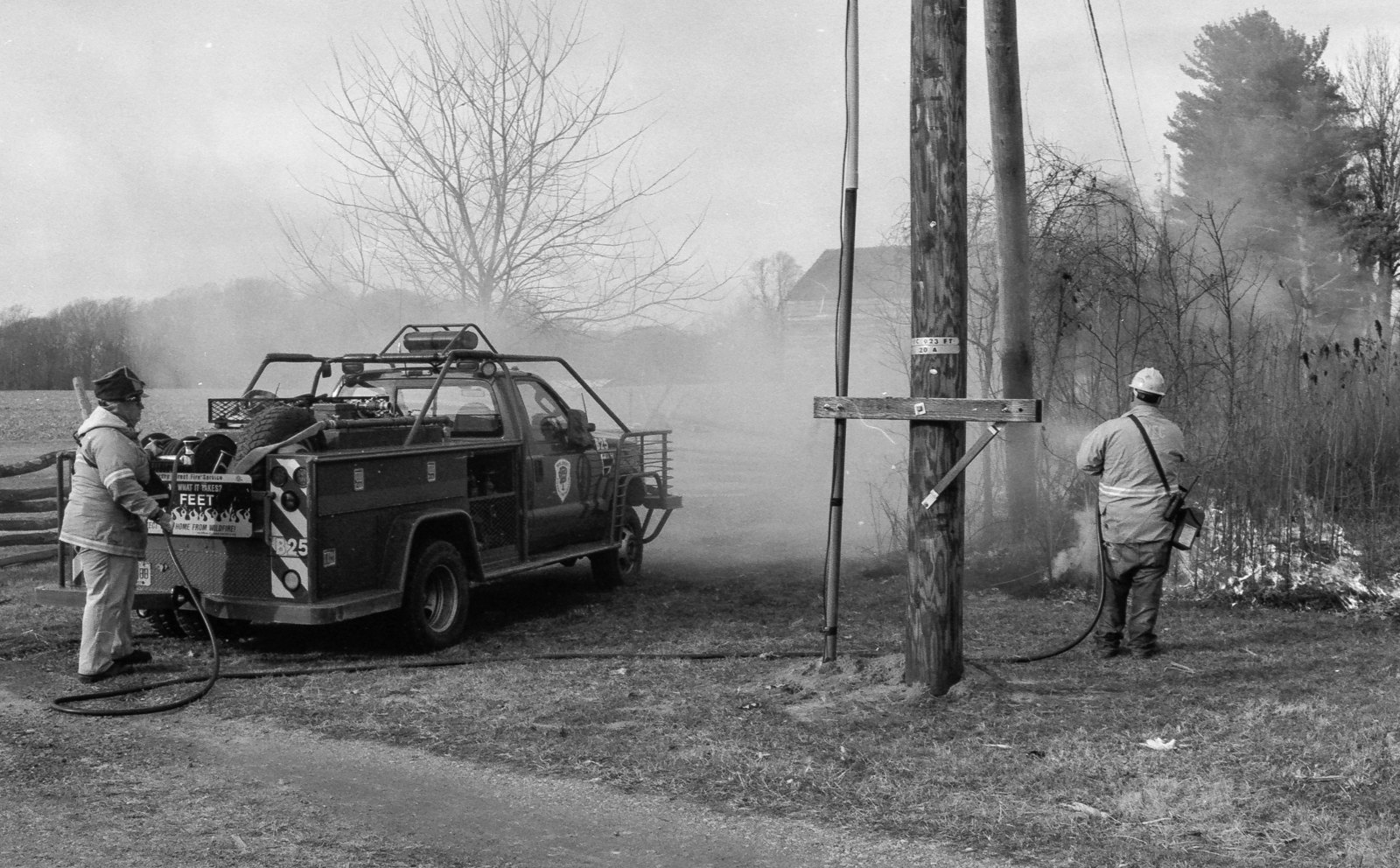
Regarding the V850, it does a very nice job with 35mm film scans, although I haven;t printed from them. Better than the V600.
Here's some 35mm Tmax 400 scanned with the V850.

I;ve done a comparison with a Howtek drum scanner with 4x5 Tmax 100. Here;s the discussion. It compares favorably at least for digital display.

I;m curious why people don't use Nikon's 35mm slide copier attachment for camera scanning?
 
Regarding the V850, it does a very nice job with 35mm film scans, although I haven;t printed from them. Better than the V600.
Here's some 35mm Tmax 400 scanned with the V850.

I;ve done a comparison with a Howtek drum scanner with 4x5 Tmax 100. Here;s the discussion. It compares favorably at least for digital display.

I;m curious why people don't use Nikon's 35mm slide copier attachment for camera scanning?
I can't comment extensively on the V850 for 35mm because I still have a V750 at home, and I seldom shoot 35mm. That said, a 35mm piece of film is quite small, relatively speaking, and as such, it quickly bumps up against the limitations of the device. The 850 may be a significant improvement over earlier models, but scanning a 35mm negative is still going to limit the dimensions of the file to a relatively low number.

Bear in mind that digital display is a vastly different thing than making a 16x20 print on baryta paper. Digital displays are a bit of a lowest-common-denominator thing - there are limits on both resolution and contrast, as well as color accuracy, especially if you have not bothered to properly calibrate your monitor. People creating files for display on a computer monitor, especially for transmission and viewing over an internet connection, are going to be compressing the hell out of the file, so any of the fine detail the drum scan can deliver will be obliterated in the JPEG compression.

As to the Nikon slide copying adapter, it was built for copying mounted 35mm slides. Most people today are probably scanning negative strips. Without making some kind of adapter, it won't hold a negative strip flat enough. Also, unless you're using a strobe for a light source, you'll risk inconsistency in exposure and color temperature.
 
I use a MFT camera (a Lumix G70). I use my Durst F60 column with a tripod head attached (this enlarger was made for double as copy stand). For lens I use a Yashica 50mm lens with a Kiwi foto adapter and a some extension tubes to get the full sensor. Depending on the work, I might use the durst negative carrier, or a hard cardboard one that I've build with a cheap LED source (I only do B&W work).
 
My most used scanner is a Canon 9000 Mark 1. I'm happy with how things present themselves in places like my Photrio Gallery uploads - many of which are negatives/slide scans: https://www.photrio.com/forum/media/users/mattking.107253/
Chose a tool that meets your needs and learn how to use it. My first such choice is a darkroom enlarger. The rest of my needs are for web sharing, and a relatively simple tool does that well.
 
I have the following:

- PlusTek 8200i
- Nikon Coolscan 5000ED with full-roll-modified SA-21 strip feeder and SF-200 automatic slide feeder
- Epson V850
- Camera scanning setup with Fujifilm X-T4 and Negative Supply stand, light source, and holders for 110, 35mm, 120, and 4x5.

I use the camera scanning setup 98% of the time, with the other 2% reserved for batch scanning mounted slides with the Nikon, or scanning 4x5 with the V850.

Camera scanning is just so much faster than any of the other options.

Is the Plustek 8200i the forgotten stepchild? If you were starting from scratch, would you buy one again?
 
a Canon 9000 Mark 1. .../... My first such choice is a darkroom enlarger. The rest of my needs are for web sharing, and a relatively simple tool does that well.

digitization is a topic where many people promote gear that is so expensive that it discourages people who want to try film photography to do it. The bigger the format the worse.

many people interested in film photography are students with limited money. they buy a cheap SLR, some film, some chemicals, a developing tank. Then they read blogs telling DSLR "scanning" is so nice, see my nice Sony A7R3 with that wonderful macro lens.

in order to keep going film photography needs customers for the film manufacturers, so simple and cheap solutions should be encouraged, explained. In fact the opposite happens, with cheap DIY being equated to bad, dimissed. And it is much worse in the large format niche.
 
Is the Plustek 8200i the forgotten stepchild? If you were starting from scratch, would you buy one again?

Yes, it is, and I think I'd buy one again given my budget at the time, but not if I could have afforded a Coolscan (or better yet camera scanning setup). It's fine, but it's annoying to have to load 6 exposure strips one at a time. The Coolscan with its ability to scan a whole roll unattended is much nicer. I was lucky to get the Coolscan for free...

In fact, I loaned the Plustek to a family member who has had it for months, so I only sort of own it now (possession is 9/10ths of the law and all that).
 
digitization is a topic where many people promote gear that is so expensive that it discourages people who want to try film photography to do it. The bigger the format the worse.

many people interested in film photography are students with limited money. they buy a cheap SLR, some film, some chemicals, a developing tank. Then they read blogs telling DSLR "scanning" is so nice, see my nice Sony A7R3 with that wonderful macro lens.

in order to keep going film photography needs customers for the film manufacturers, so simple and cheap solutions should be encouraged, explained. In fact the opposite happens, with cheap DIY being equated to bad, dimissed. And it is much worse in the large format niche.

I agree with you, but as someone who knows quite a few of the young film shooters in my community (at 41, I'm generally one of if not the oldest at our monthly photo walks), the vast, vast majority of them pay for the lab to scan their film. I don't think most of them even really realize that a DIY approach is feasible.
 
I agree with you, but as someone who knows quite a few of the young film shooters in my community (at 41, I'm generally one of if not the oldest at our monthly photo walks), the vast, vast majority of them pay for the lab to scan their film. I don't think most of them even really realize that a DIY approach is feasible.

I'm assuming most of them also use the lab to process their film?

Locally I find the young film shooters just want something that looks different, they're not interested much in the technical side at all.
 
I'm assuming most of them also use the lab to process their film?

Locally I find the young film shooters just want something that looks different, they're not interested much in the technical side at all.

Yes, they have the lab process and scan. I’m actually thinking of offering a (multi part) workshop to the group this year covering shooting, developing, and darkroom printing B&W film.

In my experience, plenty are as you say, but there are also many who like old cameras. At least, I get lots of questions about the cameras I use.
 
I use a MFT camera (a Lumix G70). I use my Durst F60 column with a tripod head attached (this enlarger was made for double as copy stand). For lens I use a Yashica 50mm lens with a Kiwi foto adapter and a some extension tubes to get the full sensor. Depending on the work, I might use the durst negative carrier, or a hard cardboard one that I've build with a cheap LED source (I only do B&W work).

Can you expand on the F60? I've got one, and I'm using the contraption that it comes with. It works fine, but it takes a ton of finesse, and the screw that goes into the camera is "infinite". Never gets super tight. Looking for a way to make things a bit sturdier.
 
Can you expand on the F60? I've got one, and I'm using the contraption that it comes with. It works fine, but it takes a ton of finesse, and the screw that goes into the camera is "infinite". Never gets super tight. Looking for a way to make things a bit sturdier.

Welcome to Photrio!
I don't fit the camera directly to the column. I first attach a tripod head (I didn't knew that Durst had the actual adapter...) to the 3/8" screw and then I attach the camera to the head through the proper connector (wich my head uses an Arca Swiss 1/4" connector).
 
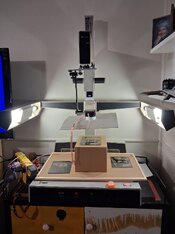
This is my rig. So awesome it sounds a alarm when you turn it on.

20260524_082258(1).jpg
 
This is a Beseler Dual Mode Slide Copier. It's basically a color diffusion enlarger upside down -- with some extras for slide/negative copying. It has a rather long bellows that is adjustable pretty high up. It's designed with a 75mm lens in mind, but many other focal lengths can be used. The 4x5 adapter (above) replaces the slide holder shown in this photo.

dualmode.jpg
 
Last edited:
You all might laugh, but I’m thinking of placing an order for a Klim K2….
Someone recommended it for phone scans.
It’s as basic as it comes. Basic is good.
The necessary app to reverse color and black and white negatives is free, and I already own the phone.
Any promising images, a pro-lab can print.
I often shoot phone, DSLR, and film in that order for images I consider meriting printing.
It won’t scan Manila RB67 negs or slides, but those I can always pay a contact sheet for them. Same with my good black and white images.
Thanks for posting this thread. I’m looking forward to others’ setups too.
 
You all might laugh, but I’m thinking of placing an order for a Klim K2….
Someone recommended it for phone scans.
It’s as basic as it comes. Basic is good.
The necessary app to reverse color and black and white negatives is free, and I already own the phone.
Any promising images, a pro-lab can print.
I often shoot phone, DSLR, and film in that order for images I consider meriting printing.
It won’t scan Manila RB67 negs or slides, but those I can always pay a contact sheet for them. Same with my good black and white images.
Thanks for posting this thread. I’m looking forward to others’ setups too.

Mamiya….
 
Welcome to Photrio!
I don't fit the camera directly to the column. I first attach a tripod head (I didn't knew that Durst had the actual adapter...) to the 3/8" screw and then I attach the camera to the head through the proper connector (wich my head uses an Arca Swiss 1/4" connector).

Thanks! I've lurked a lot (and I think had an account ages ago, but mainly lurked).

And thanks for the intel. I have a tripod lying around I can test it with I think.

One thing I'm curious about -- the knob on my F60 turns "to infinity" if that makes sense. It's always quite fragile... can easily hit it. Does your setup get around this at all?
 
Photrio.com contains affiliate links to products. We may receive a commission for purchases made through these links.
To read our full affiliate disclosure statement please click Here.

PHOTRIO PARTNERS EQUALLY FUNDING OUR COMMUNITY:


Ilford ADOX Freestyle Photographic Stearman Press Weldon Color Lab Blue Moon Camera & Machine
Top Bottom