
• Welcome to Photrio!
    Registration is fast and free. Join today to unlock search, see fewer ads, and access all forum features.
    Click here to sign up

Soaking to Remove Film Scratches?

Recent Classifieds

Forum statistics

Threads
204,295
Messages
2,866,801
Members
102,214
Latest member
AvGordon
Recent bookmarks
0

agentlossing

Member
Joined
May 11, 2023
Messages
79
Location
Seattle
Format
35mm
I seem to have a bad habit of scratching film emulsion when it's freshly developed and still wet. I suppose, lately, it's come down to a mix of using films with a thin emulsion (Kentmere Pan 200 and 400), and squeegeeing. I've learned my lesson with actual film squeegees and don't use them anymore (too risky in my opinion), but on my last developed roll, I used my (clean) fingers to squeegee the excess water off, and I still somehow put a scratch down the middle of my film, probably a bit of roughness on the side of one of my finger-joints.

I read somewhere that thin emulsion scratches can be remedied sometimes by soaking the film, so the emulsion can expand and fill the gap. Has anyone had actual success with doing this? The scratch is fairly faint but visible especially where there's significant contrast.

I hope at this point I have learned my lesson sufficiently to just leave the film alone, at least with these kinds of films.
 
No, sorry. The gelatin on film is hardened, which also means it tends to retake its original shape after soaking and drying again. It might be theoretically possible to fill in the scratches with a suitable compound (perhaps even gelatin), but I know of no common process by which this is done. Btw, you could consider fluid mounting your film for scanning or enlarging; this should reduce or eliminate most of the scratches. It's evidently only a temporary measure, and can be kind of messy.
 
Is it an emulsion scratch, or a scratch on the back (substrate) side?
 
Is it an emulsion scratch, or a scratch on the back (substrate) side?

Emulsion I am sure. Nothing happened to the film that would have been rough enough to scratch the base. I also think a more robust film (like HP5) would not have scratched in this case. Kentmere 200 is very thin.
 
I doubt there's a lot of difference in emulsion hardening between Kentmere 200 and HP5+. Same manufacturer, after all.
Also, the base scratches more easily than you think.

Either way, you can see which side the scratches are on, can't you? Hold the film at an angle to the light, inspect with a loupe.
 
Don't wipe the film with anything, just leave to dry over 24 hours. Also, this is why film manufacturers are not photographers: -

1779308564635.png
 
Last edited:
One can safely use very high grade squeegees, in a very carefully controlled workflow where relatively exceptional steps are taken to maintain scrupulous cleanliness and undamaged squeegeeing equipment.
Just ask anyone with experience with commercial lab equipment, like @foc .
But most of us are not that.
Also, the base scratches more easily than you think.

Yep!
And when you scan + invert or print the negative film, the scratch shows up in the resulting positive as a light/white line.
Whereas a scratch in the emulsion shows up as a dark line when you scan + invert or print the negative film.
 
Soaking would increase the risk of the emulsion lifting around the scratch. If the water is hot enough to make the gelatin flow, then you've got an even bigger problem.
 
Wet mount scanning may help minimize the appearance of the scratch in a scanning workflow.
But that certainly isn't the same as soaking it.
 
One can safely use very high grade squeegees, in a very carefully controlled workflow where relatively exceptional steps are taken to maintain scrupulous cleanliness and undamaged squeegeeing equipment.
Just ask anyone with experience with commercial lab equipment, like @foc .
But most of us are not that.


Yep!
And when you scan + invert or print the negative film, the scratch shows up in the resulting positive as a light/white line.
Whereas a scratch in the emulsion shows up as a dark line when you scan + invert or print the negative film.

Matt, can you explain what a high grade squeegee is? Anything touching a wet emulsion is a risk.
 
Wasn't there an Edwal scratch remover?

Yes, I still have some but never use it. It works on the order of "nose oil" AA talked about in one of his books. It fills in the scratch to make it blend in with the rest of the negative. The story AA talks about was watching an old printer fill scratches in by taking his finger and rubbing the side of his nose and then rubbing the oil into the scratch on the negative. If I remember AA did not approve of this method at all.
 
Matt, can you explain what a high grade squeegee is? Anything touching a wet emulsion is a risk.

Labs used them.
I expect they were high grade rubber, meticulously constructed and cared for.
Most roller transport processing machines incorporate them.
 
in a very carefully controlled workflow where relatively exceptional steps are taken to maintain scrupulous cleanliness and undamaged squeegeeing equipment.
Just ask anyone with experience with commercial lab equipment, like @foc .
But most of us are not that.
My poor apartment will never be that environment, no matter how well my wife keeps it clean (and keeps me in line with keeping it clean as well).

Yep!
And when you scan + invert or print the negative film, the scratch shows up in the resulting positive as a light/white line.
Whereas a scratch in the emulsion shows up as a dark line when you scan + invert or print the negative film.
Okay, good point that I was missing in my thinking. This line appears white, so it is probably a scratch in the back rather than the emulsion. Maybe it's the hardness level of the base that varies so much in different films and seems to be extra soft in the cheaper ones.
 
Matt, can you explain what a high grade squeegee is? Anything touching a wet emulsion is a risk.

I see Matt mentioned me above, regarding using a squeegee.

If used correctly, it will NOT scratch negatives. If you wish, I can let you know my procedure (for the last 40+ years), just ask.

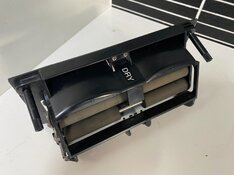
Commercial processing squeegees, in minilab equipment, usually look like this and they rotate with the movement of the film. I have never experienced a scratch caused by them.

film processor dryer squeegee.jpg
 
This is one of those topics that come up every year or so and the same actors debate about using squeegees on film. It's like the debates over using water for a stop bath or if Kodachrome will ever be revived...

As a still photographer, I never use them and have no need. When I worked at a lab that ran 35mm motion picture film at speeds up to 120 feet per minute, you HAD to use them to strip the solutions off in between tanks.

Could they scratch? Indeed! That's why we ran about 20 feet of new test film on the head of every start-up, to check for scratching and other problems. No actual job was run until the squeegee was either cleaned or replaced and then another test was run to confirm.

The fact is, you don't need them in still photography, but you can use them if you like and are very, very careful to inspect, clean and properly use them. Frankly, I don't know why you would, but that is up to you.
 
I used to use a little grease from my nose skin on small scratches on 4x5 film when enlarging. Doubt it would work well on smaller negatives.
 
Okay, good point that I was missing in my thinking. This line appears white, so it is probably a scratch in the back rather than the emulsion. Maybe it's the hardness level of the base that varies so much in different films and seems to be extra soft in the cheaper ones.

There are two main types of substrate - acetate based, and polyester (e.g. Estar) based.
They also come in different thicknesses.
And of course, they range in how old they might be, and how they have been stored and handled.
50+ year old acetate will be a lot different than 5 year old acetate - life happens.
 
I seem to have a bad habit of scratching film emulsion when it's freshly developed and still wet. I suppose, lately, it's come down to a mix of using films with a thin emulsion (Kentmere Pan 200 and 400), and squeegeeing. I've learned my lesson with actual film squeegees and don't use them anymore (too risky in my opinion), but on my last developed roll, I used my (clean) fingers to squeegee the excess water off, and I still somehow put a scratch down the middle of my film, probably a bit of roughness on the side of one of my finger-joints.

I read somewhere that thin emulsion scratches can be remedied sometimes by soaking the film, so the emulsion can expand and fill the gap. Has anyone had actual success with doing this? The scratch is fairly faint but visible especially where there's significant contrast.

I hope at this point I have learned my lesson sufficiently to just leave the film alone, at least with these kinds of films.

Just hang the film up. Don't touch it!
 
This line appears white, so it is probably a scratch in the back rather than the emulsion. Maybe it's the hardness level of the base that varies so much in different films and seems to be extra soft in the cheaper ones.
A white scratch can still be on the emulsion side. Only scratches that go all the way through the emulsion can appear dark (possibly with white edges). But a superficial scratch in just the supercoat layer will show up white as well.
As to the hardness difference - no, not really. The base just scratches easily. I guess people just don't realize it, but it's always been the case.

Back in the day of very large analog print labs, the initial prints from a freshly processed roll of film were sometimes printed with more collimated light (giving better sharpness), whereas future print jobs (e.g. enlargements) ordered by the customer from film returned to the lab for the purpose would be printed with a more diffuse light source. The reason is that the film was assumed to be scratched in the interim by handling.

Also, it used to be very common, even entirely normal, to receive lab-processed film back with very, very thin hairline scratches running the length of the film as a result of tiny abrasions, debris etc. in minilabs or infinite loop processors.

If you can get a clean process without touching the wet film, then this is preferable. In my case, I find that nigh impossible, so I generally wipe the backside of 135 film with a soft tissue to remove droplets of water to avoid drying marks. The emulsion side isn't touched. The exception is remjet-backed cine film which I do touch on both sides, but this is indeed a liability.
 
The excess water can be effectively removed using either a fresh clean sheet of kitchen towel or a scrupulously clean, fresh microfibre cloth
 
Photrio.com contains affiliate links to products. We may receive a commission for purchases made through these links.
To read our full affiliate disclosure statement please click Here.

PHOTRIO PARTNERS EQUALLY FUNDING OUR COMMUNITY:


Ilford ADOX Freestyle Photographic Stearman Press Weldon Color Lab Blue Moon Camera & Machine
Top Bottom