• Welcome to Photrio!
    Registration is fast and free. Join today to unlock search, see fewer ads, and access all forum features.
    Click here to sign up

Eugene Atget Appreciation

Recent Classifieds

Forum statistics

Threads
204,282
Messages
2,866,596
Members
102,207
Latest member
gustavocf
Recent bookmarks
0
Certainly. But the discussion here is always whether there was a third intent, an artistic pretension. Or whether he was ‘only’ a craftsman doing his self-appointed task tastefully. And in the latter case, is art then an emergent quality?

Art isn't as mystical as that implies, anyway. Art is the norm, not the exception. That doesn't mean it's always good. Art and craft are hand-in-hand - along with technique and style. You can think of it like this: tapestry weaving is a craft - a skilled application of a practice - but it may result in something that is considered art. It never stops being a craft to become art. And the maker never stops being a craftsperson to become an artist. The craftsperson may never be aware they are making something that will be considered art. They don't need to be.
 
1775166134406.png
 
I've seen enough original Atget prints to know that they don't look anything like snappy "f/64" "fine art" prints at all.
Almost looked antiquated even in their own time; understated contrast. The point is, that's the look he wanted and knew how to do. It worked for him; but it might not work at all for a wannabee. There were a number of Atget wannabees in the 70's - more pretentious than convincing. An exception was the architectural photographer Philip Trager; he successfully rekindled some of the same vibe.
 
Art isn't as mystical as that implies, anyway. Art is the norm, not the exception. That doesn't mean it's always good. Art and craft are hand-in-hand - along with technique and style. ...
Excellent...thank you. This why I consider calling oneself an artist should be the norm. It is not the big deal many think it is.
 
As I understand it from Hambourg's biographical glimpses of Atget's life, he was very disturbed by the way Napoleon III had modernized much of Paris at the expense of the traditional narrow cobblestone street corners, etc, so went out his way to document those specifically, along with the rundown parks. Just like many of us, he was trying to visually preserve what was left of the former architectural culture before it outright disappeared. Winding narrow street were part of that. And his compositions didn't just use geometric disappearing horizons, but atmospheric effects too. Apparently Paris either had thick air, or he timed his shots to look that way, much like the older blue sensitive plate photographers. I never tire of viewing his work.
 
That was what I appreciated about Tokyo -- narrow streets (rarely two vehicles wide) and distinct neighborhoods.

Paris -- at Atget's time there was most likely a lot of classic smog (fog mixed with coal smoke). Being acidic the smog would make the buildings dirty and etch all the limestone. He would have seen the beginning of electricity used for cooking and heating, but natural gas was much later.

Back in 1975 while at uni outside Christchurch, NZ, I helped with a lichen survey in the city (a high-sulfur type of local coal was commonly used for heating and cooking). Some species of lichen are more sensitive to Sulfur dioxide created by the formation of smog. So which species were in relative abundance was an indicator of the amount of smog in that area of the city.
 
Last edited:
I think the intersections were called "coins" (corner, nook, angle) in French. He liked to take his vantage point there both for sake of diminishing point perspective in the distance, and with respect to the coverage of his standard wide angle lens (which often exhibited corner falloff at the top in that setting).

He was also obsessed with the old hand-wrought architecture in those neighborhoods - railings, and especially door knockers. I have one entire Atget book mainly filled with such details. Again, a preservationist mentality. But the book editors have obviously selected what they considered his most interesting examples, often with a surrealistic tinge to them.

Another repetitive feature was a sort of social commentary. Brothels were outlawed from advertising their services, and could only identify themselves with the street number of the location, so they resorted to painting those number especially large, and that is often seen in his street corner views. What percent of that represented of his actual photo inventory is hard to say, versus what the editors themselves selectively homed in on.
 
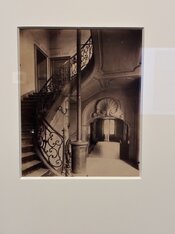
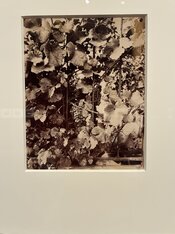
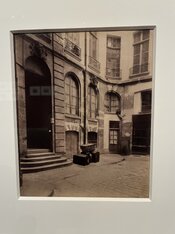
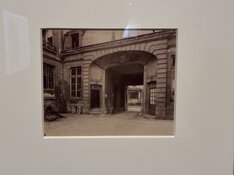
The Atget exhibition at ICP is well worth seeing, which I did a couple of weeks ago. It runs until May 4th. All the prints are by him, from the ICP’s collection, and there are some really great ones. Sadly there is no catalogue for the show; when I asked, they pointed to the Taschen book.
 
The Atget exhibition at ICP is well worth seeing, which I did a couple of weeks ago.
I would love to see it, but from my location in SW Missouri, it would require a significant investment in time to get there and back.

About how many of Atget's photos were on display? Could you get close enough to the prints to get a good long look? Was the exhibition crowded when you were there?
 
About how many of Atget's photos were on display? Could you get close enough to the prints to get a good long look? Was the exhibition crowded when you were there?

I’m not sure about the total number, maybe 50-60…. Yes, you could really get close up views. As has been discussed, he printed small, contact prints I would assume. I was really focused on the prints and didn’t read the wall texts, which had a theme about Atget’s reception.
Excuse my poor cell phone snaps.
 

Attachments

  • IMG_6948.jpeg
    IMG_6948.jpeg
    246 KB · Views: 50
  • IMG_6944.jpeg
    IMG_6944.jpeg
    313.6 KB · Views: 51
  • IMG_6942.jpeg
    IMG_6942.jpeg
    275.9 KB · Views: 50
  • IMG_6945.jpeg
    IMG_6945.jpeg
    258.4 KB · Views: 51
Atget's association with Paris is so strong, it's hard to imagine Atget without Paris.

Ignoring for the moment that Atget's business model was marketing to a community of artists that was probably larger in Paris than many other cities, I am trying to imagine what Atget's photos would look like if he had worked in London, New York, or Vienna?

In other words, how much of Atget's photography is Atget, and how much of it is Paris? Would we still be talking about him today if he had worked anywhere else?
EDIT: Re reading that, it sounds like I am trying to take something away from Atget, but that is not my intent, at all. I really admire Atget's work. Rather, I was trying to explore the relative balance between the weight of the subject and what the photographer does with the subject -- such as, framing, composition, lighting, exposure, selective focus, etc.
 
Last edited:
I’m not sure about the total number, maybe 50-60…. Yes, you could really get close up views. As has been discussed, he printed small, contact prints I would assume. I was really focused on the prints and didn’t read the wall texts, which had a theme about Atget’s reception.
Excuse my poor cell phone snaps.

This picture I took a few years ago in NYC was made to look like an old-time shot by adding the toning and vignetting, much like your first one. Of course, the building itself is probably one hundred years old, so you do have to start with an antique environment. The second one I think I added selenium toning. Both done in Lightroom.

 
Greater context : Atget had to have an income. He was basically a stock photographer who had perhaps thousands of images of wrought iron ornamentation and door hardware on hand to sell as inspiration or technique models to blacksmiths, iron worker, and related craftsmen. A few of these have been selected out for modern publication. What his financial objective was with models of women was, one can speculate (probably painters).

But he also clearly had a cultural objective, trying to preserve what he thought of as authentic Parisian architecture culture prior to its massive mid-19th C renovations. He did a lot of "street photography" of quaint people and occupations in this respect too.

Then there was the third element we photographers so appreciate - those remarkable photos he essentially took for himself.
 
Last edited:
Yeah, I just added that, right before you posted. It would be interesting if any copy exists of how he advertised or marketing his many images, or if he was just coasting on reputation at a certain point.
 
Possibly painters and illustrators would buy Atget's nude photos for reference when creating their own work, rather than paying for live models?

And many painters might not wish to paint en plein air out in the smog and amongst the footpads wandering those alleys. It appears that the history of painting from photographs started hand-in-hand with photography...or perhaps the camera obscura, actually, as a drawing aid.

I do not suppose Atget would have had a lot of competition for sales from other photgraphers once estaiblished. Some research into photographers in similar roles in London, NY, and other major cities would be interesting for comparison.
 
Greater context : Atget had to have an income. He was basically a stock photographer who had perhaps thousands of images of wrought iron ornamentation and door hardware on hand to sell as inspiration or technique models to blacksmiths, iron worker, and related craftsmen. A few of these have been selected out for modern publication. What his financial objective was with models of women was, one can speculate (probably painters).

But he also clearly had a cultural objective, trying to preserve what he thought of as authentic Parisian architecture culture prior to its massive mid-19th C renovations. He did a lot of "street photography" of quaint people and occupations in this respect too.

Then there was the third element we photographers so appreciate - those remarkable photos he essentially took for himself.

I accept all you say in that post, except I have to question the last bit. Do we actually know that he took any photos for himself, or is it an assumption about certain photos that seem to us less saleable as artists’ copy? Or do we assume this about all the late photos, made after he had off-loaded the bulk of his record of Old Paris, and was therefore comfortably off, relatively speaking?
 
As per that question, it is undeniable that Atget later in life had personal interactions with notable Surrealist painters, and that they even published a few of his photos in their own magazine, and found inspiration in his work in general. In other words, he had at least some serious artistic recognition in his own time, and not only due to his "rediscovery" by Berenice Abbot long afterwards. I think it would be utterly impossible for Atget not to have realized something of his own exceptional genius at all this. Lots of photographers have drifted from one realm into the other, the commercial side into the personal as opportunity arose, especially if they answered only to themselves like Atget.

At a certain point later in life, it seems he gravitate more and more towards that apex of personal vision with respect to the classic sculpture and ruins of the Regal French past. He might have had enough income stashed away by that time to coast awhile. But there was also the fact that some of those classic parks were getting run down an in danger of ruination; so he wanted a historical record - but wholly in his own style! Nobody composes like that without some sense of their individuality. So many of his shots later in life are so exceptional that no way can that be attributed to statistical luck.

The early assessment of him being some kind of eccentric anchorite based on a few portraits of himself in old age looking very sad and lonely was a misinterpretation. He had recently lost his wife. But all that kind of thing can be read about in later, better-informed biographies.
 
I believe a good chunk of Atgets earnings came from the French government who wanted a lot of things documented.
 
A good read? I still like Hambourg's 4-Volume MMA set. Superbly printed. I don't know what used bookstores might sell these for. Vol I has the most autobiographical information. Vol 4 has the most iconic images.
 
I still like Hambourg's 4-Volume MMA set. Superbly printed. I don't know what used bookstores might sell these for.
In the USA, I saw several copies ranging from $250USD to over $1100USD for the four volume set. The $1100 set was a bit of an outlier, a first edition signed by John Szarkowski. There were a couple of 4-book sets for $425-450.

I bought the least expensive set I saw today for $250.
 
Photrio.com contains affiliate links to products. We may receive a commission for purchases made through these links.
To read our full affiliate disclosure statement please click Here.

PHOTRIO PARTNERS EQUALLY FUNDING OUR COMMUNITY:


Ilford ADOX Freestyle Photographic Stearman Press Weldon Color Lab Blue Moon Camera & Machine
Top Bottom