• Welcome to Photrio!
    Registration is fast and free. Join today to unlock search, see fewer ads, and access all forum features.
    Click here to sign up

Color Film Problem

The Hot Waters

A
The Hot Waters

  • 0
  • 0
  • 3
Dump Truck Hat Trick

D
Dump Truck Hat Trick

  • 1
  • 0
  • 68

Recent Classifieds

Forum statistics

Threads
204,313
Messages
2,866,998
Members
102,220
Latest member
iDavidoff
Recent bookmarks
0

Citsmith

Subscriber
Joined
Dec 31, 2022
Messages
60
Location
Michigan
Format
Med. Format Pan
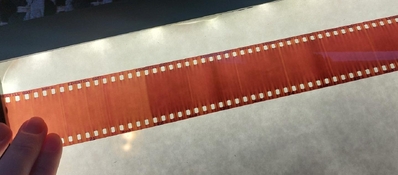
My daughter took this roll of cinestill film. I have never seen a failure quite like this. The shutter seems to be working without the film. ``
 
There don’t seem to be any images just the vertical lines. Any ideas?
Thanks
 

Attachments

  • Neg Problem.jpeg
    Neg Problem.jpeg
    96.9 KB · Views: 169
The film was rewound backwards, causing stress marks.
Why the film is blank if the shutter is working? More info needed.
Was she using flash, and the camera was on M sync?
 
There don’t seem to be any images just the vertical lines. Any ideas?
Thanks

That's very strange. I've not seen that before. You might ask Cinestill. If the shutter was opening and aperture was wide open in daylight you should have an image. Could be due to a processing problem.
It's quite strange???
 
Those two dark vertical bands and what appears to be considerable fog remind me of x-ray contamination — and 800T is more than high enough to record this over a couple of passes. Have you travelled with the camera loaded recently? Light piping — bright ambient light entering the cassette felt-trap, doesn't really fit with what is visible in the pic, but more of a "could be". The other thing... shutter capping — incomplete or erratic (or no) travel of the shutter. Load another roll of film in the camera and shoot randomly; have it processed to rule out x-rays as a culprit. You then know it will be either the camera or processing.
 
The film was rewound backwards, causing stress marks.

Well spotted! The stress marks around the sprocket holes are a giveaway.

Why the film is blank if the shutter is working? More info needed.
Well, the film isn't entirely blank - it has density on it alright. Although the 'frames' are of an odd dimension and seem to extend to the edge of the film, which is strange.

The shutter seems to be working without the film.

What kind of camera was this?
 
In 60+ years of owning all sorts of cameras, teaching and shooting, I never thought that one could rewind the film backwards. I would assume it would happen when the film was advanced tight so the film was only attached to the spool with the tape. In that state it would/could go either way.
Thanks to all.
 
I've never experienced a backward rewind either. I suppose it must be something that requires a lot of force and strain.
 
I suppose it must be something that requires a lot of force and strain.

It does, which explains the particular pattern. It literally strains the emulsion, causing mechanical 'exposure' of the silver halides.

In 60+ years of owning all sorts of cameras, teaching and shooting, I never thought that one could rewind the film backwards.

No, it's quite rare indeed. It's virtually impossible with modern cameras with motorized film transport, but with older cameras it's technically possible.
 
I think there are several problems, not just one.

- camera. We have a double density of the entire frame, including the perforation. At the same time, where the image should be, there is practically nothing meaningful.
Judging by the marking, the film should have enough density to see a clear and distinct image.
- processing. We may have some gigantic form of stress marks. Or maybe it's okay - we observe a form of light leakage. But it's probably both...
 
In 60+ years of owning all sorts of cameras, teaching and shooting, I never thought that one could rewind the film backwards

If you had worked selling cameras in the 1970s and 1980s, you would probably have seen it slightly more often :smile:
At that time (and to a great extent a bit earlier) people were moving from roll film cameras like the Brownie Hawkeye to "simple" 35mm cameras like the Konica 35, and many of them had no end of difficulty with the rewind part of the procedure.
If the film transport in a 35mm camera permitted any meaningful loss of tension on the feed side, people would do very strange things with it - particularly people who were convinced that if the box said 20 or 36 exposures, then they should stop taking pictures after 20 or 36.
If you worked in retail, you had at least some experience with people who would stop after exposing a roll of film in a 35mm camera and then bring it into the store so the staff was available to rewind that film and then load the next for them. Just like the original Kodak cameras, although not 100 exposures!
In current times, people sometimes ask why 126 and 110 film came into being. The answer comes from the problems some people had with snapshot 35mm cameras.
 
No, it's quite rare indeed. It's virtually impossible with modern cameras with motorized film transport, but with older cameras it's technically possible.

The only time in my life that I did get stress marks was with a camera that had motorised film transport. I'm pretty sure that with manual wind cameras I try to squeeze that one last frame out of the roll much harder than any motor fitted into a camera possibly could, so it was quite surprised. Probably has something to do with the type of film used. Mine was Fomapan 200.
 
Photrio.com contains affiliate links to products. We may receive a commission for purchases made through these links.
To read our full affiliate disclosure statement please click Here.

PHOTRIO PARTNERS EQUALLY FUNDING OUR COMMUNITY:



Ilford ADOX Freestyle Photographic Stearman Press Weldon Color Lab Blue Moon Camera & Machine
Top Bottom