

• Welcome to Photrio!
    Registration is fast and free. Join today to unlock search, see fewer ads, and access all forum features.
    Click here to sign up

Uh oh... I’m in trouble.

Dump Truck Hat Trick

D
Dump Truck Hat Trick

  • 0
  • 0
  • 3
Street-Lamp

A
Street-Lamp

  • 2
  • 2
  • 66

Recent Classifieds

Forum statistics

Threads
204,297
Messages
2,866,845
Members
102,218
Latest member
333Ford
Recent bookmarks
0
Joined
Aug 9, 2011
Messages
3,605
Location
On a boat.
Format
Multi Format
This was WAY to easy. And WAY too much fun. I can see this becoming a very active creative hobby. I think I almost like it better than traditional printing...I won’t make that decision yet though.

3.5 minutes under the natural sun.
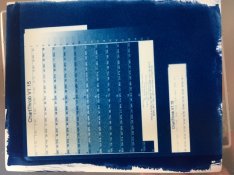
FC021190-9303-48AD-990B-581599DC50C0.jpeg
 
This does look like a good time. :smile:

The perceived simplicity of it seems like it’s going to be a big winner in my book! That perception may change once I put an actual negative down but I am so So SO looking forward to the challenge.
 
Welcome to Wonderland!

Now that you have gone down the rabbit hole, just wait until the experiments begin... there is the whole world of toning cyanotypes and then there are "surfaces" to consider... many, many papers and even other surfaces to adorn with cyanotypes!

Have fun!
 
The perceived simplicity of it seems like it’s going to be a big winner in my book! That perception may change once I put an actual negative down but I am so So SO looking forward to the challenge.

The basics are simple... mastery is another matter, but that is all part of the fun.
 
Good start. For me, the first print with a real negative only increased my interest. Printing under the sun has lots of variables, though, that I found a bit frustrating. This table is worth thinking about. I’ve seen others that also include corrections for latitude. And then there is the effect of heat...

4EECE4DA-6BF4-4DC6-AB41-0405ADB327B6.jpeg
 
This was WAY to easy. And WAY too much fun. I can see this becoming a very active creative hobby. I think I almost like it better than traditional printing...I won’t make that decision yet though.

3.5 minutes under the natural sun.

View attachment 245411

But... what ya gonna do there's less sunlight in the winter months.. or.. when there's 12 inches of snow on the back lawn and ambient temperature in 'around' -20 to -30 degrees C. which is so 'common' in my 'neck of the woods' ? Methinks I'd be better to 'doing it' in my basement darkroom
where I 'know my 'tootsies, fingers and nose' with not start showing signs of severe frost-bight.

Ken
a.k.a. the "G.O.F.
 
We wear shorts and flip flops in the winter here.

However I’m only using the sun until I get my UV light box built.
 
Good start. For me, the first print with a real negative only increased my interest. Printing under the sun has lots of variables, though, that I found a bit frustrating. This table is worth thinking about. I’ve seen others that also include corrections for latitude. And then there is the effect of heat...

View attachment 245418

I think you posted the Australian version of that chart by mistake. :blink: Hopefully, those of us in North America can simple invert the values...
 
upload_2020-5-5_16-15-12.png

:D
 
Super awesome!!

Welcome to the world of alternative printing!
 
But... what ya gonna do there's less sunlight in the winter months.. or.. when there's 12 inches of snow on the back lawn and ambient temperature in 'around' -20 to -30 degrees C. which is so 'common' in my 'neck of the woods' ? Methinks I'd be better to 'doing it' in my basement darkroom
where I 'know my 'tootsies, fingers and nose' with not start showing signs of severe frost-bight.

Ken
a.k.a. the "G.O.F.
Ian Leake sells a good device for measuring units of light , which would be tailor made for sun exposures.
 
This was WAY to easy. And WAY too much fun. I can see this becoming a very active creative hobby. I think I almost like it better than traditional printing...I won’t make that decision yet though.

3.5 minutes under the natural sun.

View attachment 245411

Since I started alt printing back in '07, I can count on one hand the number of gel sil prints I've made (not including all the prints I make with my students!). Carbon transfer, kallitypes, cyanotypes, tri-colour gums, and gumoils keep me busy.
 
Carbon transfer, kallitypes, cyanotypes, tri-colour gums, and gumoils keep me busy.
That's great!
One of the processes I've tried has been Ferric Gum
It's the best, I'd say, sonjunction between syderotypes and gum prints. It works as a positive-positive, and seems to be quite promising.

Due to the lack of chemical suppliers I'm a little slow on discovering new processes, but I'd love to try.

I also found that the mixture of a colloid + an oxidizing agent has at least some degree of photosensitivity.
 
The nuclear fusion UV light source in the sky is great. It's free. I would get a split back contact printing frame. During your exposure, you could open one half of the back to check on the exposure. If it needs more baking, close the back and expose longer.
 
Wow. And now I want to know if ferric gum can be done with multiple layers to yield a color image. My first thought is, it can't, because of problems clearing the ferric/ferrous chloride -- but perhaps one could do transfers in multiple layers, like carbon printing...
 
It can... the author says it's possible. The problem is the one you've said: The iron stain.
EDTA of some sort was used to remove it.

In my case, I've only made single layer prints but without any trouble of stains. The Ferric Chloride - Oxalic Acid complex is very soluble in water. I don't remember if that's what the author used... but whatever...
 
The article I found and read via Google only talked about ferric chloride, no mention of any other ingredients. Do you have links to the oxalic acid version?

This is of interest to me, in part, because no chromates; also, because the pigment density in the gum need not be limited by having to expose through the pigment.
 
Do you have links to the oxalic acid version?
I quote from http://www.alternativephotography.com/update-ferric-gum-process/
"Peter (...) added ferric ammonium oxalate to the sensitiser to make it faster."

Now, this is not the way I would do it.
I haven't seen it posted anywhere, so I'll describe it to you:

When I bought the Ferric chloride it came on a stock solution of around 48%. I found that diluting it caused the gum to not harden properly. Note that you have to use gum arabic (you probably have some). So, normally I would take around 15ml or around 1 tablespoon of the ferric chloride stock solution, and saturate it with oxalic acid crystals. The ferric chloride forms a complex with the acid, which is much more sensitive to light, without changing the concentration. I'm not giving exact measures here... the trick is to saturate it with oxalic acid.
Please note that exposure to oxalic acid in (very) high concentrations can be toxic. Beets and spinach contain it and a diet high on them can lead to kidney stones. I use gloves for handling this stuff, even if it's no bichromate. (I don't want to alarm... it's just normal disclaimer. But this is much better than bichromate)
The normal exposure time that I have on full sun is 15 minutes. You may have to see and try yours.
 
Thanks, @Máx Arnold , that's useful. I don't have gum arabic or the other chemicals on hand at present, but they aren't hard to come by. Good, large, separation positives may be the real bottleneck here...
 
The nuclear fusion UV light source in the sky is great. It's free. I would get a split back contact printing frame. During your exposure, you could open one half of the back to check on the exposure. If it needs more baking, close the back and expose longer.
The sun is a great light source for learning the principles. But it is very variable in intensity due to things like geographic location and weather and seasonal variation. That makes repeatability hell. You'll very quickly want to get a dedicated light source that you can use in all weathers at all times of day.
 
Photrio.com contains affiliate links to products. We may receive a commission for purchases made through these links.
To read our full affiliate disclosure statement please click Here.

PHOTRIO PARTNERS EQUALLY FUNDING OUR COMMUNITY:


Ilford ADOX Freestyle Photographic Stearman Press Weldon Color Lab Blue Moon Camera & Machine
Top Bottom
