• Welcome to Photrio!
    Registration is fast and free. Join today to unlock search, see fewer ads, and access all forum features.
    Click here to sign up

Best UV Light Source (LED vs Fluro vs HID etc)

Recent Classifieds

Forum statistics

Threads
204,281
Messages
2,866,562
Members
102,207
Latest member
gustavocf
Recent bookmarks
0

jamespierce

Member
Joined
May 22, 2007
Messages
75
Location
Australia
Format
8x10 Format
Making the leap into alternative process and I need to add a UV light setup to my darkroom... Obviously I could get a bunch of UV Fluorescent tubes and build something, but I'm wondering if I a UV LED panel, or something else is simpler.

eg.

http://www.ebay.com.au/itm/Chauvet-...e_Lighting_Effects&hash=item1e8d5d8959&_uhb=1

or perhaps something like this...

http://www.ebay.com.au/itm/Blacklig...e_Lighting_Effects&hash=item3390e30a90&_uhb=1

Also something I've been wondering about, doesn't glass block most UV, so doesn't a contact printer mostly defeat the purpose of the UV exposure ! ?
 
I use a 250w metal halide lamp of the type supplied for commercial greenhouses.
The whole setup; choke, cables, reflector etc cost me £50

Simon
 
Depends on how much realestate you are willing to give up. There are an umber of commercially available and expensive choices. The best "one size fits all" choice is the sun which is free. Some use a Nuare 26-1k or similar plate burner which should be pretty cheap. Other use a suntanning light used by some to tan their faace and place it in some sort of box or enclosure. I've built an excellent unit from plans obtained from an Apug member. It cost about $400 to build and is 28" square. PM me if you would like the plans. Bill Barber
 
I bought some florescent black lights for cyanotype and it didn't work well. when I developed the exposed print in water, all the emulsion floated off. I swapped out my black light tubes for actinic UV tubes made for aquariums and they work great for cyanotype, salt print and Ziatypes. The florescent tubes get very warm in the summer.
http://www.kensfish.com/aquarium-supplies/aquarium-lighting/coralife-actinic-t-5-bulb.html

I also built another light box with LEDs from China that also works very well that had a wavelength of 380-385nm. You can build one if you a DIYer. You have to mount them on an aluminum plate to draw the heat from them or else they'll cook.

http://www.ebay.com/itm/3W-Ultra-Vi...936?pt=LH_DefaultDomain_0&hash=item5663f06f28


But take a look at this article

http://unblinkingeye.com/Articles/Light/light.html
 
I have one box i built which contains 12 -24"fluorescent tubes, and another which houses a 1000 watt HID lamp.
The fluorescent box works best when I want to increase contrast in the print while the HID lamp is superb when the negative has appropriate range for the print. The HID is extremely fast.
 
Florescent tubes are not as fast

I have one box i built which contains 12 -24"fluorescent tubes, and another which houses a 1000 watt HID lamp.
The fluorescent box works best when I want to increase contrast in the print while the HID lamp is superb when the negative has appropriate range for the print. The HID is extremely fast.

Both my florescent and LED lightbox are slow. Takes 1/2 hr per print.

But plate burners are a good alternative also. I think with the age of digital printing presses and print shops don't burn printing plate anymore, this might be had for a song.

http://www.ebay.com/itm/NuArc-N1000...535?pt=LH_DefaultDomain_0&hash=item3390af1987
 
I have a Nuarc that I'd love to get out of the house.
 
I'm 3000 miles from you down near Pageland SC, where Jerry Springer gets his guests. :laugh: It's a 26-1K, just what you're looking for. Scout around print shops. Probably a lot of 'em will be glad to see theirs out the door. Beware--the bulbs are expensive, and after-market bulbs are total garbage that won't last 10 minutes.
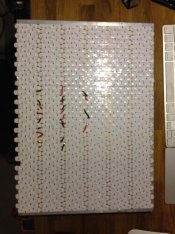
 
I'm going to try a relatively cheap eBay experiment with 395nm UV LED strips... Will total 180w for 11x14 of area - I would like to think that will give fairly quick exposures but lets see. I'll make the whole top of the printer a large heat sink. The cost for all the LED strips is about the same as two good UV tubes here in Australia - and that doesn't factor in mounting, starters and so-on. I'll update here once I've got it all together.
 
For the interested I assembled 1/3 of the lamp and did a couple of quick tests. Without glass it can fully blacken a platinum/palladium test strip in about 15 seconds. A quick 4x5 contact print looks good but a little light at 1m15s - I'm expecting working exposures in the 1m45s to 2m30s range once it's all together. The exposure is extremely even too. I've just finished soldering together the second and third panel and will make a box to mount them in in the next few weeks - then I can test the full size with 8x10 negs.

Here's a quick photo of the LED array.

IMG_4074.jpg
 
It's 720 5050 UV SMD LEDs (actually 2160, but they are mounted three into one surface mount enclosure) - Total current draw is around 15A @ 12V to power the array - So compared to a bank of UV fluros it seems like it should be much more efficient.
 
A construction update

And it's finished and into testing. The imaging area is ~280x400mm - The box was designed for printing 8x10s and just fits an 8x10 contract printing frame because that's what I shoot. Because I wasn't sure how long the exposures would be I built it with a fan setup for both the power supply and also the heat sink that the LEDs are mounted on - in retrospect this may have been overkill. Printing times are in the 3-5min range and the heatsink doesn't seem to get warm to touch at all after that length of time. Probably with very dense negatives I'll need to go much longer and this will pay off. I made an 8x10 test print last night and the exposure looks extremely uniform across the whole printing area with ~75mm between the LEDs and the surface of the paper.

Now I just need to conquer the ins and outs of managing humidity and making great prints - I'm currently following this process (http://www.mikeware.co.uk/mikeware/Platino-Palladiotype.html) because the chemicals etc are available here in Australia but would welcome advice and sources for the cheapest supplies of particularly the platinum and palladium power / solutions.

Total cost approx ~ $150USD. LEDs $60, Power-supply $20, Heat-sinks $40, Timber switches, and so-on $50. Total construction time around 8 hours.

IMG_0454.jpg
Before wiring and a putting on the lid.

IMG_5749.jpg
In place in the darkroom, the total foot print is 450mm x 400mm x 135mm

IMG_7360.jpg
My first test print out of the unit barely into the clearing bath, 5min total exposure - just a touch over
 
Hi James,

Just building one of these myself but whilst researching I found some 500W UV LEDs - how's the project going and did you come across these big LEDs too? Thoughts?
 
Hi James,

Just building one of these myself but whilst researching I found some 500W UV LEDs - how's the project going and did you come across these big LEDs too? Thoughts?

If you are referring to those cheap full spectrum grow lights then only a small amount of diodes are UV so much less wattage.

Actual 500W UV LED arrays are used for commercial UV curing applications and will set you back a lot of $$$$.
 
If you are referring to those cheap full spectrum grow lights then only a small amount of diodes are UV so much less wattage.

Actual 500W UV LED arrays are used for commercial UV curing applications and will set you back a lot of $$$$.

I just got saw a price of $250 dollars for a unit on alibaba - talking with the supplier now about specs..

Tim
 
Yes, the question is how much of the 500W is gong to end up as UV vs visible light ? My array ended up being around 200 watts and works well... For an 11x14 print area it gives me 6min exposures for the Na2 Pt/Pd process. One big advantage of using the LED strips is you can make it as big or small as required - If I had my time again I'd build a bigger box, but that's because I've moved house and have a bigger darkroom now.
 
Photrio.com contains affiliate links to products. We may receive a commission for purchases made through these links.
To read our full affiliate disclosure statement please click Here.

PHOTRIO PARTNERS EQUALLY FUNDING OUR COMMUNITY:


Ilford ADOX Freestyle Photographic Stearman Press Weldon Color Lab Blue Moon Camera & Machine
Top Bottom