• Welcome to Photrio!
    Registration is fast and free. Join today to unlock search, see fewer ads, and access all forum features.
    Click here to sign up

Zone system with 35mm

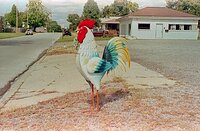
The Chicken

A
The Chicken

  • 3
  • 4
  • 80
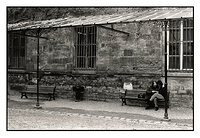
Amour - Paris

A
Amour - Paris

  • 1
  • 0
  • 83

Recent Classifieds

Forum statistics

Threads
203,241
Messages
2,851,917
Members
101,743
Latest member
Pablino
Recent bookmarks
0

alanrockwood

Member
Allowing Ads
Joined
Oct 11, 2006
Messages
2,193
Format
Multi Format
Here is an idea for using the zone system with 35mm... rather obvious really, but I wonder how commonly used this scheme is.

First, the problem: it is well-known that the zone system does not work well with 35mm because the zone system is designed for customized development of each negative, which you can't do with roll film, or can you...?

What about simply using multiple camera bodies, all loaded with the same type of film. If using three bodies, one would be reserved for normal exposure (N), one would be reserved for N+, and one would be reserved for N-. With more bodies you could add N--, N++, etc. Each roll would then be given the appropriate degree of development.

With film camera bodies so cheap these days on the used market this could be done without too much cost, and if one were to use small and light film bodies (such as you find in a number of entry level SLR cameras, such as the Canon Rebel series) then it would not be too difficult to pack all the gear.

Wha'da'ya think?
 
Sounds...plausible. It might get cumbersome with that many cameras, but I suppose you could get some small consumer SLRs, as you said. Still, lugging around that many bodies soley for the purpose of the zone system seems less than ideal. I talked to someone who was required to shoot zone system on 35mm for a class. It involves a lot of mid roll rewinding and is a complete pain, as you just designate a roll N, N+, etc, and switch out rolls as the scene desires.
 
I used to do something like that; I'd have a body set at 200 for normal development and a body set at 400 for gloomy days, which I would develop more. Then I moved out of OH and my gloomy day camera got repurposed.
 
No great revelation. This is the obvious approach to the Zone System using 35mm film...if it is feasible in one's situation. 35mm bodies are dirt cheap. The real issue, I would say, is that it if you are going to use something like the Zone System, why bother with 35mm at all? A medium format camera with a stash of exchangeable magazines would seem to provide a superior alternative in almost every way.
 
No great revelation. This is the obvious approach to the Zone System using 35mm film...if it is feasible in one's situation. 35mm bodies are dirt cheap. The real issue, I would say, is that it if you are going to use something like the Zone System, why bother with 35mm at all? A medium format camera with a stash of exchangeable magazines would seem to provide a superior alternative in almost every way.

I'd have to agree...although I have been known to carry two Olympus XAs for this reason :wink:

The principles of the Zone System, though, are very useful. Placing the shadows properly is still important to making a good negative....and understanding what will happen to the highlights. If you print on VC paper, usually you can deal with the highlights with the paper.
 
Wirelessly posted (BBBold: BlackBerry9000/4.6.0.297 Profile/MIDP-2.0 Configuration/CLDC-1.1 VendorID/102 UP.Link/6.3.0.0.0)

I 35MM photography, I use the zone system religiously for exposure. Can't do much on processing. And then use it again on printing. Granted, it's Zone Light, but it is more than enough to get the job done. It's all a matter of knowing the limitations of you gear and working within those limitations.
 
Here is an idea for using the zone system with 35mm... rather obvious really, but I wonder how commonly used this Wha'da'ya think?
*****
Sure, it's doable. I did, essentially, something similar years ago, with short lengths of 35 mm film. I found, however, that (for me) it was not worth the effort.

What I did was accept the fact that the exposures on a roll of 35 mm film were going to be a checkerboard.

So, I make sure the rolls gets enough exposure accross the board: usually just adopting as an Exposure Index that produces a Zone I from a grey card: then souping my film in a film developer which minimizes the blocking up of the high lights: in my case, D23 does it for me 99 and 44/100ths percent of the time.

Needed corrections then take place with choice of paper grade and local controls in printing. Simplify, Simplify.
 
If you want interchangeable backs plus 35mm then why not shoot 35mm on a med. format system e.g. a mamiya m645 with 35mm back.

Otherwise, you might just use an ordinary 35mm camera and clip up your rolls for separate processing. If you want to get fancy, you could use the first clip to deduce where to correctly clip off the next and the next etc. Or you could just shoot so many multiples of the same scene that you have plenty of play. There's no rule that you have to switch film to implement the zone system fully.

There are also plenty of 35mm cameras with interchangeable magazines; perhaps the most interesting/novel/nutty 35mm camera in terms of interchangeability is the Mamiya Magazine 35. (N.b this site I linked to also lists two other 35mm cameras with interchangeable backs). Of course, if you had a changing bag, you could go back and forth with several cartridge-loading 35mm cameras...
 
I've proposed exactly this solution myself (using multiple camera bodies) to many past queries on the topic. Go for it!
 
If you want interchangeable backs plus 35mm then why not shoot 35mm on a med. format system e.g. a mamiya m645 with 35mm back.

Otherwise, you might just use an ordinary 35mm camera and clip up your rolls for separate processing. If you want to get fancy, you could use the first clip to deduce where to correctly clip off the next and the next etc. Or you could just shoot so many multiples of the same scene that you have plenty of play. There's no rule that you have to switch film to implement the zone system fully.

There are also plenty of 35mm cameras with interchangeable magazines; perhaps the most interesting/novel/nutty 35mm camera in terms of interchangeability is the Mamiya Magazine 35. (N.b this site I linked to also lists two other 35mm cameras with interchangeable backs). Of course, if you had a changing bag, you could go back and forth with several cartridge-loading 35mm cameras...

P.S. Why not just wind your own 35mm film into short rolls, then you can can switch out the film canisters as frequently as you wish.
 
Adams recommended the use of multiple bodies to apply the Zone system to roll film cmeras, and he used multiple backs to do it with the Hasselblad he used in his later years. He describes it in his books. The approach is much the same as you envision, one camera for normal scenes, one for high contrast scenes, and one for flat scenes. Some compromises must be made, but you can effectively use the Zone system this way.

If your scenes do not go much beyond N+/-1, you can use the Zone system to advantage to calculate exposure even if you are only using one roll film camera. You assign a zone to the most important item and calculate the exposure. Then check to see that the shadows will be adequately exposed. If they are not, adjust the exposure to make them OK. (Film has a lot of tolerance for overexposure of the highlights but practically none for underexposure of shadows. Even so, overexposure causes problems in printing and may cause a loss of quality. There are limits to the dynamic range you can get away with.) Develop for the average scene on the roll, and work hard in printing.
 
It is doable in 35mm but not worth the effort IMNSHO. Rather take the brightest reading you want, the darkest reading you want, the tone that you would like the 18% gray to be and the average reading without the sky and adjust the settings from there. Then use the standardized processing and for get the N-2, N-1, N, N+1, N+2.

It makes more sense in MF with interchangeable backs and even more sense with sheet film in LF.

Steve
 
Last edited by a moderator:
AA was not the be all and end of all in photography. There were lots of great photographers before him and since him who never used the Zone system and whose work is still reckoned to be great. Don't get hooked on one man and his system. Just go out and take photographs for the joy of it.

TEX
 
AA was not the be all and end of all in photography. There were lots of great photographers before him and since him who never used the Zone system and whose work is still reckoned to be great. Don't get hooked on one man and his system. Just go out and take photographs for the joy of it.

TEX

That's fine, and in spirit I agree with you. Weston was doing plenty well before he was Anselized :wink: But... some of us do also get some joy in knowing that we've done the post possible job an important image.
 
I've proposed exactly this solution myself (using multiple camera bodies) to many past queries on the topic. Go for it!

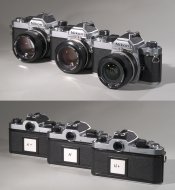
I have posted this before, but to support David's proposal, here it is again:

I bought these bodies two years ago (excluding lenses) for less than $300.
 

Attachments

  • 35mmZoneSystem.jpg
    35mmZoneSystem.jpg
    91.9 KB · Views: 152
I do both (not at the same time though): either carry two or three bodies for N+1/ N/ N-1 exposures or carry one body loaded with 8-10 frames per casette so I can dedicate one film casette to one subject and change it as I move on. You label your casettes with N+1/ N/ N-1 and develop accordingly.
 
Photrio.com contains affiliate links to products. We may receive a commission for purchases made through these links.
To read our full affiliate disclosure statement please click Here.

PHOTRIO PARTNERS EQUALLY FUNDING OUR COMMUNITY:


Ilford ADOX Freestyle Photographic Stearman Press Weldon Color Lab Blue Moon Camera & Machine
Top Bottom