• Welcome to Photrio!
    Registration is fast and free. Join today to unlock search, see fewer ads, and access all forum features.
    Click here to sign up

Zone system question - Standard negative print time confusion.

Chose vue

A
Chose vue

  • 0
  • 0
  • 15
Chose vue

A
Chose vue

  • 0
  • 0
  • 19

Recent Classifieds

Forum statistics

Threads
202,106
Messages
2,835,186
Members
101,116
Latest member
Jai DuVal
Recent bookmarks
0

batwister

Member
Allowing Ads
Joined
Sep 4, 2010
Messages
913
Location
Midlands, UK
Format
Medium Format
I'm currently doggy paddling deep in the depths of the zone system, figuring my photography and printing requires some discipline.

At the point of calibrating my equipment, I've made a greyscale with Delta 100 in order to assess a personal film speed. I'm a bit confused however about John Blakemore's suggestion, when finding a standard negative print time, to print test strips of negatives representing Zones II and III together in the negative carrier (medium format). This is in order to find the point where the the clear film stock seperating the two negatives will not render any blacker on the paper. In 'John Blakemore's Black and White Workshop' he says '...ZIII should be very dark but show full texture [uh huh] and Zone II should be only just visibly seperated from the full black but showing no texture.'

This begs the question; how will I know what Zone I looks like compared with absolute black when I'm visualizing the print and if the test is in search of dead black, surely making the test strips with negatives representing ZI and ZII would make more sense? Up until this point, I've been under the impression, during my intensive studying of the Zone System, that Zone I is the darkest usable black (tone but no texture). Why then has it been disregarded all of a sudden when it comes down to the reality of making the print?
 

Christopher Walrath

Member
Allowing Ads
Joined
Dec 30, 2005
Messages
7,175
Location
Milton, DE USA
Format
Analog
If you want Zone I for reference, burn in a narrow strip on the long side of the paper before inserting the negatives and performing your test strip as further exposure of the paper will have no effect on the burn in strip.
 
OP
OP

batwister

Member
Allowing Ads
Joined
Sep 4, 2010
Messages
913
Location
Midlands, UK
Format
Medium Format
I don't know if it's the way you've worded that (no offence) but I really don't understand.

Burn in for how long? Also, the greyscale is 10 exposures of a towel as the texture gives a more accurate idea of the substance and texture in a scene. Exposing the print to naked light would defeat the purpose really.
 
Last edited by a moderator:

Bill Burk

Subscriber
Allowing Ads
Joined
Feb 9, 2010
Messages
9,482
Format
4x5 Format
Hi batwister,

In the chapter "Shooting Tin Cans and Painted Plywood" in my book Mastering the Zone System in Four Years* I explain the same concept that Chris brought up.

If you completely expose part of the paper for a key black (don't go overboard and solarize it). Then you can tell where the towel exposure is lighter than black but still has no texture. One of your exposures will have a slightly lighter tone where you see some texture.

*Just kidding, I haven't written any books
 
Joined
Jan 7, 2005
Messages
2,743
Location
Los Angeles
Format
4x5 Format
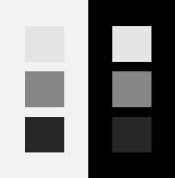
Bill, you've raised an interesting question. How will the surround with this type of test through the influence of simultaneous contrast affect the judging of the tones? And potentially, could this be an inherent problem with this approach.

batwister, with so many testing methods to chose from, what was it that made you pick John Blakemore's?

Steve
 

Attachments

  • Simultainous Contrast.jpg
    Simultainous Contrast.jpg
    5.9 KB · Views: 155
Last edited by a moderator:

Bill Burk

Subscriber
Allowing Ads
Joined
Feb 9, 2010
Messages
9,482
Format
4x5 Format
Hi batwister,

I should have answered your original question. Why does John Blakemore have you put Zone II and Zone III in the carrier?

Found an online preview and see exactly what caused the confusion.

He wants you to find standard print time by examining the area BETWEEN the frames. That is, he wants you to be looking at the black made by base + fog only. Not the Zone II and Zone III yet.
 
Joined
Jan 7, 2005
Messages
2,743
Location
Los Angeles
Format
4x5 Format
Sounds like a slightly different interpretation of tonal placement than traditional Zone System. Zone I at 90% of paper D-max works fine.

Something else to ask yourself about placement of tones a few stops up from the shadow density. Long toed curves are going to produce a different density relationship between Zone II and Zone III and different density placements on the film curve than a short toed curve. The densities will be lower and the density difference between steps will be smaller with long toed curves. This means in such a test, Zone III will either have to be darker in respect to the paper D-max or Zone I will have to be lighter in order to make the Zone III values fit.
 

ic-racer

Member
Joined
Feb 25, 2007
Messages
16,752
Location
USA
Format
Multi Format
I like that simultaneous contrast jpg that Steve posted. This comment may be a little off topic, but for me, that image emphasizes the reason why I print with the 'trial-and-error' method. I could probably obtain, calibrate and use just about any darkroom device, meter, or printing system out there. But in my 38 years experience of printing I found it best to use trial and error for print exposure and contrast control when it comes time to put the image on paper.
 

Bill Burk

Subscriber
Allowing Ads
Joined
Feb 9, 2010
Messages
9,482
Format
4x5 Format
...that image emphasizes the reason why I print with the 'trial-and-error' method. ...I found it best to use trial and error for print exposure and contrast control when it comes time to put the image on paper.

ic-racer,

You are right on topic, but at a different stage of the game. The standard print time for the purpose of these tests is not to bar you from making expressive prints. It's just a temporary lock-down to make the other Zones relative to "something".

As soon as you conclude this testing you will have an idea of the range of your paper and your EI. When you go to take pictures, you might choose to place your shadows on Zone IV and by definition that would give you denser negatives that would throw the standard print time right out of the picture.

But that wouldn't invalidate the development times or EI you came up with through these visual match tests.
 

Bill Burk

Subscriber
Allowing Ads
Joined
Feb 9, 2010
Messages
9,482
Format
4x5 Format
Sounds like a slightly different interpretation of tonal placement than traditional Zone System. Zone I at 90% of paper D-max works fine.

Right, I think it is trying to match Zone II to something like 90% of paper D-max.

Something else to ask yourself about placement of tones a few stops up from the shadow density..

This is another great idea worth developing. Why not calibrate to put Zone IV on 90% of paper D-max?

It would be great except I can predict one little problem...

The person who calibrates to Zone IV needs to place shadows on Zone II. The minute you forget that (and place shadow at Zone IV because it sounds like a good idea) you have double-bumped your shadows by placing them on Zone IV twice and now they would be at Zone VI.
 

Leigh B

Member
Allowing Ads
Joined
Jan 17, 2011
Messages
2,059
Location
Maryland, USA
Format
Multi Format
No matter how many tests you run, nor how many spreadsheets you fill, nor how many graphs you draw...

It all comes down to metering the original scene and determining which areas belong on which zones, and that comes with practice.

Any adjustments after the exposure are just used to make the print match your visualized image. :confused:

And after all, at this level of sophistication photography is an art form, not a science.

Each individual is different.

- Leigh
 
Joined
Jan 7, 2005
Messages
2,743
Location
Los Angeles
Format
4x5 Format
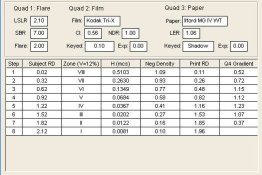
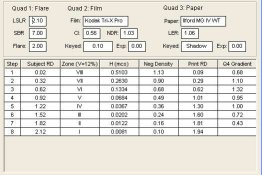
The attached two examples kind of illustrates my point about long and short toed curves and paper / negative densities. One of the films is TXP 120 and the other is Tri-X 135 both processed to a CI 0.56. The paper is Ilford Multigrade with an LER of 1.06. With a luminance range of 7 stops (Zone I to Zone VIII), the film and paper don't match up exactly but they are close.

While both curves have Zone I keyed on 0.10 over Fb+f, you can see how the long toed TXP 120 has lower densities in the middle section as compared the average toed Tri-X 135. This will result in darker mid-tones when keying the print exposure off of the shadow density or paper black like with the John Blakemore method.

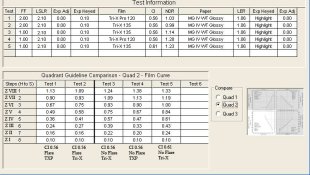
There's something else that I found interesting with these tests. The attachment "Density Comparison Tri-X and TXP" has the negative densities from five different scenarios. The first two are the same as the test above. The next two sets use the same materials except they don't incorporate flare which is more reflective of how the majority of people test.

What I found interesting is that even though both films have the same contrast index and both negative density ranges with flare are very similar, the negative density ranges are markedly different when flare isn't factored in. The fifth test has Tri-X at a higher contrast index, 0.61, in an attempt to match the negative density ranges between the two films. It actually should be around 0.63 or 0.64 to match.

This is a really good example of the point I raised in the "Speed Gain or Loss with Developer" threat about the accuracy of any testing methodology. Are we getting what we think we're getting? Anyone want to hazard a guess as to why the two films matched negative density ranges when factoring in flare and why they don't when it isn't?

Because the Zone System only uses two points of density to determine the film processing and because it doesn't factor in flare, one of two things would occur with these two films if testing using the Zone System method. Either the Tri-X is going to be processed to a higher contrast index, or the TXP 120 is going to be processed to a lower contrast index even though we know that using contrast index as a guide, they are processed to the same contrast. Makes you wonder about the density range method of contrast determination.
 

Attachments

  • Guideline Data Tri-X.jpg
    Guideline Data Tri-X.jpg
    35.3 KB · Views: 140
  • Density Comparison Tri X and TXP.jpg
    Density Comparison Tri X and TXP.jpg
    204 KB · Views: 128
  • Guideline Data TXP.jpg
    Guideline Data TXP.jpg
    35.8 KB · Views: 163
Last edited by a moderator:

piu58

Member
Allowing Ads
Joined
May 29, 2006
Messages
1,545
Location
Leipzig, Germany
Format
Medium Format
Dear betwister,

if you calibrate your film with paper (and not with the help of a densitometer) you should use an exposure time for the paper which gives deep black for empty film. I always make a test strip with empty film in 1/ stop differences and use the first time whose result does not differ from the next longer one. Please keep in mind. It is possible to get a slightly deeper black on paper if we use extreme time, e.g. with doubling this time. But that is not what we want to have.

If you exposure your paper that way, zone III gives dark grey with texture. Texture means slight variations of the grey; you see e.g. the structure of wood. In zone ii you don't see this structure or you see it very weak. Zone i shows no structure in the positive, mostly the black does not differ from the black of the empty film. But in the negative it is not hard to detect some density. It may be even possible to use that density in an image if you sacrifice the deep black. But again, that is not what we want to do with such a test.

I hope that helps.
 
OP
OP

batwister

Member
Allowing Ads
Joined
Sep 4, 2010
Messages
913
Location
Midlands, UK
Format
Medium Format
batwister, with so many testing methods to chose from, what was it that made you pick John Blakemore's?

Because John Blakemore's work, for me, is one of the highest benchmarks in fine art photography and I value his word over anyone else, except maybe Ansel of course. Blakemore has also been one of the foremost art photography teachers here in the UK for the last 30 years.

Most of the replies here are over my head and a little too deeply technical for such a simple question, from a novice.

piu58, you've cleared it up for me, cheers.
 

c6h6o3

Member
Allowing Ads
Joined
Oct 16, 2002
Messages
3,215
Format
Large Format
No matter how many tests you run, nor how many spreadsheets you fill, nor how many graphs you draw...

It all comes down to metering the original scene and determining which areas belong on which zones, and that comes with practice.

Any adjustments after the exposure are just used to make the print match your visualized image. :confused:

And after all, at this level of sophistication photography is an art form, not a science.

Each individual is different.

- Leigh

Amen.

BTW, I place my shadows on Zone IV when I meter a scene and I rate the film at 1/2 box speed. If I don't do both of these things I don't get good shadow detail. I have no idea what the densities are. I just know that any other kind of negative will not give me the prints I want.
 

Bill Burk

Subscriber
Allowing Ads
Joined
Feb 9, 2010
Messages
9,482
Format
4x5 Format
How will the surround with this type of test through the influence of simultaneous contrast affect the judging of the tones?

The optical illusion would probably not be a problem in John Blakemore's test because he has you looking for texture.

batwister, looks like you got a good answer you can use.
 
Joined
Jan 7, 2005
Messages
2,743
Location
Los Angeles
Format
4x5 Format
The optical illusion would probably not be a problem in John Blakemore's test because he has you looking for texture.

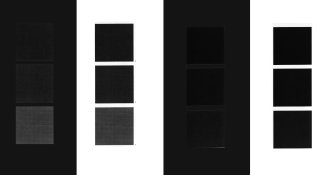
Doesn't hurt to check. I copied the texture squares from The Negative and placed one set on a dark background and one on a light background. See any difference?
 

Attachments

  • Zone Simultaneous Contrast .jpg
    Zone Simultaneous Contrast .jpg
    952 KB · Views: 141

Bill Burk

Subscriber
Allowing Ads
Joined
Feb 9, 2010
Messages
9,482
Format
4x5 Format
Doesn't hurt to check. I copied the texture squares from The Negative and placed one set on a dark background and one on a light background. See any difference?

The illusion is real and the eye is easily fooled.

But in the test John Blakemore specifies, you are to make several similar prints and compare them to each other.

Also you are looking for appearance/disappearance of texture.

So with that simple logic, I don't think the optical illusion will play a part to throw off test results.

p.s. I think it would wreak havoc trying to read these towel tests on a densitometer.
 

Bob Carnie

Subscriber
Allowing Ads
Joined
Apr 18, 2004
Messages
7,735
Location
toronto
Format
Med. Format RF
Hi Stephen

Off topic a bit , but a very simple question.
When I am preparing files for printing.. Lambda Fibre in PS I am using the Lab numbers in the Info Palette. My system has been worked out that by reading the l channel numbers I can predict very accurately how tone placement is laid down on paper, specifically in the end points, highlight with detail and shadow with detail.
We use a eye one spectrometer here to produce profiles but sadly I am not the one who is the expert here doing this tricky business of profile making.

My question for film and paper is there a device that can read L channel numbers?? If so what make , I suspect the eye one does this but I would like to hear your thoughts.
As well have you ever heard of a meter that can read the original scene and provide LAB readings.??
The attached two examples kind of illustrates my point about long and short toed curves and paper / negative densities. One of the films is TXP 120 and the other is Tri-X 135 both processed to a CI 0.56. The paper is Ilford Multigrade with an LER of 1.06. With a luminance range of 7 stops (Zone I to Zone VIII), the film and paper don't match up exactly but they are close.

While both curves have Zone I keyed on 0.10 over Fb+f, you can see how the long toed TXP 120 has lower densities in the middle section as compared the average toed Tri-X 135. This will result in darker mid-tones when keying the print exposure off of the shadow density or paper black like with the John Blakemore method.

There's something else that I found interesting with these tests. The attachment "Density Comparison Tri-X and TXP" has the negative densities from five different scenarios. The first two are the same as the test above. The next two sets use the same materials except they don't incorporate flare which is more reflective of how the majority of people test.

What I found interesting is that even though both films have the same contrast index and both negative density ranges with flare are very similar, the negative density ranges are markedly different when flare isn't factored in. The fifth test has Tri-X at a higher contrast index, 0.61, in an attempt to match the negative density ranges between the two films. It actually should be around 0.63 or 0.64 to match.

This is a really good example of the point I raised in the "Speed Gain or Loss with Developer" threat about the accuracy of any testing methodology. Are we getting what we think we're getting? Anyone want to hazard a guess as to why the two films matched negative density ranges when factoring in flare and why they don't when it isn't?

Because the Zone System only uses two points of density to determine the film processing and because it doesn't factor in flare, one of two things would occur with these two films if testing using the Zone System method. Either the Tri-X is going to be processed to a higher contrast index, or the TXP 120 is going to be processed to a lower contrast index even though we know that using contrast index as a guide, they are processed to the same contrast. Makes you wonder about the density range method of contrast determination.
 
Photrio.com contains affiliate links to products. We may receive a commission for purchases made through these links.
To read our full affiliate disclosure statement please click Here.

PHOTRIO PARTNERS EQUALLY FUNDING OUR COMMUNITY:


Ilford ADOX Freestyle Photographic Stearman Press Weldon Color Lab Blue Moon Camera & Machine
Top Bottom