
• Welcome to Photrio!
    Registration is fast and free. Join today to unlock search, see fewer ads, and access all forum features.
    Click here to sign up

Zone focusing for infrared

Recent Classifieds

Forum statistics

Threads
203,371
Messages
2,853,596
Members
101,807
Latest member
Giaco60
Recent bookmarks
1

Anaxagore

Member
Joined
Jun 1, 2005
Messages
155
Format
Medium Format
When I want to control precisely what will be in focus on my picture, I use the lens scale, my chosen aperture and try ans get the range of distances between the aperture symbols below and above the center point (Center point being where the lens would have exact focus).
The infrared center point, however, is not centered, and most often between the f/4 and f/8 of my lenses, on the side that corresponds to the longer distances. So if I have focused on a given target, I move the lens focus ring so that what was at the normal center point now aligns with the IR center point.
But how can one determine the range of distances that will be in focus when shooting IR, given that there isn’t a second row of aperture marks for IR but just that center point ?
 
In your imagination move the aperture scale so that it is centered around the IR mark.
 
So if I understand correctly, what you are saying is that the scale around the center point would stay the same, or maybe the difference is too small that shifting that scale does not result in a significant difference (less than the uncertainty in min and max distances arising from visually matching a distance on the lens barrel with an aperture mark) ?
If that’s it, that is quite easy, thank you very much!
 
Yes. Other then imaginating, you could copy the scale and stick it around the new center position.


This though yields an approximation as:

-) typically it is not known for which IR-wavelangth the IR-mark was established (in the long past more fare stretching IR-films were common)

-) as the diameter of circle of confusion growths with wavelength


In case you got exact figures you could do the math, or you make a test along a meter-scale.
 
Last edited:
If possible I would like to ask about IR when focusing 120 RF on a 4x5 camera [type kardan]
I will focus on ground glass what I see as normal say 5meters then would I move the lens to 5,60 meters ???? is there a %ratio on distance or just flat rate movement?
if some one has any trials ?????

thank you
 
If possible I would like to ask about IR when focusing 120 RF on a 4x5 camera [type kardan]
I will focus on ground glass what I see as normal say 5meters then would I move the lens to 5,60 meters ???? is there a %ratio on distance or just flat rate movement?
if some one has any trials ?????

thank you

I dont know the answer and will be interesting to know what others do.
I guess you will have to make sure your DOF is large enough to accommodate the change in focus with IR.
For large format I suppose this means wide angle lenses stopped down, and if tilts / swings are applied it will be more error prone.
With a lot of light I am able to see and focus thru the RG715 filter on my Nikon SLRs, but I doubt one should be able to see / focus thru such a filter on a large format camera.
BTW, youtube blogger Mat Marrash has recently released a video on shooting LF near IR film. And there he just guesses the adjustment he needs to compensate for the focus shift.
 
If possible I would like to ask about IR when focusing 120 RF on a 4x5 camera [type kardan]
I will focus on ground glass what I see as normal say 5meters then would I move the lens to 5,60 meters ???? is there a %ratio on distance or just flat rate movement?
if some one has any trials ?????

thank you
If you can get your hands on a camera lens of the same/similar focal length as the lens on your 4x5 camera, and that lens has an IR mark, you could transfer the information from that lens' scales.
You could make up a table based on a selection of settings from the medium format lens and carry it with you.
 
Why not look at the DoF once you focus but before shifting the focus? I always liked the red line on Takumar lenses. That approach would work with those lenses.
 
If you can get your hands on a camera lens of the same/similar focal length as the lens on your 4x5 camera, and that lens has an IR mark, you could transfer the information from that lens' scales.

Not quite... the other lens must have same IR refraction quality, this may vary at same focal length between lens designs. We are here, as indicated above, at aproximations. Which nonetheless might be sufficient.
 
So if I understand correctly, what you are saying is that the scale around the center point would stay the same, or maybe the difference is too small that shifting that scale does not result in a significant difference (less than the uncertainty in min and max distances arising from visually matching a distance on the lens barrel with an aperture mark) ?
If that’s it, that is quite easy, thank you very much!

Yes, I have not found that is difference of focus has mattered. If you were doing focus critical work like close up, it would matter, but In general it will not matter.
 
What IR film are you shooting? I only ever adjusted focus when I was using HIE and opaque filter. For IR films like Rollie, there is no need to adjust. Strongest filter I've used with this film is a 720.
 
Yes, I have not found that is difference of focus has mattered. If you were doing focus critical work like close up, it would matter, but In general it will not matter.

Yes, that reference to close focus work is what you find in literature too.

This makes me want to deviate from our topic by asking is there aside, of technical/scientific photograpgy any IR close-up photography?
(To be fair, in LF already a IR head-portrait would be close-up.)
 
Last edited:
Yes, that reference to close focus work is what you find in literature too.

This makes me want to deviate from our topic by asking is there aside, of technical/scientific photograpgy any IR close-up photography?
(To be fair, in LF already a IR-portrait would be close-up.)

I have never done any close up IR work.
 
For modern "Infrared" films (which all have a cutoff long before the range of what true IR films could register) there is no real need to refocus, like we used to do with HIE. The focus shift thing doesn't happen with films like the Rollei IR. At least not enough to be of practical concern.
 
Yes what Andrew O' Neill and paulbarden have said is also my understanding with current IR films. It makes life simpler as well

pentaxuser
 
What IR film are you shooting? I only ever adjusted focus when I was using HIE and opaque filter. For IR films like Rollie, there is no need to adjust. Strongest filter I've used with this film is a 720.
In fact I wondered about that after a few digital pictures shot with a 715 filter, including some macro ones; to me the question applies to both film and digital as this is rather about technique and physics, although the way it applies may be different.

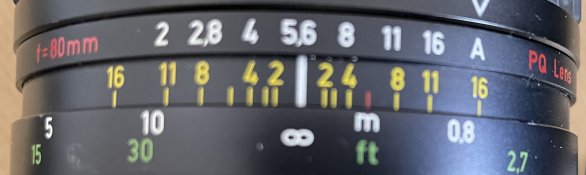
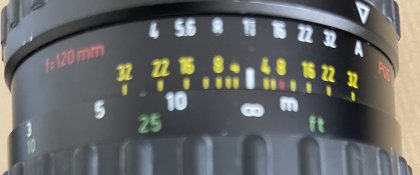
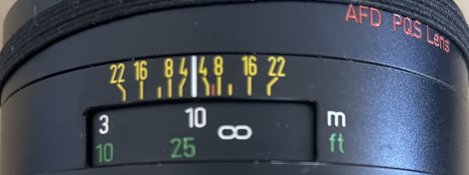
I noticed that the IR center point is much farther from the visible light center point on some lenses. Here are small pics of the DoF scale and aperture range for 4 lenses (Rollei 6000/Hy6 system):

7B84AA50-1A76-4B91-B49D-0B8A8C2478BB.jpeg
1. Xenotar 2/80
8DA816E6-9479-422F-8E23-38D0288BC139.jpeg
2. Apo-Makro-Symmar 4/90
BA9185C4-0D94-4183-8FD6-A1870956828B.jpeg
3. Makro-Planar 4/120
98FA3EED-AC2A-4C84-BEF1-7B9B1C18A86D.jpeg
4. Xenotar 2.8/80 AFD

The DoF scale is spaced much differently on all of them given their usual purpose, so maybe one scale compensates the other, but somehow at close range I’d feel more comfortable with the 90mm (red line very close to center) than the 120mm (red line farther off).. so maybe allow me to redirect the question to:
- short focus range (macro or close focus)
- the dependence of cut-off wavelength (I suppose that the red marking is standardized to a certain cut-off, don’t know which one)
 
One way to check if there is a focus shift is to focus your camera, then stick on your 715 filter. Look through the finder, cupping your hands around your eye which will become accustomed to the little bit of light coming through enabling it enough to see the image.
 
The IR mark on older lenses is probably related to the IR sensitivity of Kodak HIE, which ended all the way out to over 900 nm. So with current films, the placement of an appropriate mark would be much closer to the focus mark for visible light.
And as for the IR mark being at different distances from the visible light mark on different lenses, that is due to the lenses having different focus throws, and different focal lengths.
 
The IR mark on older lenses is probably related to the IR sensitivity of Kodak HIE, which ended all the way out to over 900 nm. So with current films, the placement of an appropriate mark would be much closer to the focus mark for visible light.
And as for the IR mark being at different distances from the visible light mark on different lenses, that is due to the lenses having different focus throws, and different focal lengths.

I agree. Since I use infrared film for landscapes and more distant subject and since I use smaller f/stops [f/8 or smaller] the depth of field is great enough that I do not have to correct the focus. Besides if I use the 720 [R72] I have to use a tripod to compose properly, I might as well us a slower shutter speed and gain depth of field.
 
If possible I would like to ask about IR when focusing 120 RF on a 4x5 camera [type kardan]
I will focus on ground glass what I see as normal say 5meters then would I move the lens to 5,60 meters ???? is there a %ratio on distance or just flat rate movement?
if some one has any trials ?????

MattKing said:
And as for the IR mark being at different distances from the visible light mark on different lenses, that is due to the lenses having different focus throws, and different focal lengths.
The amount of shift to adjust for IR will VARY dependent upon the FL of the lens!

IR_focus_shift.jpg


And Matt is correct about different lenses (even of same FL) having offset different because of the angular rotational throw of the lens.being different.
 
Last edited:
The placement of the IR offset mark is different between different lenses, even of the same focal length, because of differences in the optical design.

For large format or other situations where there isn't an IR focusing mark, there was a rule of thumb to increase the lens extension by 1/400 of the focal length. So for example if you were using a 210mm lens you would focus and then move the front standard 0.5mm further forward. This rule of thumb is unlikely to apply to zoom lenses, and was intended for Kodak HIE, so with today's IR films that have less extended IR sensitivity, you may not need to bother.

One reference for the 1/400 of focal length rule-of-thumb is in the Kodak HIE datasheet F-13, page 3: https://125px.com/docs/film/kodak/f13-HIE-200006.pdf
 
Thanks all for your tips and explanations ! I think I now have a good enough idea on how to proceed.
 
Photrio.com contains affiliate links to products. We may receive a commission for purchases made through these links.
To read our full affiliate disclosure statement please click Here.

PHOTRIO PARTNERS EQUALLY FUNDING OUR COMMUNITY:


Ilford ADOX Freestyle Photographic Stearman Press Weldon Color Lab Blue Moon Camera & Machine
Top Bottom