• Welcome to Photrio!
    Registration is fast and free. Join today to unlock search, see fewer ads, and access all forum features.
    Click here to sign up

Zone 1 density

Filling In

H
Filling In

  • 1
  • 2
  • 39
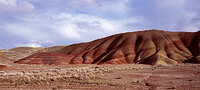
Painted Hills # 3.jpg

H
Painted Hills # 3.jpg

  • 4
  • 0
  • 86

Recent Classifieds

Forum statistics

Threads
203,208
Messages
2,851,442
Members
101,726
Latest member
Peter1111
Recent bookmarks
0
Zone 2 is only 0.24 so it's probably a bit high. Would get you better shadow detail though as long as you keep that inline with the rest of your processes.
 
Is 0.16 to high for a zone 1?

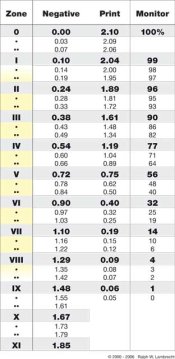
Yes, Zone I is typically defined as having a log density of 0.1 abobe base and fog. Attached is a guideline for Zone densities.
 

Attachments

  • RegularDensities.jpg
    RegularDensities.jpg
    27.7 KB · Views: 688
I'm doing a film speed and development time test with tri-x 320 and d76 1:1. I shot a film speeed at 320, 250, and 200. The 0.16 was at 320 minus FB. Maybe I'll try again at 400 and 320. See if I get the same 320 results. I'm not opposed to a little more in the shadows, but I also don't want to overexpose either.
 
Well, it's about a third of a stop over. Not particularly significant, I'd say, unless your work is critical.
 
Good for you. Tri-X is a 400 film for you. I love it when that happens! It has only happened twice to me – with FP4 and NPH. FP4 is 200 and NPH 500 in my Mamiya C series cameras.

Of course, it may just mean that your shutter is running slow and/or your light meter is calibrated to a different grey value than some. As long as it is all consistent, though, you are fine. That is why you do these tests.

What kind of light did you use to shoot your test card?

Want to get some informative results? Do the same test at noon in direct light (making sure there is no glare on the card), in the shade, and under tungsten illumination (again, with no glare on the card). Color temperature can make a noteworthy difference on b/w film IME.

Personally, I prefer a visual determination of EI when using negative film. I print the film edges exactly to maximum black, and call the zone 0 density the first frame that matches the edges. Zone I is two frames lighter when exposing with 1/2 stops or three frames lighter when exposing with 1/3 stops. Then I shoot a roll at that EI and make further exposure and development changes until a textured surface at a zone II placement looks like a zone II and a textured surface at a zone VIII placement looks like a zone VIII in my standard printing process.
 
Last edited by a moderator:
Canonically, Zone I is usually set at 0.1 to determine the film speed in the Zone system, but if the film you're testing has a long toe, you might find setting it a bit higher (or overexposing slightly) gives you better shadow separation. As long as you've got enough room at the other end, so you're highlights aren't hard to print, then you can go a bit higher.
 
Canonically, Zone I is usually set at 0.1 to determine the film speed in the Zone system, but if the film you're testing has a long toe, you might find setting it a bit higher (or overexposing slightly) gives you better shadow separation. As long as you've got enough room at the other end, so you're highlights aren't hard to print, then you can go a bit higher.

Exactly why I prefer to use zones II and VIII as the "real" markers of EI and development. I don't care nearly as much about what happens on either side of those two zones as I care about what happens between and including them. It is only in that range that I feel such precision is worth a damn. Do I really care if a tone that I placed at black or almost black ends up a little bit darker? No. But I do care if a tone that I placed at the edge of visible texture (zone II) ends up a little bit lighter.
 
Last edited by a moderator:
Sorry, Yes minus BF.

You'll get many opinions.

Whether or not it is too high, IMO, depends on what you are trying to accomplish with your testing. I assume you are trying to determine a personal EI with your process. If so, in the ZS way of determining a personal EI the target Zone I "net" density is between .09 - .11.
 
Yes, I'm testing to get a good working film speed and development time for tray processing my sheet film. I believe trx-320 has a longish toe so maybe a little extra is not so bad for shadow detail. I tested and came up with a development time which gave me 1.25. I'll shoot a few sheets and see how they print. After all thats the final test. All the numbers can be in line but if they don't produce the final print you want, it's all for not.
 
I suspect that Adams and others chose 0.1 as the Zone I density or the "speed point," because it's a fairly low number that is reliably measurable, and with films that shouldered at a lower density than modern films, the lowest possible Zone I density would yield the greatest expansion potential and would produce a thinner negative, which is a sharper, less grainy negative in general, so there are reasons to stick to 0.1, if it gives you good shadow separation. But with a film like TXP320, for instance, you might find that a little more exposure gets Zone III off the toe and gives better separation between Zones II and III.
 
I suspect that Adams and others chose 0.1 as the Zone I density or the "speed point," because it's a fairly low number that is reliably measurable

If by reliably "measureable" you mean it's the lowest "useful" density on the negative above fb+f, I would agree, at least I have proven that for my self. Useful in that it can convey a distinct tone on the surface of the paper, the first step in tonality above the paper's Dmax.

I would only add that densities much lower than .08 or .09 can be reliably measureable (base + fog for instance), but what b&w paper's emulsion can even print such low density. No real question there---it's just a point of interest.
 
A log density of 0.1 was chosen as the speed point by the people who gave us the respective ANSI, DIN and ISO standards. The correlation to Zone I was Adams' choice. My eyes cannot detect a difference between Zone 0 and I, so, I don't find it useful pictorially.
 
A log density of 0.1 was chosen as the speed point by the people who gave us the respective ANSI, DIN and ISO standards. The correlation to Zone I was Adams' choice. My eyes cannot detect a difference between Zone 0 and I, so, I don't find it useful pictorially.

Like many (and conversely, unlike many, I'm sure), I like a full range of print values and that includes the subtle difference between 0 and I and between IX and X.

I find this interesting Ralph-----I can see it plainly, especially since I have had cataracts removed in both eyes and am now enjoying my lens implants----wow!---what a difference it made in how I can perceive tonality. Your're probably laughing, but I'm very serious about this.
 
Like many (and conversely, unlike many, I'm sure), I like a full range of print values and that includes the subtle difference between 0 and I and between IX and X.

I find this interesting Ralph-----I can see it plainly, especially since I have had cataracts removed in both eyes and am now enjoying my lens implants----wow!---what a difference it made in how I can perceive tonality. Your're probably laughing, but I'm very serious about this.

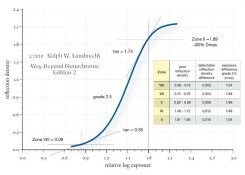
The current ISO standard defines the ‘last usable density’ as being 90% of the maximum density, also called Dmax. Another factor to be considered is the sensitivity limit of the human eye to shadow detail. I conducted a field test in ‘normal’ lighting conditions at around EV 8. Six people were asked to identify the darkest area with still visible detail on 30 different prints. The mean of 180 density readings was 1.88 with a standard deviation of 0.09 density. Today’s glossy or pearl papers have Dmax densities of about 2.10, or higher if toned. The 90% rule of the ISO standard points to a ‘last usable density’ of 1.89 on these papers. The almost precise correlation of the two numbers is a coincidence. However, the agreement of these two methods, as well as good corroboration with studies by other authors, including Controls in B&W Photography by Richard Henry, seems to indicate that this value is a good approximation for the ‘last usable density’. Consequently, I must place Zone II at about 1.89 reflection density for most papers.

Of course, if you crank up print illumination, you can see deep into the shadows. Hold a bright light behind a dark print and you can see all the shadow detail formerly way too dark to detect.

However, for 'normal' print illumination a log density of 1.89, equivalent to Zone II is about the limit for recognizable shadow detail. Zone I is too dark to include it into the range of pictorial values. That doesn't mean you need these dark tones, you do, for contrast and shadow 'foundation', but I wouldn't rely on it for pictorial value.

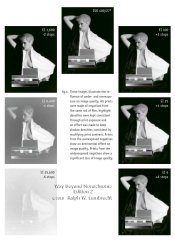
The attached graph shows the human eye is most sensitive to reflection density differences in the highlights. The eye shows about the same sensitivity to exposure differences in highlight and shadows, while exposure deviations are most obvious in the midtones. The eye’s lack of sensitivity to the density differences around Zone II is entirely compensated by the increased contrast capability of the material at Zone II, but that compensation is lost at Zone I densities.

I don't doubt that some individuals can do better and are blessed with extraordinary sight, but that is not the norm.
 

Attachments

  • TonalDiscrimination.jpg
    TonalDiscrimination.jpg
    34.2 KB · Views: 217
Impressive, but I can only say that there is a definite tonality difference that I can see between 0 and I without any special effort to see it. Therefore, in my obviously simplistic view, it has pictorial value.
 
Impressive, but I can only say that there is a definite tonality difference that I can see between 0 and I without any special effort to see it. Therefore, in my obviously simplistic view, it has pictorial value.

Exactly. By simple definition of a zone, the difference between zone 0 and zone I is visible. If it is not, maybe something is wrong with your eyes (seriously).

I read Mr. Lambrecht's post and was confused on what he is trying to prove with the test. By the way each print zone is described by the guy who gave us the term zone in the first place, there is not any detail in 0, I, or II (nor is there any in VIII, IX, or X). Zones 0 and I only show tone. Zone II only shows texture. Detail does not appear until zone III.

As I previously stated, I agree that being able to precisely place a zone II or III is infinitely more important than being able to place a zone I or 0. That is why I base my EI testing on zone II. However, by simple definition of a zone, everyone with properly working eyes can see the difference between any two zones. If he or she cannot, then they just ain't different zones!
 
Last edited by a moderator:
Impressive, but I can only say that there is a definite tonality difference that I can see between 0 and I without any special effort to see it. Therefore, in my obviously simplistic view, it has pictorial value.

Zone 0 is the darkest a photographic paper can get. It is the paper’s black.
Zone I is almost black. In this zone, a hint of tonality is observed, but it has no pictorial value.
Zone II clearly differs from paper-black through signs of shadow texture, but the deep tones make it difficult to make out image details.
Zone III is as dark as textured shadows should get, otherwise important image details are lost.

Nothing more to add, really.

Don't waste your time with aiming at Zone I. Place your detailed shadows at Zone III or IV. The rest comes by itself. You can only control two points on the paper curve anyway, one for the shadows and one for the highlights.
 
Photrio.com contains affiliate links to products. We may receive a commission for purchases made through these links.
To read our full affiliate disclosure statement please click Here.

PHOTRIO PARTNERS EQUALLY FUNDING OUR COMMUNITY:



Ilford ADOX Freestyle Photographic Stearman Press Weldon Color Lab Blue Moon Camera & Machine
Top Bottom