• Welcome to Photrio!
    Registration is fast and free. Join today to unlock search, see fewer ads, and access all forum features.
    Click here to sign up

Zeiss Ikon Contax II

Tree with Big Shadows

Tree with Big Shadows

  • 2
  • 0
  • 59
Everal Barn

A
Everal Barn

  • 3
  • 1
  • 68

Forum statistics

Threads
203,455
Messages
2,855,008
Members
101,851
Latest member
Si_Voltage
Recent bookmarks
0

tjaded

Member
Allowing Ads
Joined
Oct 15, 2006
Messages
1,020
Location
San Francisc
Format
Multi Format
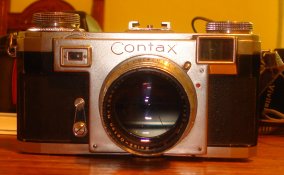
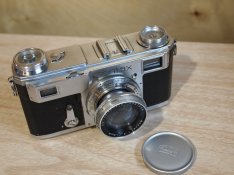
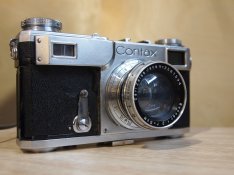
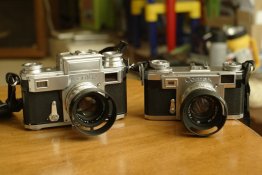
After a crazy day in the old camera world, I was very fortunate to become the owner of a Zeiss Contax II rangefinder! I am trying to dig around online to find serial number information for the body but so far cannot figure out when the camera was made. The serial number starts with the letter M and I can't find any mention of that letter code. Based on the serial number on the lens, I think it dates to 1939. The lens is a Sonnar 1:2 f5cm (Carl Zeiss Jena) with the number 2587***. The body number is M302** (same number on the back.) If anyone can help me figure out what year the body is I would love the help! Other info that may or may not be useful, shutter speeds marked: B 2 5 10 25 50 125 250 500 1250. Photos of the camera to follow in a day or two...
Thanks in advance,
Matt
 
Isn't that "garage door" shutter an amazing sight? Reminds me of the advice my great uncle gave me. Don't point your camera at the sun it'll burn a hole in the shutter curtain. Nope. It's a Contax.
 
I have a list of Zeiss numbers but when I checked they are only for post war. The Contax is a lovely thing, the ergonomics are a bit odd, but the build quality is sublime. The pre-war Contaxes are a bit prone to shutter problems, does yours work OK?
Also, the uncoated Sonnars are excellent performers, even by today's standards, and the lack of coating doesn't seem to affect these lenses as badly as some others. The contrast is still really good.
 
Wow...made during the war. Crazy. The garage door shutter is wild for sure! The camera seems to work decently, though it could stand a CLA (sometime.) The lens has a bit of haze and oil on the blades, but I'm still very happy with it.
 
The 50/1.5 Sonnar usually isn't absurdly expensive, and it's one of the best 35mm lenses on earth. Well worth picking up if you get half a chance. (There's one at KEH now for US$119, but it's in UG condition.) The 85/2 is a real winner as well.

Congratulations!

-NT
 
I have a III (1939) and a black dial IIa.
I prefer the earlier larger bodies and the rangefinder is a bit better if in good shape.

The only drawback is the earlier II/III series uses the ribbon style shutter connections that do snap.
There is great info on the net to replace the ribbons if needed.
 
Mine is from 1936:
DSC01322.JPG
DSC01322.JPG
DSC01322.JPGDSC01322.JPG
 
JA,JA,JA
Lente Sonnar f/1.5
 
The lens is incredible.
 
The lens is incredible.

I believe it. From what I gather they are all good unless they've been abused

I could be wrong but your lens in those photos is marked Opton T which makes it post war from Oberkochen.
I think they changed serial # series when they moven to west germany...perhaps that's why you are dating that example to 1936?
 
Here are a couple of pics of the newest member of the family...contax1.jpgcontax2.jpg
 
With all due respect that copy looks like a postwar Stuttgart IIa/
Unless you are speaking of the lens which I cant decipher from the web rez.

The lens shown is an Opton production-confirms postwar
Mark
 
You are right. It's a Zeiss-Opton Sonnar; S/N: 1053414
 
True...I learned that one pretty quick! HA HA. I do like the feel of this camera (I tend to like the Zeiss feel.)


I would suggest changing shutter speed settings AFTER winding-they sometimes get a bit 'confused' if slow speeds are set before winding
 
The 50/1.5 Sonnar usually isn't absurdly expensive, and it's one of the best 35mm lenses on earth. Well worth picking up if you get half a chance. (There's one at KEH now for US$119, but it's in UG condition.) The 85/2 is a real winner as well.

Congratulations!

-NT
Unfortunately the good ones are going the way of the Leica Summicron now, i.e. getting real pricey. Three years ago one could find a clean one for $150 or so, and now the same lens gets at least $300. The 5cm F2 Sonnar is fortunately a little cheaper and still a very good lens. The J8 is good for the money too particularly the later production ones (in my experience).
 
The uncoated Sonnar is an interesting lens to experiment with - not for everyone, and not for all subjects, but it can make very nice effects and is good for personal photography (family shots, friends, holiday, travel shooting, etc. - as opposed to say technically excellent work demanding best sharpness and contrast). The lack of coatings makes it prone to flare of course, and because of this it seems to do good in softer light - watch out for bright Sun, particularly backlit situations. It's a really impressive lens considering how old it is - it was very advanced for the time. It is really nicely made too mechanically - German technology at its best (for the 1930's).
 
Indeed, the uncoated Sonnar is great for B&W. With a proper hood and You wont need coatings, flare or haloing is going to be nonexistent except when shooting straight towards the Sun - but who really shoot like that and how many lenses, even coated ones can hold it up with such light?!...
Zeiss Ikon Contax II is probably the best in the 35mm department, a lot improvements since Contax I, also its build way more solid, technologically, than even Leica.
It might not be as elegant on the outside but its a beast under the hood.
 
Yes George, that's a good summary - it does not look as good as it works and handles, which is wonderfully. Zeiss really got it right with this system, and it got even better on the post-war models which are right up there with the Leica M's in quality and performance in my view (I own a Leica M too!).
 
I believe it. From what I gather they are all good unless they've been abused

I could be wrong but your lens in those photos is marked Opton T which makes it post war from Oberkochen.
I think they changed serial # series when they moven to west germany...perhaps that's why you are dating that example to 1936?
Pretty much thats the official story the restart the numering but honestly, those times are a grey shaded area.
I happen to have Zeiss-Opton Nr. 26***, non coated, on camera made 1938.
Also, some of the post war Opton have issues with the canadian balsam.
Years ago, I was cleaning a Super Ikonta Opton (Tesar) lens for a friend, one cemented group had a tinny bits of fungus on the side.
Around that post WWII time, Leica had similar issues with, again, canadian balsam, M2, M3 prisms, Summicrons an we can go on up until late 50's.
 
Pretty much thats the official story the restart the numering but honestly, those times are a grey shaded area.
I happen to have Zeiss-Opton Nr. 26***, non coated, on camera made 1938.
Also, some of the post war Opton have issues with the canadian balsam.
Years ago, I was cleaning a Super Ikonta Opton (Tesar) lens for a friend, one cemented group had a tinny bits of fungus on the side.
Around that post WWII time, Leica had similar issues with, again, canadian balsam, M2, M3 prisms, Summicrons an we can go on up until late 50's.

I have a CZJ T* dec/1945 and there is some funky things going on in the rear inner elements. I can only surmise is either separation or some internal coating issues.
This anomaly hasn't effected IQ from what I can tell so far. It is also quite dusty.
 
Photrio.com contains affiliate links to products. We may receive a commission for purchases made through these links.
To read our full affiliate disclosure statement please click Here.

PHOTRIO PARTNERS EQUALLY FUNDING OUR COMMUNITY:


Ilford ADOX Freestyle Photographic Stearman Press Weldon Color Lab Blue Moon Camera & Machine
Top Bottom