

• Welcome to Photrio!
    Registration is fast and free. Join today to unlock search, see fewer ads, and access all forum features.
    Click here to sign up

Your favorite C-41 B&W film?

Recent Classifieds

Forum statistics

Threads
203,006
Messages
2,848,589
Members
101,595
Latest member
Kellaphoto
Recent bookmarks
3
Yeah, XP2 super is really fine-grained, especially when exposed at EI 100 or 200. In my experience it seems slightly finer grain than TMX100 in Xtol, which is no slouch! That said, if you do enlarge enough to see the grain, XP2 Super grain isn't as attractive as traditional BW film grain.

It's a great travel film, as you can usually get it developed on location without worry, although finding a lab to do 120 might be a problem in some places. I shot about 60 rolls of 120 on my last vacation. This stuff and a medium format Fuji rangefinder are a terrific travel combo.
 
I strangely have had an easier time seeing the grain from Tech Pan (with the same enlargement factor) than from the XP2 Super. It must just be the shape and contrast with the color mask.
 
i have been using xp2 super off and on for about 20 rolls.
( i still have a few bulk load rolls in the fridge too )
i love over exposing the film it is sharp an smooth ...
i tend to send it to fuji labs ( via walmart/sams club ) and
they usually to send it on to dwayne's in KS ( the place that does kodachromes now )
and since they printed it on bw paper/bw/chems. they do a very good job with it.

the last bunch of rolls i asked fuji to process/print the film inhouse.
when they print it on their color machines i get a great cast /
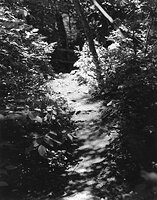
warm print. the view of the road ( 2nd from left on top row ) on my portfolio
page is a scan of one of these prints ...

i bought the 200 feet of film from a fellow apugger a few years ago -
but usually buy the film through hunt's photo in melrose mass.
they have very good deals on their film...

i haven't used enough of the kodak to make an opinion of it .

john
 
Thanks John. I guess having Walmart send my photos off to one of their labs is a good choice then! So far, I'll be sending one roll to Costco, another to Walmart.
 
Thanks John. I guess having Walmart send my photos off to one of their labs is a good choice then! So far, I'll be sending one roll to Costco, another to Walmart.

Yes, don't go overboard on processing C-41 so long as you find one that does a good job.

Or, as one fellow from Britain said here recently, one that DOESN'T wipe down the strip of negatives with a Brillo pad! :surprised: :surprised:

:wink:
 
Overexposure gives you finer grain (the exact opposite of conventional films) but reduced sharpness (just like conventional films) so there's always a balancing act. The actual speed of XP2 Super is about 1/3 stop higher than the Kodak equivalent (and 1/3 stop higher than pre-Super XP2) so setting the meter at 320-400 works very well for many people.

The flm should really have been called XP3 but allegedly the US marketing people were afraid of confusing people. Duh!

Go to www.rogerandfrances.com and the opening picture (by Frances) is on XP2. Then click on The Photo School and you'll see my favourite among all the XP2 shots I've taken, shot with a 90/3.5 Apo-Lanthar. The film was processed in a mini-lab less than half a mile from where the pic was taken. We normally use EI 320 nowadays (250 in the days of plain XP2).

Cheers,

Roger
 
i have used XP2 super and it is wonderful. i primarily shoot it in 120. i rate it 400. i have a wonderful print from angkor in cambodia that is 24x30 inches and it looks awesome. very sharp with great contrast! it was printed from a color lab's machine. great stuff for sure!

eddie
 
Thanks John. I guess having Walmart send my photos off to one of their labs is a good choice then! So far, I'll be sending one roll to Costco, another to Walmart.

:smile:

if you want them to print they kind of wacky, when you send them to walmart, put " print in house at fuji " on the bag, otherwise they will send it to dwaynes and have it printed in beautiful black and white ... :smile: "in-house" takes 2-3 days, "send out" takes about 2 weeks ...

have fun!

john
 
One thing to watch with XP2-Super is scratching. When the original XP2 came out, none of my local minilabs could process it without scratching, and that includes the one I worked at. (I was very careful, called tech support....) My XP-2 Super was processed by a pro lab in London. There were no problems whatsoever. Maybe the XP-2 Super is more scratch resistent, or maybe the prolab used more compatible machines. In any case definitely send through a test roll before commiting valuable negatives.
 
One thing to watch with XP2-Super is scratching.

FWIW, I gave a roll of XP2 Super to a local Walgreens a while ago and it came back scratched. I don't recall that minilab ever scratching film before, although I don't use it all that often (usually I process my own C-41 film). Fortunately, the scratches were on the base (non-emulsion) side, so they're easily covered up when printing.
 
I've been a huge fan of the Kodak product (T400CN, B&W 400CN, Portra 400CN, whatever they're calling it today). I've had tremendous success with shooting it in a wide variety of lighting conditions (my studio, outdoors here on the US East Coast, on the US West Coast, and even in tropical jungles in Belize and Cambodia). As mentioned before, I set the camera meter to 100, and expose it that way. This gives a very dense but very printable negative, and will allow considerable enlargement (I've made 12x18 inch prints from 35mm with no appreciable grain or softness).
 
I would echo the huge problem of scratches with both the kodak and ilford c41 bw films. When they first came out I was working a commercial lab and you couldn't breathe on the flimsy curly film base without scratching it. I absolutely detested printing from these films at the time (to bw paper not color), which was about 7-8 years ago or so. I certainly hope the films have improved since then because I've not worked with them since. They also came back very thin for making real bw prints. I have no idea if the stuff works better on ra4 paper.
 
This is strange, I haven't gotten any XP2 Super or BW400CN negs back scratched yet, although the very same lab sent back a roll of Kodak Portra 800 back to me with 2 frames really scratched up. Anything larger than a 4x6 print would show the scratch.
 
Hi Film Guy,

Harrigan and I were both reporting scratching problems with early XP2. Maybe XP2 Super has improved in this regard. I hope so. I didn't have a scratch on any of the 60 rolls of film I had developed by a pro lab in London, and these negatives gave me some of the best results I've ever had.
 
Isn't C-41 B&W film just basically a normal color C-41 film with a layer of black dye? I guess if it's easy for any lab to scratch up a color neg, it'll be easy for them to scratch up a chromogenic negative.
 
Well, the early XP-2 was definitely thinner than regular color film. It scratched much easier too. I worked in the lab that processed my film, and I processed film all day. Rarely did a film get scratched. That is, unless it was my Xp-2. In that case it was rare that it wasn't scratched. So the film was definitely more susceptible to scratching than regular color film.
 
Isn't C-41 B&W film just basically a normal color C-41 film with a layer of black dye?

No. First, there's no such thing as 'black dye' (it's something of a holy grail for colour film designers) and second, there are very different ways to approach the problem. Ilford once described Kodak B+W chromogenic films as colour films with the colour taken out and their own as black and white films with the dye precursors added. The worst chromogenic ever was probably Konica's.

Cheers,

Roger
 
Well, the early XP-2 was definitely thinner than regular color film. It scratched much easier too.

Odd, this. In 25+ years of using XP films, first XP1, then 2, then 2 Super, I can recall one batch that was scratched/cruddy (and on quizzing the lab I leaned exactly why). That was (inevitably) on a professional shoot, using a lab recommended by a local photographer. Apart from that, the proportion of scratches has been exactly the same as for colour films, and my wife and I have shot hundreds of rolls of the stuff and had them processed in England, the United States and France. My wife's theory is that you just notice scratches more on XP films because you print more of them yourself, bigger.

Cheers,

Roger
 
Hi Roger,

Having looked at a really large amount of processed color film, I don't agree with your wife's theory. (At the time, I'd regularly run my C41 color film through the machine at work and make 8x10 prints, the same size that I printed the XP-2 negatives, at home.) At the time of my XP-2 troubles, I contacted both Ilford and the maker of the minilab equipment. The Ilford people were definitely aware of the problem, and they asked a number of questions about the process, such as the dryer temperature and speed. Hence, it looks like there was a compatibility problem with some film processors and the XP-2.
 
Hi Roger,

Having looked at a really large amount of processed color film, I don't agree with your wife's theory. (At the time, I'd regularly run my C41 color film through the machine at work and make 8x10 prints, the same size that I printed the XP-2 negatives, at home.) At the time of my XP-2 troubles, I contacted both Ilford and the maker of the minilab equipment. The Ilford people were definitely aware of the problem, and they asked a number of questions about the process, such as the dryer temperature and speed. Hence, it looks like there was a compatibility problem with some film processors and the XP-2.

Fair enough. Thanks. I must just have been (generally) lucky.

Cheers,

Roger
 
Please remember, folks, that my problems were many years ago and most likely with a specific brand of processor. (I can't remember for sure what it was. A Noritsu, I think. All the local mini-labs at that time had the same machine.) Roger, I expect, had his films developed in Europe and probably with a different brand/model of equipment. Please don't go overboard with worry. Simply run a test roll wherever you want to get it developed and look closely for scratches. If there aren't any, great! I love XP-2 Super, especially as a vacation film. It can be shoot from between IE 25 and 800 with great results. It's like having the convenience of digital with the quality of really good film.
 
I'm discovering that XP2 Super is pretty nice for lith printing. It's low enough contrast to give a lot of control over the process. I find with very high contrast negatives I need to really overexpose the paper to get the contrast under control, and that can make the highlights pretty muddy.
 
Hi Paul,

That's a great idea! I've never tried XP2-Super for lith printing, but I will now.
Dear Peter,

The 'signature' pic on the home page of www.rogerandfrances.com -- the one you'll see if you click on the link -- is an XP2 lith.

On the machine topic, I had very few problems in the USA either; I lived in California 1987-1992.

Cheers,

Roger
 
Nice picture, Roger. I'll definitely give lith printing with XP-2 Super a try. Our experiences with the original XP-2's susceptibility to scratching certainly are different. Hopefully, more people shared your result than mine.
 
Photrio.com contains affiliate links to products. We may receive a commission for purchases made through these links.
To read our full affiliate disclosure statement please click Here.

PHOTRIO PARTNERS EQUALLY FUNDING OUR COMMUNITY:


Ilford ADOX Freestyle Photographic Stearman Press Weldon Color Lab Blue Moon Camera & Machine
Top Bottom
