
• Welcome to Photrio!
    Registration is fast and free. Join today to unlock search, see fewer ads, and access all forum features.
    Click here to sign up

Yet another post about the Zone System

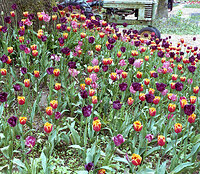
Tractor & Tulips

A
Tractor & Tulips

  • 1
  • 1
  • 34
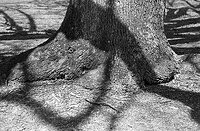
Tree with Big Shadows

Tree with Big Shadows

  • 3
  • 0
  • 82

Forum statistics

Threads
203,457
Messages
2,855,075
Members
101,853
Latest member
DJFOX
Recent bookmarks
0
The eye is non-linear due to the aperture and also due to night (or low light) adaptation. Thus on these scales the "curve" for the eye would have to go outside of the X and Y axes. I have not had time to read this, but have saved a copy.

Thanks.

PE
 
I always get a kick out of this kind of discussion, as if God originally created the world in eight discrete zones, or ten, or whatever. Different films handle contrast in very different manners. Something like Pan F has a relatively short straight line and has trouble below Zone III, while something like Fomapan 200 will easily resolve shadows clear down to essentially Zone 0 if you know how to handle it correctly. And I am NOT talking about compensating development, which essentially sacrifices midtone gradation to do this! So think of the Zone System as more like a tape rule made by Rubbermaid instead of Stanley, which you can stretch to fit your own needs. People who make a religion out of this and walk with bare feet bleeding in the snow to genuflect at some Ansel Adams shrine with exactly eight candle stations are on the wrong track to begin with - that was never the intention of the Zone System. It's really just a shorthand educational device to help you get on first base. After that, you either adapt it to your own needs or forget about it entirely.
 
I think AA would probably agree with you.
 
Back when this began, AA had a little light bulb go on in his head, and it was simply a convenient tool to differentiate categories of negative
development to alter the contrast relative to graded paper results. It was based on what he regarded as typical outdoor lighting ratios and his own typical black and white film choices. Just a common-sense thing, fine-tuned a bit. Then people like Minor White arrived from somewhere beyond earth, and made some kind of Martian religion out of all this. And various people have tried to hardball quantify it. If you enjoy nitpicking numbers, fine. But it won't yield you any better prints. R&D-style sensitometry is a whole different ballgame with a different objective.
 
As they said at EK, we sell pictures, not sensitometric curves.

There is another thread similar to this going on right now! Blecch, I hate these.

PE
 
Back when this began, AA had a little light bulb go on in his head, and it was simply a convenient tool to differentiate categories of negative
development to alter the contrast relative to graded paper results. It was based on what he regarded as typical outdoor lighting ratios and his own typical black and white film choices. Just a common-sense thing, fine-tuned a bit. Then people like Minor White arrived from somewhere beyond earth, and made some kind of Martian religion out of all this. And various people have tried to hardball quantify it. If you enjoy nitpicking numbers, fine. But it won't yield you any better prints. R&D-style sensitometry is a whole different ballgame with a different objective.

I've always though of the zone system as a quantification of "expose for the shadows, develop for the highlights" crossbred with the calculator dial from a Weston meter. One of the reasons I like the old Westons and keep two of them, one unused in the original packing.
 
I always get a kick out of this kind of discussion, as if God originally created the world in eight discrete zones, or ten, or whatever. Different films handle contrast in very different manners. Something like Pan F has a relatively short straight line and has trouble below Zone III, while something like Fomapan 200 will easily resolve shadows clear down to essentially Zone 0 if you know how to handle it correctly. And I am NOT talking about compensating development, which essentially sacrifices midtone gradation to do this! So think of the Zone System as more like a tape rule made by Rubbermaid instead of Stanley, which you can stretch to fit your own needs. People who make a religion out of this and walk with bare feet bleeding in the snow to genuflect at some Ansel Adams shrine with exactly eight candle stations are on the wrong track to begin with - that was never the intention of the Zone System. It's really just a shorthand educational device to help you get on first base. After that, you either adapt it to your own needs or forget about it entirely.

Or a way to adjust the Procrustean bed, so you don't have to rack the poor ba$tard or trim his legs (i.e. lose shadow and highlight detail).:laugh:
 
When I first read The Negative, many moons ago, I thought of the Zone System as a nightmare.:confused:

I understand it better now, but have not been assimilated into the "way of the zone".
However, I can honestly say that I can deal with it equally well in binary, octal, decimal or hex:laugh:
 
However the numbering is not 1 to 10, it is 0 to 10 making it eleven steps.

No no no, you have completely misunderstood the zone system. The clue is the name "Zone". A zone is an area or region and not a "pinpoint" value.
You have the zone between 0 and 1, 1 and 2, 2 and 3 ..... 9 and 10. That is "10 ZONES". Now go and mull that one over.

Should keep him quiet for a while anyway.... :laugh:
 
No no no, you have completely misunderstood the zone system. The clue is the name "Zone". A zone is an area or region and not a "pinpoint" value.
You have the zone between 0 and 1, 1 and 2, 2 and 3 ..... 9 and 10. That is "10 ZONES". Now go and mull that one over.

Should keep him quiet for a while anyway.... :laugh:

Not likely. So is Zone 0 the center of 0 or is it from 0 to 1? With 35mm film is 0 before the first negative or the first negative? Can you have multiple zones on the roll?

Welcome to APUG
 
Not likely. So is Zone 0 the center of 0 or is it from 0 to 1? With 35mm film is 0 before the first negative or the first negative? Can you have multiple zones on the roll?

Welcome to APUG

when you represent zones in units of light you say that zero is a 1/2 so that 1 is twice as much as a half and 2 is twice as much as 1. Everyone knows it couldn't be 0 because twice zero is zero so how can you have Zone 0.
 
when you represent zones in units of light you say that zero is a 1/2 so that 1 is twice as much as a half and 2 is twice as much as 1. Everyone knows it couldn't be 0 because twice zero is zero so how can you have Zone 0.

This causes great distress for c programmers since they start counting at 0 rather than following the convention of starting from 1.
 
I thought the Zone System was ordinal.
 
I don't know if this has already been mentioned, but the zone system is on the binary system. Each zone increment represents a factor of two difference in exposure.

As to the issue of how many zones to include, I have no strong opinion, but keep in mind that there are some limits due to the properties of the materials, i.e. if (the arbitrarily named) zone V is the reference point for exposure on film there is only so far down you can go before you effectively reach the base-plus-fog point.
 
I still think because Ansel was not very good at math and had 10 fingers.
 
But he was a pianist. Why didn't he name 88 key values?
 
I only have 10 digits on my hands. If the ZS has steps from 0 through 10 then I'd need to be a eunuch to start with 0. All I can say is, TG I can count from 1 to 11.
 
Photographic systems are designed to fit into 21 steps separated by 1 stop or 0.3 Log E. They do encompass more than these 21 steps though and that is why there are step tablets with a density range up to 6.0 in units of 0.6 log E and etc.

Of course, we use them all, but you guys, being digitally challenged, don't.

PE
 
I still think because Ansel was not very good at math and had 10 fingers.

Uhhh....so wouldn't Ansel have been one of the earliest digital photographers? 10 Zones, 10 digits (fingers)?!
 
When you play the piano you would not think how many keys it has.

Chan Tran,

You might be onto something here - your thought actually helps explain why it doesn't matter that there are 10 (or 11 or more) Zones, because when working with black and white analog photography you are able to play infinite continuous tones.
 
Chan Tran,

You might be onto something here - your thought actually helps explain why it doesn't matter that there are 10 (or 11 or more) Zones, because when working with black and white analog photography you are able to play infinite continuous tones.

I think Ansel as he had 10 fingers he thought he picked 10 zones 1 to 10. So 5 is the middle zone right (he thought). But after counting his fingers it was not so he added the zone 0.
 
Chan Tran,

You might be onto something here - your thought actually helps explain why it doesn't matter that there are 10 (or 11 or more) Zones, because when working with black and white analog photography you are able to play infinite continuous tones.

Like a trombone or violin?
 
Photrio.com contains affiliate links to products. We may receive a commission for purchases made through these links.
To read our full affiliate disclosure statement please click Here.

PHOTRIO PARTNERS EQUALLY FUNDING OUR COMMUNITY:


Ilford ADOX Freestyle Photographic Stearman Press Weldon Color Lab Blue Moon Camera & Machine
Top Bottom
