
• Welcome to Photrio!
    Registration is fast and free. Join today to unlock search, see fewer ads, and access all forum features.
    Click here to sign up

Xtol

Forum statistics

Threads
203,134
Messages
2,850,377
Members
101,691
Latest member
Kajo
Recent bookmarks
0
srs5694 said:
If you're implying that Kodak wants you to use less-diluted XTOL to bolster their profits, I'm skeptical.

Not at all. I'm merely resentful of a CYA approach. If the answers aren't clear, then I want to know this, and I do not like to have my perceptions managed.
 
XTOL gives the smooth grain that d76 gets but adds a sharpness that d76 lacks. Less grain erosion - better accutance - finer grain. In my opinion - XTOL is better than d76 in every way. It is my first choice for big enlargements.


chiller said:
An additional question on Xtol??

Has anyone directly compared the results of a film in both D76 and Xtol at whatever dilution is the norm for you??

What are the characteristics that make one "better" or more suited to your work style?
 
Back to the original question: has anyone had experience with pouring the powder out of the two XTOL envelopes, keeping the contents separate and sealed, and then mixing the powder with water at the appropriate ratios prior to each developing session?? Would that reduce the SDS rate, or would it extend the life of the developer??
 
I use a 5 litre wine cask to store Xtol stock solution. I'm using my latest lot at 1:3 and it's 5 months old. If you can drink 5 litres of average wine you end up with a very convenient, air-free vessel for developers.
 
I too mix 5 liter batches of Xtol with distilled water: fill 3 glass bottles to the rim, and the rest I divide over smaller glass bottles with either 150 or 500 ml stock, and I fill these bottles to the rim with deminiralised water. So when I either process a 35 mm or a 120 film I take the appropiate bottles, and dilute it to either 300 or 1000ml for Xtol 1:1 in my patterson tank.

The oldest stock used in this way is 2 years old: no problems.

The only problem with Xtol is that it does not change colour when its dead.

Just to be overly sure I dip an exposed piece of film in the mixed developer, and see if it slightly blackens..

Best,

Cor
 
Lets just say this...Kodak says stock lasts a month in half empty bottles. I have used some which has spent 6 weeks or so in a full bottle, followed by about 2-3 months in mostly empty brown plastic chemical bottles and it was fine. It was not a fluke as I used some from two seperate 1 litre brown plastic bottles which were 2/3 empty and BOTH were as good as new. I did film leader tests first to be sure. This took all of 10 mins...

I agree, nobody gives clear accounts of failure with the 5L bags. I am not saying it does not happen, but think that lots of people swallow the storeis hook line and sinker and before you know it a new urban legend is born.
 
My guess is that Kodak figured that users reporting failures at 1:2 and 1:3 were using less than the recommended 100ml per 35mm roll or equivalent so they simply withdrew the 1:2 and 1:3 times from their site. I'm aware that many users claim good results with less than 100ml per roll, but there are probably many inexperienced workers who simply mixed up dilute solution and filled the tank just enough to cover the reels, thus resulting in far less than the needed stock solution to achieve development. TMX apparently exhausts developer more quickly than other emulsions due to its greater activity and thus probably resulted in more failures.

Just my guess, but it seems like a reasonable one. Of course, the 1 liter packaging problem was a different issue completely.

This is a very important point. I usually go beyond the 100ml stock minimum in dilution for a 8x10 and have never had a problem even with the old 1 liter packages in purified water. Don't be cheap with the developer; Your time cost you a lot more.
 
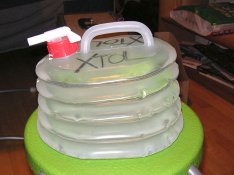
I store my XTOL in a 5l collapsible camping water "bottle". Very convenient.

Trond
 

Attachments

  • PICT2524_APUG.jpg
    PICT2524_APUG.jpg
    118.9 KB · Views: 103
Correct me if I'm wrong. Did not Ryuji Suzuki assert that the iron molecule in one of its several possible valences can cause the failure of an ascorbate developer by acting as a catalyst; that this iron could in fact be present in distilled water depending on the apparatus used in distillation; and that the chelating agent in Xtol was not capable of isolating this iron?

Ryuji and I do not always agree, but I believe anything he says is worth listening to.
 
I only mix it 1L at a time.
50g of A with 800mL and then 54g of B with 200mL, store in an accordion bottle.
The powder will keep fine and there's no way you wont use that one liter before it goes bad.
 
Thank you, RoBBo. Just curious: how do you keep the powder between mixings??
 
I don't recall where I picked this info up but I mix the 5L packet to produce 2L of concentrate. I don't believe that one can concentrate more than that.

I then store the concentrate in eight 250ml bottles and mix 1:4 and that works out to be the standard 1:1 dilution. I have done this for three packets now and haven't had a failure and I don't have a storage problem either. Excellent results but I should add that I consumed the three packets in about 15 months.

Just my .02,
 
Mixed the 5L and stored in 1L glass bottles filled to the top. This lasted 14 months at room temp. I dumped the remaining amount at that point just to be safe.
 
Thank you, RoBBo. Just curious: how do you keep the powder between mixings??

When I open the bag, I only cut off the one corner, and then just roll it up and wrap some tape around the bags, keep it in a dry area, or at the very least, stick it in a nice tight ziplock, something to keep the humidity out.
 
When I open the bag, I only cut off the one corner, and then just roll it up and wrap some tape around the bags, keep it in a dry area, or at the very least, stick it in a nice tight ziplock, something to keep the humidity out.

I am realy surprised this actually works (taking portions of the dry chemicals and mix them, that is). People have been warning against this practice since the powders are not just one pure chemical, but more chemicals mixed together. Mixed chemicals have the tendecy to "settle out", that is (if I am not mistaken) the smaller size particles go slowly to the bottom, the bigger size size stay on top. Ofcourse you can mix the content of the bag, but that is not verry efficient.

OTOH the previous posts do not report any problems, I will stick to mixing the whole batch with water and store it properly.
 
I am realy surprised this actually works (taking portions of the dry chemicals and mix them, that is). People have been warning against this practice since the powders are not just one pure chemical, but more chemicals mixed together. Mixed chemicals have the tendecy to "settle out", that is (if I am not mistaken) the smaller size particles go slowly to the bottom, the bigger size size stay on top. Ofcourse you can mix the content of the bag, but that is not verry efficient.

OTOH the previous posts do not report any problems, I will stick to mixing the whole batch with water and store it properly.

Hm, well I've yet to have any inconsistencies in my negatives that I could attribute to the chemistry, I'll continue to keep an eye on it.
Though this is only what I'm doing while I have limited storage too, can't shell out for extra accordions right now...
 
Has anyone mixed the 5 litre Xtol packet as per instructions and then bottle the 5 litres in many smaller bottle with no air?

If so how has it stored and what shelf life have you achieved?

Does it still suffer from the sudden unexpected Xtol death syndrome?

I'm using 40oz brown beer bottles with a screwcap, of which my local corner store has an indefinite supply. Costs me only the price of the recycling charge, which is pretty cheap. I mix everything in a clean bucket using distilled water, and fill the bottles to the brim. Never had any problem, but I also use most of the XTOL in a 6 month period. Also, I use 1+1, and always dilute just prior to developing my film, and then discard the used solution.
 
I just bought a packet of XTOL but won't be mixing it up until I get some exposed film shot. A friend of mine just gave me a 1.75L stainless steel bottle that Kru 82 brand vodka came in. It looks exactly like a larger version of the smaller steel water bottles that are so fashionable right now, and the cap even has a nice airtight rubber seal. I thought it would be perfect, but now I'm wondering if the stainless steel would be non-reactive enough with the chemistry. I certainly wouldn't want it to affect the developer over its storage time in the bottle.

Has anyone else here used stainless steel bottles for storing photographic chemicals, especially XTOL?
 
I would not recommend storing Xtol in steel or metal containers that are unlined with plastic. Xtol is an ascorbic acid developer and will react with metals on some level. Plastic soda/seltzer 1Liter jugs are easy enough to come by and are well sealed.
 
I agree about the steel containers for storage.

A few years back I had all sorts of problems when mixing XTOL, because of all of the metal containers etc I was using. Once I switched everything over to plastic and moved to another country all of my problems went away. Well, at least my problems with XTOL.

I really do believe there is something to the theory that XTOL and metals don't play nicely.

I still used a steel developing tank and reels, but that does not seem to be a problem, maybe due to the short amount of time everything is in contact.
 
Photrio.com contains affiliate links to products. We may receive a commission for purchases made through these links.
To read our full affiliate disclosure statement please click Here.

PHOTRIO PARTNERS EQUALLY FUNDING OUR COMMUNITY:


Ilford ADOX Freestyle Photographic Stearman Press Weldon Color Lab Blue Moon Camera & Machine
Top Bottom