

• Welcome to Photrio!
    Registration is fast and free. Join today to unlock search, see fewer ads, and access all forum features.
    Click here to sign up

Xtol or D-76?

Forum statistics

Threads
203,275
Messages
2,852,199
Members
101,755
Latest member
andescapes
Recent bookmarks
0

moouers

Member
Allowing Ads
Joined
Nov 19, 2009
Messages
152
Location
Oregon
Format
Multi Format
I realize my question will be interpreted in a mostly subjective manner by most posters, and subjective answers are totally accepted and legitimate...so post away.

I've used D-76 for years and find the results with my two favorite films to be very good in the proper dilutions for each film. I'm pretty comfortable with predicting the results I will get with the films I use in D-76, so now I don't mind branching out to some other developers to compare how they perform. One developer in particular that has caught my interest is Xtol. I don't really know anything about it...so that's where you all (hopefully!) come in.

How do you see Xtol as a developer compared to D-76? What are the reasons you would use one over the other?
 
I used to use nothing but D76 but I don't see the point of using D76 now that there's xtol. D76 'just works' but so does xtol. Xtol has a bit more speed, a bit finer grain, it's easier to replenish with itself, and it doesn't change activity or 'migrate' like D76 can. I suppose D76 has the advantage that you can mix it bulk easier, but if I want to mix up developer I just make D23. It seems to me that Xtol makes D76 obsolete/redundant.
 
XTOL - one of my all time favorite developers. It's like D-76 with the rough edges knocked off. Very similar activity. Goes well with just about everything out there. If you can't find a development time for a particular film in XTOL, use the D-76 development time because it will be close enough. Fine tune from there if necessary. IMO it has made Microdol-X obsolete.
 
How do you see Xtol as a developer compared to D-76? What are the reasons you would use one over the other?

What format do you shoot? If a small format, then you might enjoy the finer grain when it comes to enlargements, so the trade off is somewhat less acutance. I've never used Xtol, but if the others compare it to Microdol-X, then it definitely softens the grain. If you prefer a higher acutance in your negative (more pronounced grain), then D-76 probably provides a bit more of that.
 
Xtol as others have said is a touch better alround than D76. For years Kodak played at tweaking D76 to try and improve it, various official variations have been published.

While Kodak used Ascorbic based developers internally from the 1940's it was many years before they released Xtol, this may have been because of a prior US Patent held by a Swedish company.

Xtol like D76 is designed for replenishment and has a huge advantage in being self replenishing (with fresh developer), a replenished developer once ripened gives the best of both worlds, the advantages of using a stock solution and increased tonality, sharpness and finer grain.

Ian
 
Xtol as others have said is a touch better alround than D76. For years Kodak played at tweaking D76 to try and improve it, various official variations have been published.

While Kodak used Ascorbic based developers internally from the 1940's it was many years before they released Xtol, this may have been because of a prior US Patent held by a Swedish company.

Xtol like D76 is designed for replenishment and has a huge advantage in being self replenishing (with fresh developer), a replenished developer once ripened gives the best of both worlds, the advantages of using a stock solution and increased tonality, sharpness and finer grain.

Ian

x2
 
but if the others compare it to Microdol-X, then it definitely softens the grain

No.

The term 'fine grain' used to mean regular, neat, and unobtrusive grain. That changed - largely through Kodak's marketing of DK-20, Microdol, and Microdol-X - whose signature SOFT grain (for reasons beyond the scope of a quick forum post !) became the standard.

But there is NO NEED for fine grain to be soft and XTOL delivers fine grain and sharpness

D-76 was the best all around developer for 70 years. XTOL is EVERYTHING D-76 is, but better in most things, and LOTS better in a couple things. XTOL is especially useful because it's 'look' can be fine tuned by the craftsman. The ultimate thrill for the craftsman is Xtol replenished. VERY easy, and reliable.


D-76 is easier for a recreational user to mix from scratch...

The short comparison: Finer grain, sharper, more dependable over a long storage period, and at least a half-stop more speed. BETTER IN EVERY WAY.
 
For me, XTOL is like D76 but with finer grain and more detail/better sharpness on fast films.
Use it for 35mm and 6x6 Tri-X. "Some of the sharpness of Rodinal but with fine grain."
Behaves better in the scanner (with diffusor) than the same film with the type of grain you get from D76.
Used as a one-time solution mixed 1+1 with water from stock solution the cost becomes acceptable for low volume work.
Seems to increase nominal film speed a little if you only consider the mid grays. If you want rich details in the shadows though you will have to overexpose a stop or two with XTOL just as with other developers (and underdevelop if you so wish).
(Unscientific/subjective answer.)
 
Not to sidetrack the thread but I would like to give Xtol a proper go. I have had great difficulty in keeping the developer active for more than six weeks.

I have mixed 7 or so 5L batches, store the developer in brown glass 750ml wine bottles with VacuVin stoppers (I use a pump to evacuate all the air) but the developer is dead after six weeks or so.

I use a thoroughly clean plastic bucket for mixing, tap water (normally) at about 80 degrees and mix A thoroughly before adding B.

Film developed within the first couple of weeks looks okay but I can see the decreasing activity as the next few weeks pass. At five or six weeks the negs are quite thin. At eight weeks it is dead.

I store the topped, evacuated bottles in the darkroom at about 65 degrees.

I have also tried Brita filtered water and supermarket distilled water. No difference.

There has to be something wrong with my system but I haven't been able to put my finger on it. I use D-76 most of the time using the same mix/storage system and have had no failures.

Have also tried the replenish method, same result.

Any thoughts?

-F.
 
Last edited by a moderator:
Rather strange, I've used Xtol since it's release and never had a keeping problem, I use heavy grade dense polythene bottles taht originally held Nitric acid, i prefer these to glass. I've kept mixed Xtol in these for well over a year, I replenish my Xtol and find it's one of the most stable developers I've ever used.

Try storing in something else, keep the bottles full with minimal air space.

Ian
 
Not to sidetrack the thread but I would like to give Xtol a proper go. I have had great difficulty in keeping the developer active for more than six weeks.
...

Any thoughts?

-F.

I use it replenished.

The stock is stored in a "recycled" wine box, current box is getting light and probably about 6 months old, working perfectly.

The replenished working solution I keep in a recycled 1.75 liter Margarita mix bottle completely full. Same age as above.
 
I've never used Xtol, but if the others compare it to Microdol-X, then it definitely softens the grain. If you prefer a higher acutance in your negative (more pronounced grain), then D-76 probably provides a bit more of that.

Not so. XTOL gives fine grain AND good sharpness. I don't know how it does it, but it does. Maybe because it is less alkaline than many other developers and doesn't promote as much grain clumping? Whatever. It works and produces fine grain without the speed loss associated with Microdol-X, and with better sharpness and higher potential resolution.
 
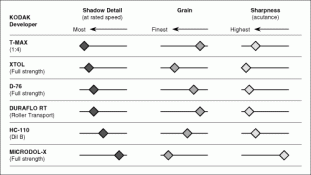
It appears that few are using the link, so here's the image.

Lee
 

Attachments

  • f002_0072hc.gif
    f002_0072hc.gif
    7.3 KB · Views: 431
Not so. XTOL gives fine grain AND good sharpness. I don't know how it does it, but it does. Maybe because it is less alkaline than many other developers and doesn't promote as much grain clumping? Whatever. It works and produces fine grain without the speed loss associated with Microdol-X, and with better sharpness and higher potential resolution.

I only meant that fine grain films can suffer from some developers with a lot of solvent action on the silver, giving a loss of acutance and speed. I have a good feel for that with LF and D-76 1:1. But I've always felt that Microdol-X gave softer grain than D-76, so a comparison of Xtol to Microdol-X, to me, and apparently I'm wrong, would have mean that perhaps Xtol had some solvent action on the silver grains. I'm not a chemist by any means, but maybe I have misunderstood some things I've read.
 
I refuse to use a developer that does not turn color when it goes bad. This overrides any other advantage. After you blow a shoot that you can`t repeat, you will understand. Kodak has told me there is NO RELIABLE home check for activity. I know about all the suggestions people offered. They are not 100%

I can mix D76 a liter at a time for $2.00 and I have a lifetime supply of ingredients.

If you an ecology freak, Xtol is better. At my volumn, I will not hurt the world.

If I ran a lab with lots of thruput and did control strips like you are supposed to do, I might consider it.
 
A little off-track, here, but could someone explain (step-by-step example) the replenishment process for XTOL?

Thanks.
 
A little off-track, here, but could someone explain (step-by-step example) the replenishment process for XTOL?

Thanks.

You just add fresh developer 70ml for each roll of 35mm (36ex) 120, 4 sheets of 5x4 or single sheet of 10x8, usually you need to bleed of some of the used solution.

I split a 5 litre pack into 2.5 litres of Working stock, the rest is used to relpenish, all the details are here.

Generally I replenish after every 10 films or so, and probably by less than recommended but I always get consistent results. I've been replenishing devs since at school (in the 60's) and you get a feel for it quite quickly.

Ian
 
I replenish every roll. I have two bottles one for working stock and one for replenishment. When I pour out the 300ml for the roll out of working, I then pour about 70ml back in from the replenishment. Then when I finished developing I pour the developer back in and toss the 70ml that won't fit in the bottle.
 
I refuse to use a developer that does not turn color when it goes bad. This overrides any other advantage. After you blow a shoot that you can`t repeat, you will understand. Kodak has told me there is NO RELIABLE home check for activity. I know about all the suggestions people offered. They are not 100%.

I can mix D76 a liter at a time for $2.00 and I have a lifetime supply of ingredients.

Good point, Ron! From my observations it is not an 'over the cliff' death but a slow, gradual loss of activity.

I, too, mix my D-76 a liter at a time to ensure freshness. I will continue with that process.

Although, I wish I knew what was causing the problem.
 
The short comparison: Finer grain, sharper, more dependable over a long storage period, and at least a half-stop more speed. BETTER IN EVERY WAY.

Exactly. I would only add that it's reportedly better for the environment than D-76 too. But if everything else was actually equal, I would use it just because with XTOL I get full box speed with TMY-2. That extra half- stop of real film speed is a huge plus for me.
 
If you are going to use a developer over and over (not as a one shot)...you need to use one that can be replenished. Xtol is the easiest developer to use replenished, because you just replenish with fresh developer, not a "replenisher". If you develop regularly and replenish after each run, your developer can have indefinite life.
 
Photrio.com contains affiliate links to products. We may receive a commission for purchases made through these links.
To read our full affiliate disclosure statement please click Here.

PHOTRIO PARTNERS EQUALLY FUNDING OUR COMMUNITY:


Ilford ADOX Freestyle Photographic Stearman Press Weldon Color Lab Blue Moon Camera & Machine
Top Bottom