
• Welcome to Photrio!
    Registration is fast and free. Join today to unlock search, see fewer ads, and access all forum features.
    Click here to sign up

XTOL and sharpness

Fujino Trail

H
Fujino Trail

  • 0
  • 0
  • 0
Dead and Living.

H
Dead and Living.

  • 5
  • 4
  • 83

Recent Classifieds

Forum statistics

Threads
201,820
Messages
2,830,676
Members
100,972
Latest member
Tom Janu
Recent bookmarks
1

Animalcito

Member
Allowing Ads
Joined
May 22, 2014
Messages
40
Location
Minnesota, USA
Format
35mm
In literature it is commonly stated that classic developers increasing visual sharpness are mostly based on Metol (Beutler) or p-aminophneol (Rodinal) and are used at high dilutions allowing local exhaustion. Also diluted solvent Metol (Perceptol) and MQ developers (ID11/D76) are said to increase the sharpness. PQ developers (Mircophen, Tmax) are do not to pronounce sharpness even diluted as Phenidon is very active even at low concentrations.

There are two developers not fitting into this matrix FX-37 and XTOL. In case of XTOL it is said (Kodak, this forum) that its sharpness is superior to ID11/D76, but the XTOL developer is closer to PQ type of developer - this puzzles me. Has anyone some information or an idea what chemical interaction makes XTOL that different from the rest of the typical PQ developers showing better sharpness? Is it just the ascorbic acid or something else?

My intention is not to start a discussion on what developer is better, the interest is only in the science/chemistry behind.
 

RalphLambrecht

Subscriber
Allowing Ads
Joined
Sep 19, 2003
Messages
14,928
Location
K,Germany
Format
Medium Format
In literature it is commonly stated that classic developers increasing visual sharpness are mostly based on Metol (Beutler) or p-aminophneol (Rodinal) and are used at high dilutions allowing local exhaustion. Also diluted solvent Metol (Perceptol) and MQ developers (ID11/D76) are said to increase the sharpness. PQ developers (Mircophen, Tmax) are do not to pronounce sharpness even diluted as Phenidon is very active even at low concentrations.

There are two developers not fitting into this matrix FX-37 and XTOL. In case of XTOL it is said (Kodak, this forum) that its sharpness is superior to ID11/D76, but the XTOL developer is closer to PQ type of developer - this puzzles me. Has anyone some information or an idea what chemical interaction makes XTOL that different from the rest of the typical PQ developers showing better sharpness? Is it just the ascorbic acid or something else?

My intention is not to start a discussion on what developer is better, the interest is only in the science/chemistry behind.
I'm not a photochem expert but some developers are better at fine grain where others are better at sharpness.I always use a std all-round developer such as D76 or ID11 as they are the best compromise in speed,grain and sharpness in my experience. You can start mixing your own and vary the compositions to find out what works best for you.until then just use D76 at different dilutions and enjoy the compromise.
 

Gerald C Koch

Member
Allowing Ads
Joined
Jul 12, 2010
Messages
8,131
Location
Southern USA
Format
Multi Format
The maximum silver halide solvency is at ~70 g sulfite/l. Therefore undiluted Xtol is not going to produce great sharpness. Diluting it 1+1 would provide better acutance.

Gainer was wrong when he brought up infectious development in film developers. It does occur under certain conditions with hydroquinone when it is used alone without any other developing agent being present. He was right when he noted that ascorbic acid based developers produce finer grain than those containing hydroquinone. But this effect has to do with the difference in redox potentials between the two.
 
Last edited:

Athiril

Subscriber
Allowing Ads
Joined
Feb 6, 2009
Messages
3,062
Location
Tokyo
Format
Medium Format
I find the maximum is not 70g/L. I found this testing home brew D76 ages ago. 100g/L had softer/finer grain. I tested it on T-Max 100.

Also testing I found Xtol stock/replenished as sharp/resolving as Rodinal 1+25, but with much better grain. And both were better resolving than 1+100 stand.

Xtol is objectively a better all round developer than D-76.

Adding 5mg/L to working solution to either of those jumped the sharpness up on FP4+ significantly and on T-Max 100 a little. Adding potassium thiocyanate to the Rodinal improved the grain and brought it close to Xtol. That also worked for stand and there was no longer a sharpness disparity with stand vs 1+25.
 

baachitraka

Member
Joined
Apr 6, 2011
Messages
3,646
Location
Bremen, Germany.
Format
Multi Format
It may be complex to understand if you don't drive your interest to learn photo chemistry. Even then it is too complex.

But the all-rounders are D-76/ID11 and X-tol(need to store in air-tight containers).

My personal choice is PC-TEA. Its scratch mixed so the consistency is guaranteed.
 

Gerald C Koch

Member
Allowing Ads
Joined
Jul 12, 2010
Messages
8,131
Location
Southern USA
Format
Multi Format
I find the maximum is not 70g/L. I found this testing home brew D76 ages ago. 100g/L had softer/finer grain. I tested it on T-Max 100.

Also testing I found Xtol stock/replenished as sharp/resolving as Rodinal 1+25, but with much better grain. And both were better resolving than 1+100 stand.

Xtol is objectively a better all round developer than D-76.

Adding 5mg/L to working solution to either of those jumped the sharpness up on FP4+ significantly and on T-Max 100 a little. Adding potassium thiocyanate to the Rodinal improved the grain and brought it close to Xtol. That also worked for stand and there was no longer a sharpness disparity with stand vs 1+25.

LFA Mason disagrees. IIRC Grant Haist also. Of course they were considering traditional emulsions and not T-grain ones.
 

Alan Johnson

Subscriber
Allowing Ads
Joined
Nov 16, 2004
Messages
3,375
In agreement with Gerald, post 4, and LFA Mason,infectious development with hydroquinone probably is not significant at the pH in question.
With FX-37 the increase in sharpness compared with D-76 may be partly due to less silver being redeposited from the lower sulfite solution of FX-37 and to its higher pH increasing granularity and apparent sharpness, a completely different reason to the case of Xtol. Crawley never published a view on why his developer was sharper.
 

Ian Grant

Subscriber
Allowing Ads
Joined
Aug 2, 2004
Messages
23,409
Location
West Midland
Format
Multi Format
I find the maximum is not 70g/L. I found this testing home brew D76 ages ago. 100g/L had softer/finer grain. I tested it on T-Max 100.

Also testing I found Xtol stock/replenished as sharp/resolving as Rodinal 1+25, but with much better grain. And both were better resolving than 1+100 stand.

Xtol is objectively a better all round developer than D-76.

Adding 5mg/L to working solution to either of those jumped the sharpness up on FP4+ significantly and on T-Max 100 a little. Adding potassium thiocyanate to the Rodinal improved the grain and brought it close to Xtol. That also worked for stand and there was no longer a sharpness disparity with stand vs 1+25.

The 70-80g/l Sodium Sulphite is optimal where there's also an adjustment in the Metol & Hydroquinone. I used Adox Borax MQ commercially for a few years and supplied it (& replenisher) to two other commercial/advertising photographers. Grain was finer than D76 there was about half a stop better film speed and it was cleaner working (less base fog).

I switched eventually to Xtol for commercial work and the sharpness, finer grain, better tonality (particularly shadow detail) compared to D76 and it was quite noticeable. For personal work I used Rodinal3:100 or 1:50for about 20 years 1986/2005 with APX25/100 and Tmax 100. With 35mm negatives I always found Rodinal gave excellent fine grain on a par with Xtol.

Ian
 

Alan Johnson

Subscriber
Allowing Ads
Joined
Nov 16, 2004
Messages
3,375
The reason why the ascorbate-containing Xtol gives more sharpness than D-76 is that with Xtol the acidic oxidation products of development with ascorbate at a boundary diffuse back from the more developed side and cause even less development on the less developed side.This causes a line of less density which is called a fringe effect, as detailed in Dr Henry's book.
 
OP
OP

Animalcito

Member
Allowing Ads
Joined
May 22, 2014
Messages
40
Location
Minnesota, USA
Format
35mm
Thanks for all your responses. The acidic by products looks like a good reason for XTOLs behaviour. The mentioned book from Dr. Henry sounds good, too. Ergo I will try to get a copy of this book.These were the hints I was looking for.

For all others suggesting developers, I´m fine with the tested film&developer combination accumulated over the years. The developers I use are good old Rodinal, Perceptol (sometimes mixed by raw chemicals) and XTOL. I have here my preferred combinations depending on subject and mood.
 

Murray Kelly

Member
Allowing Ads
Joined
Jan 31, 2007
Messages
661
Location
Brisbane, Australia
Format
Sub 35mm
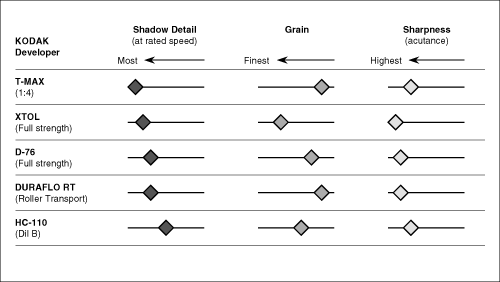
I always find this assesment by Kodak of their own developers and film combinations interesting
TasQd.gif

HC-110 comes out very middle of the road in the three categories.
 

Kawaiithulhu

Member
Allowing Ads
Joined
Sep 20, 2013
Messages
549
Location
Southern Cal
Format
Multi Format
I find Xtol to be fine with details even if rotary development should hide the edge effects everyone is so fond of. I have to think that 90% of sharpness differences in developers is hidden by lapses in technique, unstable stance or forgetting to use mirror-up modes. Like this 35mm Tri-X + XTol sample hand held in available light. No amount of chemical wizardry could make the bit of movement blur go away. Which reminds me, is there a reference of "same shot different developers" online? I don't have the resources to do any solid experimenting and I find the subject interesting.

4pMwDhP.png
 

Sirius Glass

Subscriber
Joined
Jan 18, 2007
Messages
50,814
Location
Southern California
Format
Multi Format
I always find this assesment by Kodak of their own developers and film combinations interesting
TasQd.gif

HC-110 comes out very middle of the road in the three categories.


Hey, I am the one that usually posts that. I found that I got even better results with replenished XTOL.
 

Gerald C Koch

Member
Allowing Ads
Joined
Jul 12, 2010
Messages
8,131
Location
Southern USA
Format
Multi Format
In literature it is commonly stated that classic developers increasing visual sharpness are mostly based on Metol (Beutler) or p-aminophneol (Rodinal) and are used at high dilutions allowing local exhaustion. Also diluted solvent Metol (Perceptol) and MQ developers (ID11/D76) are said to increase the sharpness.
Really sharpness is one of those fuzzy non-technical terms thrown about by photographers. The correct word is acutance. Which BTW has nothing to do with grain size.
 

MattKing

Moderator
Moderator
Joined
Apr 24, 2005
Messages
55,182
Location
Delta, BC Canada
Format
Medium Format
Hey, I am the one that usually posts that. I found that I got even better results with replenished XTOL.
Sadly, with the recent replacement with a lot of the Eastman Kodak links with Kodak Alaris links, it seems that the link to this chart has become non-functional.
 
Photrio.com contains affiliate links to products. We may receive a commission for purchases made through these links.
To read our full affiliate disclosure statement please click Here.

PHOTRIO PARTNERS EQUALLY FUNDING OUR COMMUNITY:


Ilford ADOX Freestyle Photographic Stearman Press Weldon Color Lab Blue Moon Camera & Machine
Top Bottom