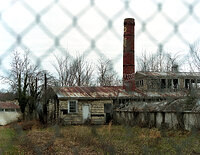
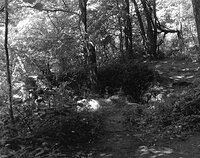
In response to GeorgesGiralt, absolutely. I've done this a few times before, but cutting the film up for use in a 6x9cm 120 camera and for 4x5 film holders.
In my experience, the results are high in both contrast and grain, though they have a nice effect to them. The speed is somewhere around ISO 12 or 25. I've not done specific testing, though I'd suspect it to be on the lower end of that range.
They sell X-Ray films in both blue sensitive and green sensitive varieties; I believe that the green sensitive film is both blue and green sensitive (ortho). I have looked for panchromatic X-Ray film, though it does not appear to exist. It works quite well considering what the film is intended for, but there are a few issues.
First of all, the emulsion is very very soft (at least with the film I'm using). I've accidentally scratched it off completely with my fingernail. Hardening fixer, or a hardening bath somewhere along the line is definetely in order.
Second, most of the X-Ray films out there are double emulsion (one one each side of the base). I believe that this is done to increase contrast for X-Ray work. This softens the image focus-wise, but it's not too bad. I could see this being very nice for some purposes.
Last, many films have a green or blue colored base.
I develop it in D-76 1+1, and it comes out well, but it is contrasty. I haven't worked with it seriously enough to discover how to fix this, but it would certainly possible to tame the contrast.
It can be worked with under a dim red safelight. Be careful, as it fogs MUCH more quickly than paper does, especially the green sensitive stuff. Every time I use the red safelight that I have for paper, I always end up with rather fogged film.
The BEST part about using X-Ray film for visible photo work is the price. There are quite a few suppliers in the US that will send you free sample packs of 8x10 or 11x14 films. Should you want to buy it, its really cheap. I think that 11x14 sheets end up being a dollar or two.