


• Welcome to Photrio!
    Registration is fast and free. Join today to unlock search, see fewer ads, and access all forum features.
    Click here to sign up

WWII films - what would you guys do?

High Street

A
High Street

  • 0
  • 0
  • 23
Plato's Philosophy.

A
Plato's Philosophy.

  • 2
  • 2
  • 91

Recent Classifieds

Forum statistics

Threads
201,869
Messages
2,831,471
Members
100,993
Latest member
DIY123
Recent bookmarks
0

AllanD

Member
Allowing Ads
Joined
Apr 13, 2003
Messages
121
Location
UK
Format
Medium Format
Hi all,

A friend of mine bought this lot at a boot sale (photo below). Some have been exposed and some remain unused. No clues re. provinance, how they have been stored (other than in an old cigar box, in their original tin canisters) or what might be on the exposed films. She does know that they are circa 1941-1946, but I don't know were she got that info from. My friend's main interest is in the actual cartridges. She does not want to use the unexposed films. I have suggested to her that there is a chance that something may be recoverable from those that have been exposed. My questions are:

1. If I were to have a go at developing these films, what are your suggestions re. the best developer and process? I have on hand D76, PQ universal and the makings of D23 or basic M/Q or P/Q type developers. I also have available some CD3 and CD4, if something more exotic would do the best job. I have two retrainers available; potassium bromide and benzotriazole.

2. I am presuming that the used films are B&W. Is this correct? Either way, would I be better off processing all of them as B&W?

3. Do these film canisters come apart easily, or would I be better off trying to pull out the leader? As I said, my friend is mainly interested in the cartridges as an addition to her collection of old cameras.

I do not have the films on hand, so I cannot say anything more about them than you can see from the attached photo.

What would you guys do?
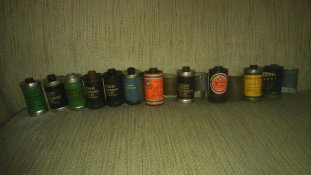

11071299_959530524065195_7307391285990146198_o.jpg
 

Gerald C Koch

Member
Allowing Ads
Joined
Jul 12, 2010
Messages
8,131
Location
Southern USA
Format
Multi Format
If any of the unexposed films are on nitrate base then discard them. They are a fire hazard.

Acetate films may have experienced vinegarization. You can tell by the smell. Again discard any unexposed ones as unusable.
.
If you decide to develop some of the exposed films then do not use an anti-foggant like benzotriazole or add any additional bromide to a developer.
 
Last edited by a moderator:

pdeeh

Member
Allowing Ads
Joined
Jun 8, 2012
Messages
4,770
Location
UK
Format
Multi Format
I've had good luck exposing nitrate stock from a similar era and developing it in D23 1:1 with 0.5g/L of KBr. Without the KBr the fog level was too high. Only because I had D23 already made up, it isn't ideal for such old film. D76 stock might be better to give the contrast a kick.

There are easily found pdfs on handling (or not) nitrate films (e.g. http://www.nationalmediamuseum.org.uk/~/media/Files/NMeM/PDF/Collections/Universal/NitrateFilm.pdf) , and if you do want to dispose of them then you'll need to contact your local authority because they shouldn't just be thrown into the rubbish for collection with your household stuff.
Contrary to popular myth it won't spontaneously combust but it is very flammable indeed. If you have a hankering to burn some just to see how it goes up (like a bomb, actually) Don't breath the fumes, by the way - they are hideously toxic.

I'd guess they're acetate though.

I'm not sure why Gerald thinks one shouldn't use a restrainer - perhaps he could elaborate?
 

cliveh

Subscriber
Allowing Ads
Joined
Oct 9, 2010
Messages
7,801
Format
35mm RF
I would not discard any of them and try and develop each one in turn re advice link given by Richard. Those films may hold several classic images. They are like archaeological finds that need to be carefully excavated (in this case developed) and should be handled and processed with care.
 

Gerald C Koch

Member
Allowing Ads
Joined
Jul 12, 2010
Messages
8,131
Location
Southern USA
Format
Multi Format
I'm not sure why Gerald thinks one shouldn't use a restrainer - perhaps he could elaborate?

The latent image on old film has already lost part of its density. You don't want to decrease this any more. Remember that anti-foggants not only decrease fog density but image density too. The same applies for bromide.
 
Last edited by a moderator:

snapguy

Member
Allowing Ads
Joined
Jan 1, 2014
Messages
1,287
Location
California d
Format
35mm
WW2

I was around in World War II but awful young. These films (it is sort of hard to read the labels) look to me like non-nitrate films of the WW2 era. Super Double X (for still cameras) was pretty big into the 1950s and Plus-X and Tri-X came after it. The casettes should come apart if you push on the small end (in the darkroom of course.) I still use some of this type of casettes for reloading. I would read up on the problems consistent with this type of film and its age (you got some good advise from others here). Good luck. There might be some gems there.
 

Simon R Galley

Member
Allowing Ads
Joined
Nov 2, 2005
Messages
2,034
Location
Cheshire UK
Format
Medium Format
Dear AllanD,

I cannot see anything that is likely to be nitrate at all but you do have colour, I think they are probably post WWII.

BUT : The monochrome should absolutely be processed, the simplest way is D76 / ID11 12 minutes is our usual advice. You probably will have nothing but you may have something, regardless its important that you process and check.

As to the cartridges ( cassettes ) the bottom should come off and be replaceable on the body, if you have difficulty the logic is to get the film leader and remove the film by pulling very,very slowly till it stops, and cutting off directly from the opening aperture ( velvet ).

I am colour ignorant, but guess some apuggers may be able to offer some solutions ( no pun intended ).

Simon: ILFORD Photo / HARMAN technology Limited :
 
OP
OP

AllanD

Member
Allowing Ads
Joined
Apr 13, 2003
Messages
121
Location
UK
Format
Medium Format
Thanks for the replies and encouragement everyone. I will not be rushing into this and will do more research when I receive the films. Honestly, it never occurred to me that any of the films could be nitrate, but I will warn my friend. Of course, I will post my results if, and when, I give it a go.
 

railwayman3

Member
Allowing Ads
Joined
Apr 5, 2008
Messages
2,816
Format
35mm
If the Agfa films carry reference to "I G Farben" or Berlin, they could be WW2 (or earlier) (I G Farben being the chemical conglomorate which was the then parent company of Agfa, but was also notorious for the production of WW2 poison gases, for which work it was dissolved after the war). But it would obviously have to be old stock if a UK photographer were still using Agfa film during the war ?

After the war, Agfa was separated into the West German company in Leverkusen, and the East German company in Wolfen (later to be Orwo), so there could be references to those factories on the rolls which would date the films later. If the Kodak films were known to be from the same period, this might help in dating.

(As referenced in other threads, the Agfa history is very complicated right up to the present date!)
 
Photrio.com contains affiliate links to products. We may receive a commission for purchases made through these links.
To read our full affiliate disclosure statement please click Here.

PHOTRIO PARTNERS EQUALLY FUNDING OUR COMMUNITY:


Ilford ADOX Freestyle Photographic Stearman Press Weldon Color Lab Blue Moon Camera & Machine
Top Bottom
