
• Welcome to Photrio!
    Registration is fast and free. Join today to unlock search, see fewer ads, and access all forum features.
    Click here to sign up

Wm. Eggleston: How'd He Get Such Vibrant Color?

Somewhere...

D
Somewhere...

  • 5
  • 2
  • 110
Iriana

H
Iriana

  • 7
  • 1
  • 175

Recent Classifieds

Forum statistics

Threads
202,752
Messages
2,845,112
Members
101,505
Latest member
PeterFFM
Recent bookmarks
6
I love the deeply saturated colors, but how did he accomplish that?
He had a lot of prints made as Dye Transfers - the contrast index that the RGB separations are processed to will determine the saturation in the final print. A higher CI = more saturation. This is a very simple explanation of the process, but there's a fair bit of info out there, including how to make your own matrix film etc, if you're obsessed enough with the process, given that Kodak stopped making the materials in the early 90's.
 
LOL - I wasn't intending to start a discussion of his content (which I love), just trying to understand his process.

I read a little bit of that old thread, and all I can say is there are bashers and disbelievers for every artist that anyone can name.

DYE TRANSFER! Thanks for that.
 
I don't know how the giant prints were made at his show when he moved to Zwirner but they were incredible too, and not dye transfer. They were probably four feet tall. There were dye transfers there as well and they were sublime.

Anyway I think he was getting his color by using slow slide film, shooting in favorable light, using quality people and materials for printing, and, oh yeah, being a genius.

:smile:
 
I don't know how the giant prints were made at his show when he moved to Zwirner but they were incredible too, and not dye transfer. They were probably four feet tall. There were dye transfers there as well and they were sublime.

Anyway I think he was getting his color by using slow slide film, shooting in favorable light, using quality people and materials for printing, and, oh yeah, being a genius.

:smile:
Wonderful! I agree totally on the genius attribute. I can still recall being floored when my old art mentor first pulled out a book on Eggleston.
 
More about printing. For the past 10 years or so I have been exclusively using Epson printers to make my own prints. Ergo, I have totally lost my understanding of what current color labs can do. I dumped by Epson last year because it was getting old and misfiring a lot. I also put down my cameras. Now, I have picked them up, and have no handy source of prints. So, I'm just trying to get my arms around current the process again.
 
Quoting from Wikipedia: In 1994, Eastman Kodak stopped making all materials for this process. The dyes used in the process are very spectrally pure compared to normal coupler-induced photographic dyes, with the exception of the Kodak cyan. The dyes have excellent light and dark fastness. The dye transfer process possesses a larger color gamut and tonal scale than any other process, including inkjet. Another important characteristic of dye transfer is that it allows the practitioner the highest degree of photographic control compared to any other photochemical color print process.

Arghhhhh.
 
Wonderful! I agree totally on the genius attribute. I can still recall being floored when my old art mentor first pulled out a book on Eggleston.

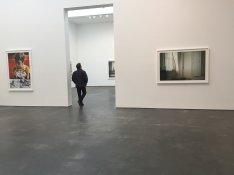
An example shot from my phone. The prints were awfully big considering their 35mm negative size. But the color was great.
IMG_1024.jpg
 
Quoting from Wikipedia: In 1994, Eastman Kodak stopped making all materials for this process. The dyes used in the process are very spectrally pure compared to normal coupler-induced photographic dyes, with the exception of the Kodak cyan. The dyes have excellent light and dark fastness. The dye transfer process possesses a larger color gamut and tonal scale than any other process, including inkjet. Another important characteristic of dye transfer is that it allows the practitioner the highest degree of photographic control compared to any other photochemical color print process.

Arghhhhh.

there are people who are making their own matrices &c from scratch
not sure if he is still is ctein might still be doing it ...
http://ctein.com/dyetrans.htm
 
I don't know how the giant prints were made at his show when he moved to Zwirner but they were incredible too, and not dye transfer. They were probably four feet tall. There were dye transfers there as well and they were sublime.

Anyway I think he was getting his color by using slow slide film, shooting in favorable light, using quality people and materials for printing, and, oh yeah, being a genius.

:smile:

A good drum/ high end CCD scan (not an Epson or a minilab machine), competent Photoshop work, & output with a good pigment ink inkjet printer on a baryta paper is pretty stunning & can get you not far off the ballpark of dye transfer colour etc. You can use neg or transparency film & you don't have the grain issues of Super-XX as a separation film (though TMX was suggested latterly as an alternative in the literature). The kit is not desperately esoteric, but it does need competent, skilled people to use it well. You'd be surprised at how well a 35mm neg holds up at 4ft across...

Film-wise, probably Kodachrome 25, quite a bit of Ektachrome (I recall he used a Mamiya Press & even a 5x7 at one point) and quite a lot of colour neg too.
 
I think you have your answers already. I've just come in to say "Add me to the Eggleston Appreciation group" as well! Saw his exhibition in Melbourne last year and was very much in awe of his work.

(BTW, there appears to be a few members on this forum who tend to think there was only ever one great photographer, AA be thy name)
 
Photrio.com contains affiliate links to products. We may receive a commission for purchases made through these links.
To read our full affiliate disclosure statement please click Here.

PHOTRIO PARTNERS EQUALLY FUNDING OUR COMMUNITY:



Ilford ADOX Freestyle Photographic Stearman Press Weldon Color Lab Blue Moon Camera & Machine
Top Bottom