• Welcome to Photrio!
    Registration is fast and free. Join today to unlock search, see fewer ads, and access all forum features.
    Click here to sign up

Wide angle lenses image angle coverage confusion

Viaduct.jpg

A
Viaduct.jpg

  • 3
  • 1
  • 45
Durham walk.jpg

A
Durham walk.jpg

  • 0
  • 0
  • 32

Recent Classifieds

Forum statistics

Threads
202,538
Messages
2,842,056
Members
101,369
Latest member
hluvmiku
Recent bookmarks
0

Alexz

Member
Allowing Ads
Joined
Sep 21, 2004
Messages
365
Location
Israel
Format
Multi Format
Looking into wide angle lenses specifications I'm getting lost in image angle numbers:
for instance, there are 65mm/4.5 (Grandagon-N) shows image angle of 105 deg, whilst a longer, 90mm/4.5 Grandagon-N shows similar 105 deg. This doesn't sound to me logical, I used to the rule that longer focal lentgh lenses have narrower angle coverage. Do I mix up different things altogether ? Or in LF conventional physics rules are not always applied ? :smile:

Alex
 
You're looking at coverage angle.

Image angle will depend on the format you stick behind the lens. In LF the lens company has no control over you.

Take the 65mm. Stick it in front of a rollfilm back with 6x4.5 film in it. It's just a little wide. Move up to 6x9 and it's gotten wider. Move up to 4x5 and it's much wider. Same lens.
 
Thanks, but this is clear for me, what I meant is that for the same format (4x5) they mention the same image angles for different focal lentghes, i.e.
both 65mm/4.5 Grandagon-N and 90mm/4.5 Grandagon-N have the same 105 deg. image angles at 4x5 format.
 
No, they don't mention image angle on the film. They mention image angle in front of the lens. How much of this you choose to record on your film is up to you, you choose that by selecting film size.

All Grandagon-N lenses share the same construction and the same image (field) angle.
 
Thanks Ole, but still doesn't clear the issue for me.
I mentioned that for this instance, I consider one particular format, 4x5.
The manufacturer mentions the same image angle for different focal lengths, say 105 deg.
Yes, you're correct, I can alter the actual angular coverage on film by switching formats, but for a given single format (say, 4x5), if both lenses are said to produce similar image angle, I also obtain the same angular coverage on film.
I.e., if both 65mm and 90mm lenses are advertised to ofer 105 deg., shooting on 4x5 both of them produce the same angular view on film ?
 
Nick's answer was the answer, and I think you're still confused about the difference between the angle of view an the angle of coverage.

These lenses both cover 105 deg. They project a cone of light that has an angle of 105 deg, independent of film format. The 90mm lens has a larger image circle than the 65mm lens at infinity, because the 90mm lens is farther from the film plane at infinity than the 65mm lens.
 
NO!!!!!

Read what I said again: The specification is only for the field image angle, which turns into image circle or angle of coverage on the film side.

LF lens makers don't specify what film size their customers should use, only the maximum angle or radius of coverage.

My 90mm is a moderate wide-angle on 4x5. So if I want more angle, I'll put the same lens on a 5x7" where it is very wide. Specifications haven't changed, only how big a piece of the 105 degrees image angle I decide to use.
 
Let me have a go here. One thing you are not taking into consideration is the focal length. Imagine you have both lenses floating in the air in front of you. Both have the same shaped cones of light coming through them at the same angle. The difference is that when you focus your 4X5 sheet of film, the 90mm lens has you 15mm further away from the nodal point of the lens so it is actually takin up less of the cone with the film. Therefore, you are getting a smaller image angle on the film with the 90mm than the 65mm. Basically you are working with two angles here and the image angle will be smaller and fit inside of the lens coverage angle. The film sits further back from the lens on the 90mm so it defines a smaller image angle. I wish you were sitting here so that I could draw this on paper, it would make more sense. :smile:
 
Paul Sorensen said:
The difference is that when you focus your 4X5 sheet of film, the 90mm lens has you 15mm further away from the nodal point of the lens so it is actually takin up less of the cone with the film.

Paul, I don't quite know what means the 'nodal point of the lens' - I guess you mean the centre through which one measures in optical laws - , but shouldn't the 90 mm take up more of the cone rather than less compared the 65mm?
 
Now it gets clearer, thank you guys.
I guess, Paul you meant not a nodal points but rather principal focusing points of the lens (albeit for very particular lens design principal focusing point conicide with nodal point).
What aparently clarified a picture for me is the note of Paul that albeit featuring by similar image angle, to focus on similar focus plane we need different distances to the film plane for 65mm lens and 90mm lens which means different cone in coverage on the film, thus causing different viewing angles obtained on the film.
Hope I made myself clear enough now for understanding. :smile:
 
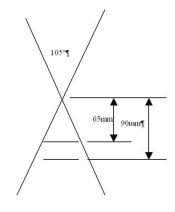
Heres a quick diagram of what is happening.
 

Attachments

  • angle.jpg
    angle.jpg
    18.1 KB · Views: 125
Rlibersky said:
Heres a quick diagram of what is happening.

Yup. that's it. Maybe you should have made the film planes inside the cone two different colors? That way it is clearer what happens to the image on an equal surface (say a 4x5' film) at different distances from 'nodal point'. This way it is much clearer what Paul means by taking up 'less of the cone'. We should do this more often with diagrams, it's fun.
 
Perhaps it would have been easier if some of the terms were used more carefully - we should make a distinction between "angle of view" (which is defined by lens' focal length - i.e. what the lens "sees" in front of the camera) and the "angle of coverage" (which is the image circle the lens projects "behind" it - i.e. on film).

I think Alex was initially confused by "image angle" - which would be better named "angle of coverage" in the above sense.

Denis
 
Ok guys, I'm grateful to all who tried to help me out, but lets put things simple:
in 35mm format we all got used to the rule that shorter focal lengthes produce wider angle of view, i.e. 50mm lens produces wider view on the film then 100mm lens and 28mm lens is wider then 50mm.
So this is the issue I was trying to clarify here, but for LF lenses in this instance.
 
I think people coming from other formats get confused by the difference between angle of view and angle of coverage, as Denis points out. Aleza is looking for the angle of view of the various focal lengths, which of course becomes larger (for a given format) with shorter focal length.

There is a simple equation that gives the answer, as long as you have a scientific calculator or trig tables (or a lot of patience). For a lens of focal length f mm, and film of dimension d mm (say the diagonal, or perhaps the length), the angle of view across dimension d is theta = 2 inverse tangent (d / (2f)). An example: f = 65 mm and 120 mm length of 4x5 film: theta = 85 degrees.

Here is a previous discussion: W.A. Lenses and Angle of View at (there was a url link here which no longer exists)
 
Exactly, Michael, thanks.
I remember developing this formula a while ago by basic geometry optics rules, just have been forgotten.
So the physics laws are still applicable in LF. :smile:

Thanks, Alex
 
Photrio.com contains affiliate links to products. We may receive a commission for purchases made through these links.
To read our full affiliate disclosure statement please click Here.

PHOTRIO PARTNERS EQUALLY FUNDING OUR COMMUNITY:


Ilford ADOX Freestyle Photographic Stearman Press Weldon Color Lab Blue Moon Camera & Machine
Top Bottom