• Welcome to Photrio!
    Registration is fast and free. Join today to unlock search, see fewer ads, and access all forum features.
    Click here to sign up

Why was Verichrome Pan discontinued?

Recent Classifieds

Forum statistics

Threads
203,199
Messages
2,851,176
Members
101,718
Latest member
ClassyJ
Recent bookmarks
4
Verichrome Pan lived a long and to some a useful life. To others of us VP never lived up to the claims of how wonderful it was supposed to be. I agree that it was intended to be "the" film of choice for box camera users. I believe it did a satisfactory job in that category, but many of us were not at all happy with it for repeatable professional use in top of the line medium format cameras. Panatomic X was everything that some folks believe VP to be a faster Pan X and was very similar, chemically it may have been, but it is simply not true that the two emulsions worked equally well.

VP seems to have become one of photography's myths and is being touted by some to have been a wonderful long scale film. I and many others did not find that to be the case. There were several films available at that time that gave superior results to the best that VP had to offer. Super XX for instance, Ansco had a great film named Hypan, later Super HyPan or something like that. Gevaert had some wonderful films that did everything that VP was supposed to do, but diden't. Believe the myth if you want to, but I know better!

Happy dreams of of films now long gone! Thank the Lord that Kodak had the good sense to remove VP from the market when it did. Now I'll bet the flames begin!


Charlie..............................................
For the record, I am not knocking Verichorme Pan simply making the point that today it is rated well above what it could actually deliver in it's best day. I could never repeat
the claims the photo mags claimed for it in my darkroom or studio.
 
Check out the name of the seller as well. Very aptly named in this case.
 
That film has been exposed, it has no guard edges and is not a 'real' item. It is probably some sort of contrived item with no basis in reality.

Large rolls of that film came on spools with large side flanges to prevent exposure. They had no paper backing, just as in 220 film.

Caveat Emptor.

PE
 
Verichrome Pan lived a long and to some a useful life. To others of us VP never lived up to the claims of how wonderful it was supposed to be. I agree that it was intended to be "the" film of choice for box camera users. I believe it did a satisfactory job in that category, but many of us were not at all happy with it for repeatable professional use in top of the line medium format cameras. Panatomic X was everything that some folks believe VP to be a faster Pan X and was very similar, chemically it may have been, but it is simply not true that the two emulsions worked equally well.

VP seems to have become one of photography's myths and is being touted by some to have been a wonderful long scale film. I and many others did not find that to be the case. There were several films available at that time that gave superior results to the best that VP had to offer. Super XX for instance, Ansco had a great film named Hypan, later Super HyPan or something like that. Gevaert had some wonderful films that did everything that VP was supposed to do, but diden't. Believe the myth if you want to, but I know better!

Happy dreams of of films now long gone! Thank the Lord that Kodak had the good sense to remove VP from the market when it did. Now I'll bet the flames begin!......


Please don't flame him - or me either!

Reading through this thread has been a fascinating journey into a particular film's "history".

Seems to me that the product was simply replaced by what The Great Yellow Father considered to be a superior one. Opinions may vary on whether that was a wise choice but it's not as if it died an unnatural death at the hands of the evil digis - it simply got "upgraded". :wink:
 
Verichrome Pan

When I got a Yashicamat 124G in High School the two films I started with were Tri-X and Verichrome Pan. Verichrome was the least expensive b&w 120film I could find that was made by a major manufacturer and was fresh. It had very fiie grain. I would say that it was less tolerant of underexposure than either Tri-X or Plus-X but was much more tolerant of overexposure. I remember photographing the conservatory at the NY Botanical Gardens in The Bronx with the 124G with Verichrome and with a tripod. This was before the many overhauls of the dome which came later. The 8X10 was so sharp and fine grained you could see every bit of peeling paint. Later I came to like Panatomic-X for slow speed work but I have many good memories of using Verichrome. I was also disappointed when Kodak discontinued Panatomic-X and claimed that TMX was a good replacement.
 
For years my 120 size b/w film of choice was Verichrome Pan. I got great results with this film developing in WD2D Pyro developer. It was also cheap. The cheapest to purchase Kodak brand b/w film in 120 format.
 
I always thought the reason was the demise of the one-exposure-setting box camera, since VP was a thick-coated film designed for maximum exposure latitude when used with this type of camera. I thought that Kodak felt that Plus-X was the natural successor to VP if extreme tolerance to exposure errors was not required.

Regards,

David

Are you sure that the box camera film of long ago was Verichrome Pan and not Verichrome? Verichrome Pan began when Verichrome ended. The reason Verichrome Pan could not easily be used in the same cameras that used Verichrome was that the window that showed the frame number was red. The film backing paper was dense enough to make that a non-issue if you kept it out of direct sunlight. However, if your camera had the red window, it was designed to use ortho film. Kodak didn't design cameras to use film from other makers.
 
Are you sure that the box camera film of long ago was Verichrome Pan and not Verichrome? Verichrome Pan began when Verichrome ended. The reason Verichrome Pan could not easily be used in the same cameras that used Verichrome was that the window that showed the frame number was red. The film backing paper was dense enough to make that a non-issue if you kept it out of direct sunlight. However, if your camera had the red window, it was designed to use ortho film. Kodak didn't design cameras to use film from other makers.

Kodak, like all other film makers, did for a long time offer an orthochromatic roll film - their name for it was Verichrome, Ilford's was Selochrome, etc., hence the red window you describe. This was a little before my time - from the mid-50s onwards, I seem to recall that the film had changed to a panchromatic version called Verichrome Pan (Ilford - Selochrome Pan, etc.). The wind-on windows became very deep red when pan film came in. As far as I am aware, the philosophy behind both the ortho and pan versions was a double coating of the type described in another posting, with the aim of providing maximum exposure latitude (mainly tolerance to overexposure). In the days when box cameras had single-meniscus lenses, the ortho emulsion probably allowed sharper results, since the camera focus could be fixed for blue-green, red rays which were out of focus due to chromatic aberration would simply not register on the film.

By the mid-50s, snapshot cameras users were being given lenses with at least some color correction in the hopes (of the film manufacturers) that they would use nice expensive color film (Kodacolor negative film was, IIRC, also engineered for very wide exposure latitude). Users probably were starting to feel, too, that the color rendition of ortho film was a bit peculiar (any red skin blemishes reproduced as black, etc.), this was probably one reason to switch to pan.

Like other posters here, I recall VP as being relatively grainy - it had as already mentioned a thick emulsion, and there's no such thing as a free lunch!

Regards,

David
 
The semi-official reason, as I recall, was that VP and PX were redundant, especially with the recent improvements in PX. This happened at the same time Kodak did its massive revision of films - discontinuing 620, 127, 116, 616 and probably some other sizes as well as a lot of different kinds of film. In its last years, I preferred VP over PX, and I thought they discontinued the wrong film. But I understand sales were zilch except in Latin America, while PX at least had miniscule sales in MF. VP was designed as a very wide latitude film for simple, non-adjustable cameras. It had a long toe and superb image quality. I suspect it may have been a bit more difficult and expensive to make than PX.
 
The reason Verichrome Pan could not easily be used in the same cameras that used Verichrome was that the window that showed the frame number was red. ... However, if your camera had the red window, it was designed to use ortho film.

My old Brownie Starflash had a red window in the back, and was intended to be used with Verichrome Pan or Kodacolor. I don't remember any issues with fogged film because of it.

I do remember, however, on one of my dad's old folders was that there was a movable cover over the red window that you opened only when advancing the film.

I seem to recall on one of the vintage camera sites that there was one particular model of Kodak camera that had a GREEN window for viewing the frame numbers.
 
My above mentioned Kodak Brownie Hawkeye camera circa 1958 had a red window and came with Verichrome Pan. I never had a fogging problem, but occasionally it would take photos with street signs hanging out of my brother's ears or trees growing out of my sister's head. These problems when a way when I got a filter that improved compositions.

Now where did I leave that filter?

Steve
 
I discovered VP some time in 2000-2001 when Silverprint started importing it into the UK (also through Barry Thornton's piece in Ag magazine)-I was smitten! Tonality with PMK was super smooth with that old thick emulsion look and grain was pretty good too (BT quoted RMS granularity figures of 10 for VP versus 9 for TMAX 100 if that means anything)-certainly hardly visible on a 10 x10 in unless you had your nose in the print. Gutted when it went, but there's still Efke/adox and Foma to try some more (Adox 100 in PCAT has that same look about it)....life goes on.
 
Verichrome Pan replaced orthochromatic Verichrome about 1957.

Another feature of Verichrome Pan is incredible shelf life, both unexposed and exposed. It was designed for folks who could only afford to take a few pictures a year, so it might take a few years to finish off a roll and get it processed.

Sure, there's speed loss, and a bit of base fog, but 1960 Verichrome Pan is quite usable.

I suspect that Verichrome Pan could have stayed on the market longer if they had moved it through the professional products distribution channel, rather than through the consumer products (drug-store, etc.) channel. The consumer market for it was deader than a doornail, nobody wanted to process the stuff.

Of course, having three B&W films of the "same" speed (Verichrome Pan, T-MAX 100, and Plus-X 125) was a bit of excessive self-competition.
 
I still have a couple rolls of this stuff left. I sold the majority of it years ago. A few years back I bought the last 11 rolls any store in North America had. It was long discontinued when I got them. You see them on Ebay now and then. I have heard the grain is finer with VP then PX. I still have yet to find what look this film has compared to others. Pan X was another interesting film. There are some 100 foot rolls actually on Ebay as we speak. But I found Pan X to be contrasty in anything but dull lighting. This is why I would probably use Plus X instead. And you can still get that fresh today.
 
I just shot a roll a Verichrome Pan film that had an expiration date of 8/1995 in a No.2 Cartridge Hawk-Eye model c, and the results were fantastic. Using modern films like Ilford Pan F left me with under exposed negatives. Even Ilford FP4 left me with negative that were a bit under exposed. So to use my older box cameras, I have been buying up late expiration date Verichrome Pan off of that auction site. I don't know if it's because Spring is right around the corner or people are starting their spring cleaning earlier, or maybe that Plus-X has been discontinued, but I have noticed that there is more Verichrome Pan coming up for auction than I has seen in a while. 127, 116/616 and even 122 up for grabs. It's time to buy some film and get those unused cameras moving again.
 
Verichrome Pan film was double coated containing a slow speed emulsion and a higher speed one. It was ideal for simple cameras as it gave much greater exposure latitude. I would check to see what is available from former eastern block countries to see if there is something comparable.
 
Let's give due credit to VP. How many of us (and I'm dating myself) got started with VP and Tri-Chem packs? In many respects it was amazing what VP could do in the simple box cameras of the early 60s.
 
Don't forget Universal MQ developer and Velox paper in the 2-1/2 x 3-1/2 size, 25-sheet packages. The Kodak Fixer (powder form, non-rapid) probably hasn't changed in all that time, except for the packaging!
 
I just shot a roll of May 1966 expired VP 126 in my old Instamatic X-15F and it still worked great! I used to shoot a ton of it and bought some 120 and 620 recently as well.

That said, I like FP4+, T-Max 100 and Delta 100 too but they look very different. I do miss VP and will continue to pick up cheap deals though it is kind of silly to buy such old stuff. Nostalgia! Gets me every time.

I souped it along with the FP4+ for 9:00 @20C and it turned out! Hard to believe, film probably made in 1963 and it still worked.


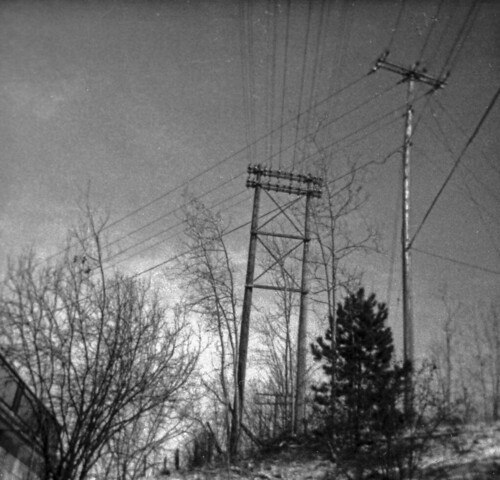
Convergence by Harry Pulley, on Flickr


Dark woods by Harry Pulley, on Flickr
 
Last edited by a moderator:
One thing Verichrome Pan doesn't have is acuity. (Look at the Kodak data books.) It's fine-grained, but not all that sharp, probably due to the thick emulsion. Very nice tonality, but if you want crisp, TMAX 100 is the recipe. Still, I think there are more rolls of Verichrome Pan in my film fridge and freezer than any other film, in 828, 127, 120, 116, 616, and 122 sizes.
 
I have a private stash of VP 120 in my freezer that I use for landscapes in my Cambo 23SF 6x9 camera. I bought every roll I could find and now I'm running out. :sad:

Great film no doubt.
 
Then send some rolls of VP 120 to me so that I can test them. That way you will run out even faster!

:wink:
 
I got an exposed roll of 1959 expired VP620 along with a lot of unexposed VP620, same 1959 expiry date which must be from one of the earliest runs of Verichrome Pan. I don't know when it was shot but I developed it last night in HC-110 1+31 6:00 @18C (65F) and there are pictures! And there are people, jackpot! Not celebrities or anything, just someone's snapshots, likely from a Kodak Six-20 of some sort I bet. Amazing how this stuff can last.

It was wound VERY tight so loading it onto a Paterson reel wasn't easy and it was fun to bet it hung up to dry but it is drying now. I'll try to get something off of it soon.
 
Photrio.com contains affiliate links to products. We may receive a commission for purchases made through these links.
To read our full affiliate disclosure statement please click Here.

PHOTRIO PARTNERS EQUALLY FUNDING OUR COMMUNITY:


Ilford ADOX Freestyle Photographic Stearman Press Weldon Color Lab Blue Moon Camera & Machine
Top Bottom