• Welcome to Photrio!
    Registration is fast and free. Join today to unlock search, see fewer ads, and access all forum features.
    Click here to sign up

Why large format?

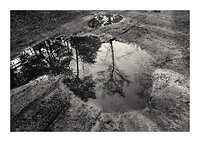
Tree of a kind

H
Tree of a kind

  • 1
  • 0
  • 0
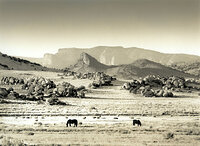
Two Horses

A
Two Horses

  • 10
  • 2
  • 41

Recent Classifieds

Forum statistics

Threads
202,803
Messages
2,845,720
Members
101,541
Latest member
ΦÆdon
Recent bookmarks
0
8x10 negative allows me to contact print in Alt. processes. The camera movements allow for manipulation of image geometry, focus plane... Image resolution is also a plus.
 
I started with 4x5 in 1995, and in the past five years added 5x7, and a year & half ago added 8x10. It comes down to four main reasons for me:

1. It's fun. LF is a slow, much more hands on type of photography. It's more in the historical feel which appeals to me.
2. I can make negatives big enough to make contact prints. These prints can be done in a number of historical processes such as albumin prints etc.
3. The main reason is I just love using antique lenses. I have a set of beautiful and impressive (big!) brass lenses made before the 1860s, also some from around 1900-1920a. I love the look these lenses give.
4. I'm not limited to just shooting film with LF. I also shoot dry plate (1880-1920 technology,) and have been doing wet plate (1850--1880) with it. I find wet plate to be the most fun and challenging photography of all! I've been doing it for three years now.

I find I often do use lens movements, especially front rise, and also some front tilt. Mainly though I love LF for it's connection to history, especially 19th C.


Kent in SD
 
I'm nuts like you. At the beginning of Covid with nothing else allowed to do, I bought a Chamonix 4x5 and 4 lenses. I figured I could get out by myself in the woods and be happy alone. I was shooting medium format for years as a hobby and didn't really need the LF. I guess it was gas. I don't develop at home so it's expensive but I don't shoot that much. Then I went out and spent $1100 on a new scanner for 4x5 (Epson V850) making my V600 superfluous since it only shoots up to 6x7 MF.

LF is even more deliberate shooting than MF which is nice when you want to contemplate your navel. I don't print but the tones do look nicer than smaller formats. See my Flickr for a comparison of the different formats both in color and BW.

Frankly, if I had to do it over, I would have passed on LF and stuck with MF. Now I never know which format I want to shoot in.

Alan--

Processing b&w is very easy. I compare it to making pancakes. Get a Stearman Press 445 and a few chemicals (HC110, Rapid Fixer) and go for it. You can also use the SP445 to process color. It's slightly more involved--an extra chemical step and you keep the SP445 at constant temp using a water bath in a big plastic tub. Not only does this save money, but you don't have to wait for your negs to come back. I process all of my own film now and have for over two years. It's quite easy.


Kent in SD
 
Why do large format ? Why not? Old fogged photo paper makes ideal paper for negatives, you can use almost anything that light transmits through as a lens, and you can have people ask you endless questions on the street like "do they still make film for that" or "is that a hasselblad" when you are taking pictures. If you want a GIANT large format camera I think the Abe Morelle book gives you the ingredients to make a room into a camera like his hotell room sceries.
 
You say tedious, I say fun!

Also, Las Cruces...Organ Mountains...really? I've never seen another LF camera in this town other than mine, and rarely seen another MF camera...I guess we're few and far between.

I guess you missed me the several times I was there. I have some great shots at White Sands and the White Mountains, too.
 
I started with 35mm, moved to MF and found myself wanting movements. That's what prompted my move to 4x5. Now, when I go back to a smaller-format, solid-body camera I feel I'm missing the most important part; the camera movements.

I won't ever go bigger than 4x5. My wooding folders are small and light enough that I can hike easily (my kit with four lenses is likely lighter than lots of MF kits).

And, I only work in black-and-white film, developing and printing myself in the darkroom. If I needed to work in color, I'd have a digital back or move to smaller-format digital in a heartbeat. The type of images I like to make lend themselves well to large-format and camera manipulations. If I were shooting sports/action or wildlife (extreme telephoto) or even "decisive-moment" street photography, I'd be using a different camera.

And, as much as I like contact prints, I like to make bigger prints for display. My standard size is 11x14 inches. 8x10s are only for small still-lifes and detail images. I make up to 20x24-inch prints in my darkroom regularly. There's no way I'm going to ever get the images I get hiking long hours lugging an 11x14 or larger camera, so I'll stick with 4x5 and enlarge. Plus, then I can crop to get the image I want (I guess I could take the paper cutter to larger contacts and achieve the same).

Bottom line: it's the movements that make me stay with LF and then just a lightweight (but full-featured!) 4x5 kit.

Sure, I like being able to develop each sheet individually, but really, I end up developing 80% of my negatives "N." I do like not viewing the world through a viewfinder. I use a viewing frame to find and frame my images before I even bother setting up. And, I don't chimp, I don't spend hours going through hundreds of machine-gunned images on my computer screen, deleting the majority and then not printing many of the rest. I make images that I've carefully considered and chosen before releasing the shutter. I like the analog workflow, but that isn't necessarily connected with large-format photography.

So, if large-format doesn't fit with the kind of images you like to make, then avoid it; it's more trouble than it's worth. If, on the other hand, large-format capabilities are things that will enhance the images you like to make, then the trouble is worth it.

Best,

Doremus
 
If you have the chance to observe someone else using LF in real life take it.
Internet videos are great, but actually looking at a view screen and seeing how things come together is quite different.
 
First of all, I wouldn't bother with large format film photography unless you're willing to seriously commit to it for awhile, and properly learn its real potential. And to do that, it's also a good idea to FORGET every comparison with digital shooting, including all that pixel-this, pixel-that talk. What is you're objective anyway? Just more little web snapshots lost among the billions, or serious printmaking? I've been doing mainly LF shooting for the past 45 years, and can't imagine being without it. It can be a real joy in that it slows you down, and causes you to compose things a lot more thoughtfully, whether you intend to seriously enlarge the result or simply contact print it. Think like a sniper instead of machine-gunner : the one shot at a time that really counts. But whatever you choose - don't go halfway with LF - commit to it long enough to appreciate the real difference.

But if you have contact prints in mind, it might make more sense to go with 8x10 or even 5x7 rather than 4x5. And enlargements, quality-wise? Well, even a full frame 35mm DLSR is just a cockroach under the foot of a rhinoceros compared to real 4x5 film.
 
McDiesel, Since you've posted your LF desire in the analog section....I'll just say unless you're going to process your own film, & contact print or enlarge darkroom prints, i'd avoid LF. So much of the experience is tied not only the the big film, but the output.
I've worked with 4x5, 5x7, 8x10 & 4x10. You can do outstanding work with any of the formats, and as mentioned the tonal range and delicacy of contact prints is something special. If you sub out any part of the process, you're missing out on a great deal of the beauty of large format.

Our job at APUG Photrio is to enable people to spend money, buy equipment and use it. Please get with the program!
 
Alan--

Processing b&w is very easy. I compare it to making pancakes. Get a Stearman Press 445 and a few chemicals (HC110, Rapid Fixer) and go for it. You can also use the SP445 to process color. It's slightly more involved--an extra chemical step and you keep the SP445 at constant temp using a water bath in a big plastic tub. Not only does this save money, but you don't have to wait for your negs to come back. I process all of my own film now and have for over two years. It's quite easy.


Kent in SD

Thanks for the suggestion. I don't shoot enough to make it worthwhile. As far as waiting, sometimes it's so long, that I forget what's on the pictures until I get it back from the developer.
 
McDiesel, there are almost as many accessories, lenses, doo-dads, magic bullets, etc. for large format as 35mm. If you truly embrace GAS, that should be enough to make you get that 4x5.
 
All the cool people are doing it...
Join us!
🤓

Only a few Ansel Adams, Imogen Cunningham, John Paul Edwards, Preston Holder, Consuelo Kanaga, Alma Lavenson, Sonya Noskowiak, Henry Swift, Willard Van Dyke, Brett Weston, and Edward Weston, Willard Van Dyke, Minor White.
 
Instead of getting into large format photography, why not choose a somewhat easier hobby -- such as solving global warming?
 
Whaaaat ??? How come thousands of photographers in the 19th and first half of the 20th Centuries routinely worked with box and view cameras, but somehow it's an unintelligible skill today? But then ... I don't know how to take a cell phone picture, and really don't want to even learn how.
 
Instead of getting into large format photography, why not choose a somewhat easier hobby -- such as solving global warming?

Get a large format camera to proselytize solving global warming as Ansel Adams did for helping the Sierra Club.
 
Whaaaat ??? How come thousands of photographers in the 19th and first half of the 20th Centuries routinely worked with box and view cameras, but somehow it's an unintelligible skill today? But then ... I don't know how to take a cell phone picture, and really don't want to even learn how.

-.-. .-- / ..- ... . -.. / - --- / -... . / -.-. --- -- -- --- -. / - --- ---

... speaking of deprecated skills.

Taking a cell phone photo is usually 2 taps and pointing the phone correctly, so I'm sure you could learn if you had a need. I suspect you'd need a smartphone as well (although flip phones usually have a camera as well).
 
What keeps me shooting LF personally is the impact I find from negatives/slides. Perspective correction and control are very nice and I have found times when I am out and about where I wished my camera had more.
I like the super thin depth of field possible for working with living subjects, I enjoy the comparative ease at times for macro work.
Last thing I did was some landscape type work in some ghost towns and I ran out of movements on my LF camera at times despite not really doing anything architectural.
I personally just enjoy the process and I find it helps reduce my GAS tendencies since all I really would want for LF work is sufficient holders to not have to try and unload and reload in a portable darkroom tent and that's easy enough to do.
To me, there is something interesting too about being near the minimum possible camera (with only a pinhole being simpler) and it can be nice to work with purely what I want and not have my camera deciding to override my settings at times because the ttl meter isn't liking a scene.
 
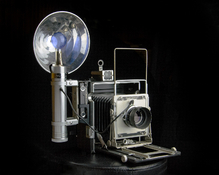
If the main attraction is playing with the large format cameras, rather than resolution, you could consider putting a 120 roll film back on a large format: all of the fun and hassles of large format cameras with none of the film processing hassles or resolution advantages. You can have a lot of fun with a Crown Graphic or Century Graphic (technically, the Century isn't considered large format by some) and a 90mm Wollensak WA Optar for very little money. And there's those cool flash handles and sizzling flash bulbs...
 

Attachments

  • 49582547507_b5a0ebfb64_h.jpg
    49582547507_b5a0ebfb64_h.jpg
    387.3 KB · Views: 126
If the main attraction is playing with the large format cameras, rather than resolution, you could consider putting a 120 roll film back on a large format: all of the fun and hassles of large format cameras with none of the film processing hassles or resolution advantages. You can have a lot of fun with a Crown Graphic or Century Graphic (technically, the Century isn't considered large format by some) and a 90mm Wollensak WA Optar for very little money. And there's those cool flash handles and sizzling flash bulbs...

I have those and I never use a roll back. I much rather shoot 4"x5" if I am going to take the camera out at all.
 
The best argument against shooting 4x5 film format : 8x10 format instead !
 
Imo, viewing upside down and backwards allows “a type” of contemplation that for me is quite satisfying.
 
I'm about to make a large diptych with one print rightside-up, adjacent to an identical print mounted upside-down. It's an image that works equally both ways, and in a manner that the typical personal can't even tell which side was up in the original scene. No - it's not an abstraction. Nothing you actually take a picture of with a camera can legitimately be called an abstraction. It's there. But still, it's fun to mess with the mind.
 
Photrio.com contains affiliate links to products. We may receive a commission for purchases made through these links.
To read our full affiliate disclosure statement please click Here.

PHOTRIO PARTNERS EQUALLY FUNDING OUR COMMUNITY:



Ilford ADOX Freestyle Photographic Stearman Press Weldon Color Lab Blue Moon Camera & Machine
Top Bottom