
• Welcome to Photrio!
    Registration is fast and free. Join today to unlock search, see fewer ads, and access all forum features.
    Click here to sign up

Why do we dilute? Full strength vs Dilution 1:1

Recent Classifieds

Forum statistics

Threads
201,860
Messages
2,831,271
Members
100,987
Latest member
Rubens Cavallari
Recent bookmarks
0

RPC

Member
Joined
Sep 7, 2006
Messages
1,633
Format
Multi Format
There's confusion because Kodak refer to ratio rather than dilution and unless you state clearly what you mean by 1:3 there's ambiguity. In some publications Kodak do use the term ratio.

Other companies use very much clearer terms and this is why typical dilutions might be listed as 1:20 with instructions stating that's 1 part developer + 19 parts water.

So a Dilution of 1:20 is actually a Ratio of 1:19. This is also why dilutions are often 1 +9, +19. +29 etc

Kodak are very clear in the HC110 data-sheet that the 1:3, 1:29 etc etc are ratios, while in the data sheet for D76 j-78 they incorrectly state it can be Diluted 1:1 something that's a oxmoron as it means the starting volume is the same as the final volume and no dilution has occurred. Luckily most people realise what they mean. Whoever wrote some of the Kodak data-sheets began mistakenly calling Ratios dilutions.

Ian


I have seen it everywhere in the photographic literature--the "dilute a:b" designation as meaning a parts of stock, to b parts of water. So even though it may somehow be construed as being technically incorrect, it is common usage, and I think it is so because that's what most have seen, and I think it makes more sense to most people.
 

gzinsel

Member
Allowing Ads
Joined
Mar 20, 2011
Messages
402
Format
Med. Format RF
regardless, of what you believe 1:1, 1:20. or 1:3 means. . . .etc , testing is required to affirm or deny, the results you require. experimentation is USUALLY required to get what YOU need to get out of the particular developer, for paper or for film. Time, temperature, aggitation, may need adjustments. Why different companies insist on silly, willy nilly with "their ratios" "their math" is beyond me.
 

Gerald C Koch

Member
Allowing Ads
Joined
Jul 12, 2010
Messages
8,131
Location
Southern USA
Format
Multi Format
If you use the PLUS notation there is no ambiguity. Thus the statement "Dilute 1+7" is very clear. It means dilute 1 part of developer with 7 parts water.
 

RobC

Member
Allowing Ads
Joined
Nov 5, 2007
Messages
3,880
Location
UK
Format
Multi Format
If you use the PLUS notation there is no ambiguity. Thus the statement "Dilute 1+7" is very clear. It means dilute 1 part of developer with 7 parts water.

+1

The voice of common sense.
 

mdarnton

Member
Allowing Ads
Joined
Mar 4, 2008
Messages
463
Location
Chicago
Format
35mm RF
I've been using replenished D76 for 45 years for economy--the people who claim economy for 1:1 haven't done their math. My two quarts of solution (one of developer, one replenisher) will develop 32 rolls of 35mm. Two quarts of developer used 1:1 will develop 16. For 120 the numbers on dilution look twice as bad.

There's another aspect to it: for about a year I've been preoccupied with xray film, large format, and haven't shot much 35mm. The other day I decided to do a run. My D76 was mixed in January 2014, and it's done about 16 rolls. As a consequence of replenishment, the bottle was absolutely filled--no air space at all. The developer was crystal clear. The results were perfect. How would your half full bottle have weathered that? As an added bonus, D76 is unstable in its first months of life--it's well known, or should be, that it changes radically in activity in the first weeks. People who are always using relatively fresh developer are getting something different every time. So much for the consistency argument. :smile:

there is the little matter of how much and how often you actually do development. Most people use very little film and dev so the economies to be had from replenishment are debateable, especially if you're not using the same developer all the time. Having litres and/or gallons of mixed stock lying around in a small darkroom isn't necessarily desirable when it takes you a month of sundays to use only a litre of stock.
 

RPC

Member
Joined
Sep 7, 2006
Messages
1,633
Format
Multi Format
If you use the PLUS notation there is no ambiguity. Thus the statement "Dilute 1+7" is very clear. It means dilute 1 part of developer with 7 parts water.

But someone might think it means mix 1 part water with 7 parts developer!

How about, "Dilute 1 part of developer with 7 parts water". Not much ambiguity there.:smile:
 

removed account4

Subscriber
Allowing Ads
Joined
Jun 21, 2003
Messages
29,832
Format
Hybrid
If you use the PLUS notation there is no ambiguity. Thus the statement "Dilute 1+7" is very clear. It means dilute 1 part of developer with 7 parts water.

hi jerry

the only time i have ever seen the "+" sign is when it ISN'T as you say 1 part developer + 7 parts water, but instead
i was told it was 1 part developer and ( 1+7 ) parts water ...
i just use my default chemistry background and my knowing that at least for sprint chemistry it is as you suggest ( but with a ":" and 1:9 = 10total )
so i automatically make that "total units" a sum of the2 sides of the ":" ..
the chemistry teacher i had wrote text books that lots and lots of chemistry class / intro to chemistry class ( physical science ) use/d ( both part I and II )
and if we had ever used the "+" or translated it any differently than (part) : (part ) we would not done well ...

luckily i don't use anything i am not familiar with these days so i don't get confused about any of this .. but i can see how
someone without a chemistry background, or without familiarity with the solutions and dilutions used can be confused .
 
Last edited by a moderator:

MattKing

Moderator
Moderator
Joined
Apr 24, 2005
Messages
55,200
Location
Delta, BC Canada
Format
Medium Format
If you use the PLUS notation there is no ambiguity. Thus the statement "Dilute 1+7" is very clear. It means dilute 1 part of developer with 7 parts water.

+2

Although I always find this dilution discussion to be historically interesting.

It arises because of Kodak's long used convention, which was to use "1:1" paired with the word "dilution". In olden times, a huge percentage of amateur users used chemicals and films from a single manufacturer, and had on hand the instructions supplied by that manufacturer as part of the packaging, or in separate publications purchased from their local camera store.

If one used Kodak materials, the Kodak convention was for a very long time (and continues to be) consistent throughout the Kodak materials, and there was (and is) no confusion.

If one used Ilford, or Agfa, or ...? the instructions that came with those materials were also consistent within those materials, and there was no confusion.

For those few brave souls who moved from manufacturer to manufacturer, it was likely that they would read the full instructions that came with the materials they used, and understand them.

The confusion arises because of the "Massive" (slight pun intended) increase in the number of information sources, and the sloppy use of shorthand versions of that information.

"1:1" makes total sense when it is paired with the word "dilution", and is used in materials that are internally consistent. If you are just using the shorthand, without all the other more complete but internally consistent materials, then 1+1 is better.
 

Bill Burk

Subscriber
Allowing Ads
Joined
Feb 9, 2010
Messages
9,470
Format
4x5 Format
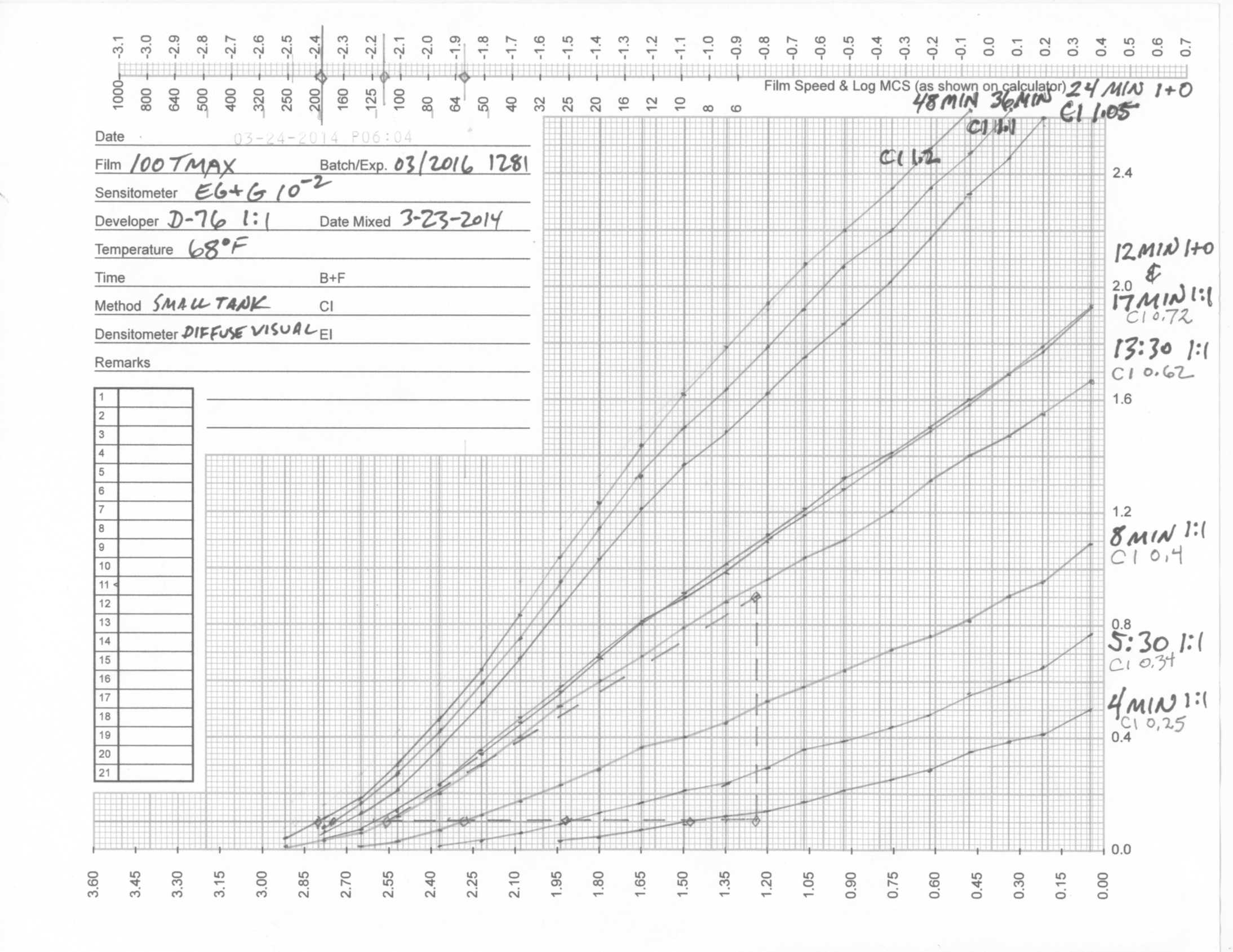
I saw very little difference in curve shape or printing characteristics. Just a time adjustment.

That's what I found too. The curves for TMAX 100 in D-76 at 12 minutes Full Strength and 17 minutes 1:1 are indistinguishable, they coincide exactly in the toe. They stray from each other and meet again along the rest of the curve but never more than 0.02 density units apart from each other.

tmxfamily.jpg
 

Gerald C Koch

Member
Allowing Ads
Joined
Jul 12, 2010
Messages
8,131
Location
Southern USA
Format
Multi Format
But someone might think it means mix 1 part water with 7 parts developer!

How about, "Dilute 1 part of developer with 7 parts water". Not much ambiguity there.:smile:

Whether one uses colon or plus notation the convention is that what is to be diluted is expressed first. So there is really no problem. However to be absolutely clear the additional wording does add clarity.
 

Bill Burk

Subscriber
Allowing Ads
Joined
Feb 9, 2010
Messages
9,470
Format
4x5 Format
I just played it safe and used both notations in my graph...
 

Sirius Glass

Subscriber
Joined
Jan 18, 2007
Messages
50,835
Location
Southern California
Format
Multi Format
But someone might think it means mix 1 part water with 7 parts developer!

How about, "Dilute 1 part of developer with 7 parts water". Not much ambiguity there.:smile:

Of course if one uses stock or replenished developer then one does not have to worry about the : notation or the + notation, or the order of reagents. Life is so much easier with replenisher XTOL.

:tongue:
 
Photrio.com contains affiliate links to products. We may receive a commission for purchases made through these links.
To read our full affiliate disclosure statement please click Here.

PHOTRIO PARTNERS EQUALLY FUNDING OUR COMMUNITY:


Ilford ADOX Freestyle Photographic Stearman Press Weldon Color Lab Blue Moon Camera & Machine
Top Bottom