
• Welcome to Photrio!
    Registration is fast and free. Join today to unlock search, see fewer ads, and access all forum features.
    Click here to sign up

why aren't there chrome slr lenses

Recent Classifieds

Forum statistics

Threads
202,980
Messages
2,848,367
Members
101,574
Latest member
JohnoT2
Recent bookmarks
0

Mewael

Member
Allowing Ads
Joined
Sep 25, 2013
Messages
30
Format
35mm RF
Well atleast before they turned plastic...

I personally like the look of chrome on chrome for Leica LTM/M cameras but then most (maybe all?) SLR lenses turned black. Maybe because at that point, black cameras dominated the pro market (F3 and onward I believe was mostly black for Nikon outside some exclusive models)?
 
Early lenses from the 1950s and into the 1960s used satin chrome barrels. I think that at some point in the early 1960s, makers began to shift to mostly black-barreled lenses.

In 2005, Carl Zeiss AG unveiled its Zeiss Ikon rangefinder system and offered lenses in both satin chrome and black.
 
I think some older SLR lenses were chrome. Someone who remembers exactly which will be along presently. They were probably more costly to burnish and polish than black metal lenses, and may have required higher quality steel. There were late period plastic AF SLR lenses in silver.
 
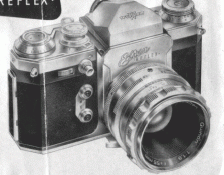
The 50mm lens on my 35mm Edixa reflex (1954-1959) is silver, not black.
edixa_3.gif
 
Along with post #3 strictly cost involved nothing to do with professional use. Most of the 35mm market was aimed at amateurs and without that base, none of the companies could afford to produce a camera to the limited "pro" market.

There were a couple of silver AF lenses around later but were entry level kit lenses.
Of course Canon has their white lenses.
 
Yes, mainly a cost consideration, I think. And esthetically, I think black lenses go better with a chrome body than vice versa, so the lens makers went with black pretty much exclusively.

I also expect that chrome plating weighs more than black anodizing or black paint, so for larger telephoto and zoom lenses it could become a significant weight disadvantage to chrome plate them.
 
Pentax do some lovely looking chrome lenses, Zeiss too I think.
 
fashion, pure and simple. Chrome used to be the norm -- leica and Exakta all made chrome lenses.
But in the 50s and 60s photographers wanted black because they figured it made them less noticeable--suddenly black cameras and lenses were the preferred mode, Chrome less so.

Funny thing, for modern lenses with all their elements, black gets hot and expands too easily, which is why Canon makes their long lenses white.
 
Even more than fashion I think weight and cost were the big issues.

Even today, Cosina Voigtlander has produced the Nokton 50 1.5 lens (and maybe others) in chrome and black versions. And I have read several comments from people how the chromed version is wayy too heavy and they want the lighter, black version instead. And the chromed version is quite a bit more expensive for the same lens. A good chrome job costs money! :smile:
 
Leica chrome lenses were brass and their black lenses were aluminum-cheaper & lighter.
 
The early Nikon series E 5cm f/1.8 for the EM series was all black polycarb.
People grumbled so Nikon did a 'chromed' aluminium ring version, 5gms heavier.
Id a preferred fitting rabbits ears, but bling won out instead.
 
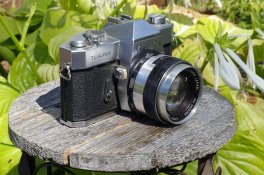
Old Yashica DX 1:1.4 f= 50 mm
 

Attachments

  • Y_DX_50mm.jpg
    Y_DX_50mm.jpg
    600.9 KB · Views: 126
Old Yashica DX 1:1.4 f= 50 mm

Interesting. I have the same camera with a DX 50/2, which has a silver nose and the rear section which on yours is silver (clear anodised aluminium, not chrome) is black on mine. I guess they thought the f;1.4 lens should be shinier!:laugh:
BTW, the same focussing mount was used on both lenses.
 
black gets hot and expands too easily, which is why Canon makes their long lenses white.

I believe the reason they did this is so they standout when being used by pro photos at sporting events; much like Apple has the backlit Apple on the covers of Apple laptop machines.
 
On large lenses the white reduces heating and expansion, which could degrade the optical performance. With modern compact lenses, I doubt there is a significant advantage. But old ideas die hard, and the white is seen as a serious lens. To the unknowing.


Sent from my iPad using Tapatalk HD
 
When lens barrels were made of brass, chrome plating was the easiest way to finish them. Chrome plates readily onto brass and its hardness protects the softer brass. Once aluminum became the material of choice for lens barrels, chrome plating was no longer needed or practical. Chrome plating aluminum is difficult and problematic. Anodizing is the natural finishing process for aluminum and it can be dyed various colors. To avoid being garish, black was the natural choice. It also matches the rubber grips that were put onto SLR lenses.
 
When lens barrels were made of brass, chrome plating was the easiest way to finish them. Chrome plates readily onto brass and its hardness protects the softer brass.
And brass tarnishes, so it has to have a coating of something.

Once aluminum became the material of choice for lens barrels, chrome plating was no longer needed or practical. Chrome plating aluminum is difficult and problematic. Anodizing is the natural finishing process for aluminum and it can be dyed various colors. To avoid being garish, black was the natural choice. It also matches the rubber grips that were put onto SLR lenses.
Anodizing also imparts a hard layer to the aluminum, increasing its durability.
 
Last edited by a moderator:
If you look at a black lens through an infrared viewer, it will look like a chrome lens... It's an eerie effect.
 
Fashion male jewelery...

The Zeiss Ikon cat of 58 was all chrome including the new pro SLR Contarex by the end of producion they were offering lenses in black and panda bodies.

But early Leicas were black and nickel years before they offered chrome option

bling
 
Older pre-AI Nikkors all had chrome barrels. Usually with black metal focusing rings and aperture rings. But, the filter ring and the barrel itself were chrome anodized.

-J
 
Photrio.com contains affiliate links to products. We may receive a commission for purchases made through these links.
To read our full affiliate disclosure statement please click Here.

PHOTRIO PARTNERS EQUALLY FUNDING OUR COMMUNITY:


Ilford ADOX Freestyle Photographic Stearman Press Weldon Color Lab Blue Moon Camera & Machine
Top Bottom