

• Welcome to Photrio!
    Registration is fast and free. Join today to unlock search, see fewer ads, and access all forum features.
    Click here to sign up

Why are you drawn to decay?

Hooters gonna hoot

H
Hooters gonna hoot

  • 1
  • 0
  • 16
Barry at Elwood

A
Barry at Elwood

  • 0
  • 0
  • 20

Recent Classifieds

Forum statistics

Threads
202,484
Messages
2,841,409
Members
101,351
Latest member
pavdee
Recent bookmarks
0

David Brown

Member
Allowing Ads
Joined
Feb 16, 2004
Messages
4,060
Location
Earth
Format
Multi Format
(Caveat: with tongue firmly in one cheek ...)

I hang out with four LF and ULF photographers. We are putting together a modest exhibition, and I've noticed something that I've noticed also in the larger population of you sheet film guys. Being a roll film man myself, I just have to wonder why so many LFers are drawn to decay, destruction, or derelict sites and buildings as subject matter. (Don't derail the thread to deny it - you "know" it's true!)

So, is it because the leather bellows on all of the old cameras smell so bad? It's just my theory ...

:tongue:
 
(Caveat: with tongue firmly in one cheek ...)

I hang out with four LF and ULF photographers. We are putting together a modest exhibition, and I've noticed something that I've noticed also in the larger population of you sheet film guys. Being a roll film man myself, I just have to wonder why so many LFers are drawn to decay, destruction, or derelict sites and buildings as subject matter. (Don't derail the thread to deny it - you "know" it's true!)

So, is it because the leather bellows on all of the old cameras smell so bad? It's just my theory ...

:tongue:

I've never noticed that before, but now that you mention it. I've always wondered why a lot of LF and ULF photographers seem to be drawn to what some call the "intimate" landscape; it is as if they aren't comfortable with the "grand" landscape. FWIW, I wish that "intimate" landscapes came more natural to me; I stuggle with it.
 
Not all of them :smile:

Just between you and me, and they'll never admit to this, but it's because all that gear makes them lazy. Better to wallow in decay than to sweat bullets dragging the camera to distant amazing scenes. What a bunch of weinies!!!!! :wink:

Murray
 
it's kind of the nature of the medium, right (see also: Sontag's On Photography - yes, plugging it again! There's so much good stuff in there that people seem to miss - she suggests on several occasions this relationship)
 
I'd like to hear what everyone else says too actually. For me, I think it has something to do with the character of these things. Too many things today are mass produced and all look exactly the same and I just get tired of looking at them, where old places and old things have a more colorful appearance and a sense of mystery. Even if they are simply old it is often possible to just suspend disbelief and wonder about their past (we know about the reality, don't mess with the fantasy!). They exhibit fascinating textures and colors and shapes that are difficult to find elsewhere. Much of the machinery of the past exhibits it's own form of art, and hell, old machines are just fascinating! Or it could be that, as my wife says, I just live in the past all the time, either one...

- Randy
 
Years ago, one of the regular writers in Popular Photography, Bob Schwalberg, coined the word "decrepitomania" to describe this phenomenon.

And yes, it's very true.

I think it has to do with the fact that old things have texture and character that meat and potatoes for LF photographers. And decaying old structures don't move - something that is a significant consideration when your average exposure time is measured in seconds.
 
For me, it seems to be a connection to the past. Someone else in history stood on this very spot and used this very tool I am photographing or worked in the building where I am photographing.

I feel by photographing objects of decay, especially where people have worked, somehow pays respect to what they did and somehow validates their time here on earth.

My father worked at Terminal Island in Southern California building ships during WWII. I have been trying to photograph in that area for years but never get permission to do so.


Gary
 
I suppose to make clear what I was trying to say (realize nobody reads much these days...:smile: ). It's simply that photographs tend to be memorials themselves. Certainly, in using the camera - you mark the death of a moment - it ceases to exist at precisely the point at which the shutter closes. The photograph's prime 'mode' is melancholia. Especially considering the cumulative perception until this point with respect to the 'black and white' photograph. That is - there are many associations with the state of mourning or 'wistfulness'. And thus, being somewhat sensitive to, or at least somewhat conscious of, this - we choose our subjects accordingly. This is an aspect, I think, inherent to all photographs (of the 'black and white' variety for sure), and hence we tend to exploit it whenever possible. Why not?

Why are some musical instruments better at expressing sadder music than others?
 
It's not just LF people, you know, even us 35mm people aren't always hunting for the decisive moment on a busy street.

To me, the appeal for me is not in the derelictitiousness(??): everybody is doing the same old tired "beauty is decay, decay beauty" romantic crap that we suffer since the Romans became ruins. It's rather the fact that a pile of old things have shapes about as unique as you can get.

The Walker Evans picture of the stamped tin plate to me is a great example: I don't read it as a lament for loss time, I read it more like his later series of Polaroid, as a fascination with things, their shapes, especially the oddest ones, and the fact that these artifacts have at some point intersected with human life, and gain their meaning thereby.

I haven't made great photographs with trash (partly because I find them cliché), but I'm always sniffing around when I see a good spot.
 
Like the old withered man down the street, these old, peeling, weathered structures have interesting (visual) stories to tell, of lives that lived and worked hard and as witnesses to our collective history.
To many of us LF'ers these structures are more interesting to point our cameras. They tell us more about ourselves than that shiny new, barely used building. Maybe I am trying to hear the stories that I never got to hear because my grandparents passed away before I was born.

gene
 
Just a state of mind...
 
I'm a structural engineer with minor in historic preservation. I was born to photograph industry and bridges. Unfortunately, for the U.S., most of it's heavy industry and huge bridges is over. I wish I was around to photograph it when it was new.
 
I'm drawn to some of these old decaying subjects -- and I only go as high as 6x6. :smile: I think reellis67's comments are right on. A modern shiny structure is just there, doing its thing. Viewing an old ruin may prompt us to activate our imaginations a little about what used to be -- I think that's a good thing.

DaveT
 
Here you go--

http://www.theonion.com/content/node/46932

But seriously, I think in part it's a desire to preserve things that are about to disappear.

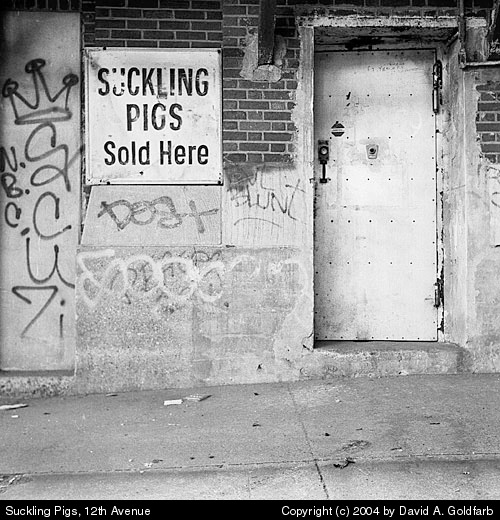
I photographed this bit of New York history a couple of years ago right near my apartment building. Today it's gone with gentrification--

pigs2.jpg
 
"Decay"

Just a state of mind...


Have you come to deny the subject, passing it off like a fleeting thought; or, do you mean to say that "decay" as a persistent subject of photographers is mere happen-stance of their equipment and location?
Certainly, through the "saftey" of the ground glass we keep at bay that which disturbs. We make friends of our enemy by reverse electron shooting it to capture and controll it. Time-bound, it, is chemically dipped and washed, dried and spotted, mounted to a wall with other trophies of the hunt for endless "self"-validation; or, perhaps sold as fresh meat for the mass-hunger for the bain of "self"-existence.
 
Maybe it's just an antidote to all the images of fresh shiny stuff we're bombarded with each day in advertising and in media.
On another line of thinking, people are attracted by the novel, but the scenes of new stuff become stale in our heads from all the exposure. Whereas scenes of places people don't see routinly, or that are shown in a new way become what's different.
 
Great Thread David!! As one of those LF folks you photograph with, can only say that when you set up a camera that was 'new' when the building was 'new' and open up the lens, that was also 'new' it is kind of like letting old friends get together and have a nice long chat (you've had to wait on some of those long exposures :smile: ) Seriously, much like the face that has so much character - the years that show, the old buildings tell much the same story. In my own case, while the exposure is going I find myself wondering the who has been here before, what was it like..what did it look like, what were the people like that built it, could they have been family.

And much like the elder members of our society today, they often are forgotten...and yet they have stood the test of many years, and have so much to offer...

A bit more navel gazing than you may have intended.
 
Decay is a powerful visual metaphor for the extended passage of time. It is one of few pieces of subject matter that still photography can easily access to affirm that all things, and all people, must pass.
 
I'm not a LF photogrpaher just MF but I am drawn to the old and decrepit. Perhaps it my age? Ha! today we were driving around a lake nearby and came across a run down abandoned cottage and my husband started to stop, but I said no thanks, I'm trying to cut down!
 
Artists in the late 18th and early 19th century -- especially the "Romanticists" -- were very drawn to ruins of all kinds. Ruins have held a special fascination for people and especially for artists for a very long time. The reasons behind this have to do with the search for immortality, hoping traces of us will remain behind long after we're gone so people will remember what we did, and the whole idea that nature will ultimately reclaim what man builds and produces. Ruins that are covered in vines and other natural matter are far more interesting to the painter and photographer than the well-maintained ruins we have today at "historical sites" around the world. That mix of man's production with nature's reclamation strikes a chord in the human psyche that needs expression.

For photographers, ancient ruins, old houses, cemeteries, rusting cars, abandoned factories, and even dead creatures have been of interest since Day One when photography was discovered. There is simply something in human soul that finds a connection with the past and somehow sees a connection to "those who have gone before" through ruins and decay.

I think this is a very elemental spiritual/emotional/psychological phenomenon we cannot escape. Interested to hear other thoughts as well! :smile:
 
From the original post;

(Caveat: with tongue firmly in one cheek ...)

:tongue:

YIKES! Y'all got floppy-flacid funny bones??? This puppies got a yuk-yuk factor of 0.000000001.

:smile: Murray :smile:
 
Photrio.com contains affiliate links to products. We may receive a commission for purchases made through these links.
To read our full affiliate disclosure statement please click Here.

PHOTRIO PARTNERS EQUALLY FUNDING OUR COMMUNITY:


Ilford ADOX Freestyle Photographic Stearman Press Weldon Color Lab Blue Moon Camera & Machine
Top Bottom