• Welcome to Photrio!
    Registration is fast and free. Join today to unlock search, see fewer ads, and access all forum features.
    Click here to sign up

Why am I losing highlights?

Recent Classifieds

Forum statistics

Threads
203,242
Messages
2,851,947
Members
101,746
Latest member
Balage
Recent bookmarks
0

paulfish4570

Member
Allowing Ads
Joined
Feb 2, 2010
Messages
155
Location
At the confl
Format
35mm
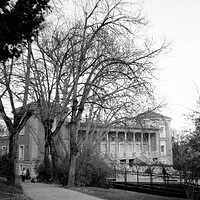
Lighting on thios photo was difficult, but I think I might be losing highlight detail because of something in developing instead of exposure. This is just my seventh or eight roll. Did I read here that too much agitation increases contrast and robs highlight detail? The opposite?

rik-leaves-1.jpg
 
Over agitation just increases the development, so yes the contrast.

You need to cut the development time back, probably giving a slight increase in exposure as well. Really depends on what film & developer.

Ian
 
Paul, can you state what kind of enlarger you're using, and what kind and grade of paper this was printed on?
 
Agitation does increase contrast so over-agitation definitely can cost your highlights. However, it's impossible to say just by looking at that image if this is what's at issue.

We need more data. What film/dev combo are you using and, at least as importantly, what agitation routine?
 
Here are the data for this roll (after an all-day rain, my kitchen developer temp fell to 66 rather than the usual 68):
Arista Premium 400, 1:4 Tmax at 6'45", 66F, spin agitation (Paterson Super System spinner thingy) 10 seconds every minute, no inversion, scanned on Epson v300.
My usual agitation for 68F had been inversion 1-2 times every minute. I was losing some high-end highlights then, too.
Would I not have lost more highlight detail with a longer exposure?
 
You didn't say how you metered the exposure. If it's not on the negative it won't be on the print.
 
You are not missing much, but yes, just a bit of highlight detail and a bit of shadow detail seem to be lost - too much contrast. My guess at the best approach would be to cut back on agitation, but that is hard to control. Just less development would probably work. If this were sheet film, it would be easy to apply the old zone techniques. With roll film, it can be more difficult. A developer that offers significant compensation effect, or possibly two bath development, can be useful for roll film in these circumstances.
 
If you lowered contrast by decreasing development you might find the whole thing becomes quite dull.

Try burning in the highlights and dodging the shadows a bit. I am assuming the negative holds detail in these areas.

If you are only going to scan the negative then use the histogram/dropper tool to set the highlight and shadow points slightly outside the negative's range. This may make the resulting print a bit dull, however. The software that must not be named can fix this for you.
 
Another opinion -
You are using 6 -7 minutes at 68F, not a long time for this temperature, and not a lot of room to go down in time. 10 seconds per minute doesn't sound like over agitation either. If this was HC110, I would recommend increasing dilution and keeping the rest the same, but I don't know how TMax Developer reacts to greater dilution.
Before you do anything, though, I would look closely at the neg (with a light behind) and be sure you are really losing the highlights. Epson scanning software can be goofy when scanning negs. I would want to print the negs on my chosen paper before deciding about the development.
 
If you lowered contrast by decreasing development you might find the whole thing becomes quite dull.

Try burning in the highlights and dodging the shadows a bit. I am assuming the negative holds detail in these areas.

If you are only going to scan the negative then use the histogram/dropper tool to set the highlight and shadow points slightly outside the negative's range. This may make the resulting print a bit dull, however. The software that must not be named can fix this for you.

Nicholas is right. Printing this in the darkroom will not be too difficult. If you are only going to scan it, I suggest scanning it twice: once a bit dull to get shadow and highlight detail, and once the way you did. Then superimpose the two and merge them to one full-tone print with full shadow and highlight detail supported by contrasty midtones.
 
Before you do anything, though, I would look closely at the neg (with a light behind) and be sure you are really losing the highlights. Epson scanning software can be goofy when scanning negs. I would want to print the negs on my chosen paper before deciding about the development.

My thoughts precisely. I would not adjust development time based on scanning the neg -unless that is what you are doing in a hybrid workflow- but make a print of the neg in the darkroom first to see how it looks on paper.
 
Over agitation just increases the development, so yes the contrast.

You need to cut the development time back, probably giving a slight increase in exposure as well. Really depends on what film & developer.

Ian
**************
While Ian is on the topic Paul, I shall chime in here to say this: I was taught to control contrast with time of development (all other things being equal), regarding the same agitation pattern an unchanged factor in the development process.
 
One thing for sure. On film, burned out highlights are possibly recoverable through burning in. But if its a digital camera, forget about it. Once highlights are blown out digitally, there's little or no highlight information there. I'm sure you could do some darkroom magic and get some detail back.
 
Ralph, I had been not shooting very much, only a little family stuff; my passion for 15 of those years had been deer hunting. Then my first grandchild arrived 15 months ago. My daughter requested I shoot Zella in black and white because she so much loved some of my black and white work from way back then, especially a shot of her (my daughter) as an infant in her maternal grandmother's lap (Tri-X, by the way, shot with an M3/Elmar 50/2.8). My daughter has that print hanging in her home, and it is still in beautiful shape at 31 years of age.
So, I unlimbered my pawn shop Praktica LTL3 and some BW400CN. In January, I had some trouble with the camera. Then came an internet search for a rangefinder, then a replacement M42 body, then lenses, then ... :wink:
 
Ralph, I had been not shooting very much, only a little family stuff; my passion for 15 of those years had been deer hunting. Then my first grandchild arrived 15 months ago. My daughter requested I shoot Zella in black and white because she so much loved some of my black and white work from way back then, especially a shot of her (my daughter) as an infant in her maternal grandmother's lap (Tri-X, by the way, shot with an M3/Elmar 50/2.8). My daughter has that print hanging in her home, and it is still in beautiful shape at 31 years of age.
So, I unlimbered my pawn shop Praktica LTL3 and some BW400CN. In January, I had some trouble with the camera. Then came an internet search for a rangefinder, then a replacement M42 body, then lenses, then ... :wink:

APUG, the deer and I are very happy about the change.
 
On film, burned out highlights are possibly recoverable through burning in.

The "possibility" in that sentence is important; with some film/developer combinations printing down burned out highlights will just give flat grays.

A flakey thermometer can lead to burned out highlights, as can a rise in developer temperature while processing. The latter is almost inevitable (to some extent, anyway) if you have a small stainless tank and a large hand, and agitate by the invert-and-twist method. Whether or not this applies to the tank that you are using, I don't know, but it is one of the (many) reasons that you should plan to adjust the effective film speed and developing time to your own personal methods.
 
Plastic Paterson tank, Paterson spinner agitation, but only 6 minutes development time in a very air-conditioned kitchen. I do not lose the highlights in all of my negatives. I think the leaf shot was particularly hinky with a wide range of exposure values. In any case, I think I will continue current procedure except for development time, which I will shorten by 15 seconds next roll. Thank for all of your wonderful advice ...
 
Photrio.com contains affiliate links to products. We may receive a commission for purchases made through these links.
To read our full affiliate disclosure statement please click Here.

PHOTRIO PARTNERS EQUALLY FUNDING OUR COMMUNITY:


Ilford ADOX Freestyle Photographic Stearman Press Weldon Color Lab Blue Moon Camera & Machine
Top Bottom