
-
Welcome to Photrio!Registration is fast and free. Join today to unlock search, see fewer ads, and access all forum features.Click here to sign up
- Home
- Forums
- Analog Workflow Forums (100% Analog/Traditional)
- Analog Equipment
- Medium Format Cameras and Accessories
You are using an out of date browser. It may not display this or other websites correctly.
You should upgrade or use an alternative browser.
You should upgrade or use an alternative browser.
Who Likes a Prism on Their Medium Format Reflex Camera?
-
A
- Thread starter ic-racer
- Start date

Recent Classifieds
-
For Sale Linhof 135mm Focusing Cam for Technika IV 4x5 45.00.
- Started by John Ackley
-
For Sale Darkroom Tool Set for Print or Sheet Film Handling
- Started by davela
-
For Sale Testrite CS-1 Copy Stand with Original Box
- Started by davela
-
For Sale Pentax branded camera straps (1 black w/ viewfinder cap, 1 grey)
- Started by Disconnekt
Forum statistics


Donald Qualls
Subscriber
I use the waist level, chimney, and prism on my RB67 almost equally, depending on what I'm photographing. The only TLR I own (with a focusing screen, obviously not counting the Duaflex family or the Brownie Bullseye etc.) never had a prism option: Kodak Reflex II.

Rayt
Subscriber
I shoot street and travel with medium format and adding a prism to a Rolleiflex TLR or Hasselblad makes them less portable and more difficult to carry in a camera bag. I can fit two TLRs in one small Billingham but not with prism mounted. Also for me it’s much easier to focus a WL.

Marcelo Paniagua
Member
Use prism on nearly all my MF cameras, Kiev's, Bronica's, Mamiyas's and even Rolleiflex, but only when putting camera on tripod.
Exception bein Bronica ETRS, which normally use with prism and handle. 35mm handling on a 35mm camera.
Exception bein Bronica ETRS, which normally use with prism and handle. 35mm handling on a 35mm camera.

warden
Member
Mine isn't metered, but I think I made a mistake there as I'd love to have one now.Always use a metered prism on my Hasselblad. Not only do I get great exposures, it helps steady the camera when used hand-held.
Donald Qualls
Subscriber
I can fit two TLRs in one small Billingham but not with prism mounted.
My RB67 doesn't fit in the (huge) Gitzo backpack I use for it with the prism mounted, either. I pack it with the WLF, put the prism in one of the compartments (along with lenses and film backs, of course). I use the chimney mainly on a tripod for close work, and don't usually put it in the backpack. And when hand holding, I usually use the prism and left hand grip (plus a shortish strap for insurance).

JerseyDoug
Member
I have no prism finder for my Rolleiflex 3.5MX-EVS and have no issues with R-L reversal after using it for 60+ years. (For example, when shooting portraits with the subject in profile I have them facing to my right with my 35mm RF's and facing to my left with my WLF Rolleiflex or Hasselblad, knowing they will be facing the other direction on the MF negative.)
I do have unmetered 45º and 90º prism finders for the Hasselblad 500C/M but I haven't used them in years. They are just too big and heavy. I mostly use the ultra lightweight 52094 chimney finder.
I do have unmetered 45º and 90º prism finders for the Hasselblad 500C/M but I haven't used them in years. They are just too big and heavy. I mostly use the ultra lightweight 52094 chimney finder.

Nokton48
Member
- Joined
- Oct 8, 2006
- Messages
- 3,149
- Format
- Multi Format
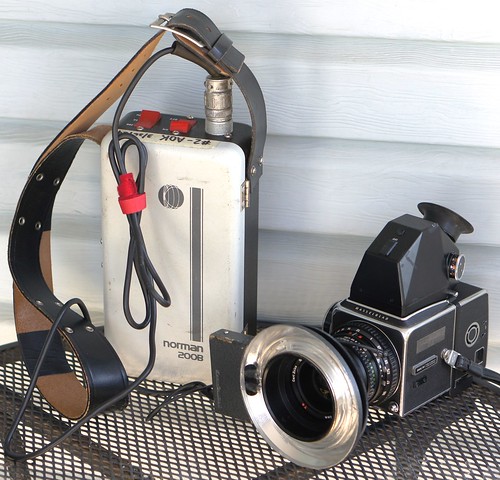 SONY DSC by Nokton48, on Flickr
My CFV16 Hasselblad Fat Digital Back 36x36cm 60mm T* Distagon 500C/M 25th Anniversary P&F 200J Ringflash with Hasselblad Adapter. I used to use this Ringflash for Fashion Photography, back in the day. LOL. Now the CFV16 Digital Bacvk gives me instant gratification. The Flash and Norman 200B pack (two packs actually) went to new York City Flash Clinic (sadly gone SNIFF). They Hot Rodded it to the Norman pack, everything needed adjusting by thm, so the flashtube didn't "sparkle" after firing. This until runs off on 12V Dry Cell Batteries, trickle charged. I've replaced the batteries several times, just solder 'em right in. This works great and is an UBER HOOT to shoot with. Many more uses for this thing up ahead. Maybe buy some more cheap batteries, they are available on Amazon.

I find the weight/balance better on my Rolleiflex TLR with the WL finder. I did have a prism for sometime & found the camera awkward....& by the time you add the eyelevel finder and the handgrip it's a whole other level of size management....

Liked the chimney-finder on the Hasselblad the most as it lets you see the groundglass from a little bit more distance where you can better appreciate the whole picture through an adjustable eyepiece. Edit: And its picture is free of the pincushioning that you will find in most WLFs. Such a nice and simple thing! The 45 deg prism with leatherette was a close second with the benefit to put your head behind the camera, allowing for a higher point of view without having to resort to a stepladder.
Last edited:

Oldwino
Subscriber
I prefer WLFinders on my Rollei and Mamiya cameras, but I just recently picked up a nice 120mm macro for the 645 1000s, and I am thinking a prism might make it easier to shoot. There's a nice AE prism that might make working with the bellows/exposure compensation a little easier. If I can find one that a) works, and b) doesn't have separation.
I never got on with the WLF on my 501CM. I bought a PM45 very quickly after acquiring the camera, and have used it ever since.
Having said that, I have no problems at all working with the inverted ground glass image on a LF camera.
Having said that, I have no problems at all working with the inverted ground glass image on a LF camera.
Donald Qualls
Subscriber
inverted ground glass image on a LF camera.
I find the mirrored image in a waist level finder hard to orient than the inverted image on a large format ground glass. Likely because it looks normal, but when I try to move to include more of something at one edge, it goes out of view instead. This would probably be less of a problem if I used WLF more, but I don't.
I find the mirrored image in a waist level finder hard to orient than the inverted image on a large format ground glass. Likely because it looks normal, but when I try to move to include more of something at one edge, it goes out of view instead. This would probably be less of a problem if I used WLF more, but I don't.
Yeah being only inverted laterally is much harder to adapt to I found, especially hand-held. I'm sure with practice it gets easier, but I'd rather just have a normal image (upside-down or not).
Dan Daniel
Subscriber
It does. Eventually the flip comes natural. And once the brain catches on, moving from flipped to normal is pretty quick. Sort of a 'muscle memory' develops. You'll know you've got it when you go to use a 'normal' camera and the first movement is backwards.I'm sure with practice it gets easier

Sirius Glass
Subscriber
I started taking photographs in 1958 and developing and printing film a few years later. In 1966 I got my Minolta SR-7 and have been hooked on SLRs since then. In 2007 when I bought my Hasselblad 503 CX I purchased the 45 degree PME prism, removed the WLF and used it that way ever since.

Steven Lee
Member
WLF for 6x6. Prism for everything else.
abruzzi
Member
The first WLF camera I got, I wondered if I’d end up swerving my car into incoming traffic after I internalized the left/right switch. That hasn’t happened yet. I did become completely acclimated to it in about a week.

I'm not too bothered by the left-right reversal with a WLF, except when trying to track movement - and even then I can usually manage.
I think part of that comes from the fact that when one is looking down at the finder, there is no problem with being confused by activity outside the frame, because usually one sees the floor/ground outside that frame.
The WLF isolates from one's attention that which is outside the photo. Eye level finders tend to permit distraction from the other eye.
I think part of that comes from the fact that when one is looking down at the finder, there is no problem with being confused by activity outside the frame, because usually one sees the floor/ground outside that frame.
The WLF isolates from one's attention that which is outside the photo. Eye level finders tend to permit distraction from the other eye.

RalphLambrecht
Subscriber
I never got on with the WLF on my 501CM. I bought a PM45 very quickly after acquiring the camera, and have used it ever since.
Having said that, I have no problems at all working with the inverted ground glass image on a LF camera.
I think, the Pentax line of MF cameras are underestimated.
I think, the Pentax line of MF cameras are underestimated.
I have a Pentax 6x7 MLU with the standard pentaprism finder too. Don't use it nearly as much as the Hassy though.

franglais69
Member
I use a Mamiya 645 Pro with the prism based metering AE Finder, but I also have a WLF.
Its probably my eyes that just get worse, but I do find the WLF reverse image makes me dizzy and I get frustrated by spending more time than necessary on framing.
Maybe I am just not used to it enough.
Thus my AE Prism finder is used more often than not esp as the WLF has no meter
Its probably my eyes that just get worse, but I do find the WLF reverse image makes me dizzy and I get frustrated by spending more time than necessary on framing.
Maybe I am just not used to it enough.
Thus my AE Prism finder is used more often than not esp as the WLF has no meter
Sirius Glass
Subscriber
I use a Mamiya 645 Pro with the prism based metering AE Finder, but I also have a WLF.
Its probably my eyes that just get worse, but I do find the WLF reverse image makes me dizzy and I get frustrated by spending more time than necessary on framing.
Maybe I am just not used to it enough.
Thus my AE Prism finder is used more often than not esp as the WLF has no meter
Welcome to Photrio! Early on I chose the prism because the stray light entering the WLF, the left-right [right-left in the UK] reversal making the tracking of a moving subject, and the lack of a light meter.
franglais69
Member
Welcome to Photrio! Early on I chose the prism because the stray light entering the WLF, the left-right [right-left in the UK] reversal making the tracking of a moving subject, and the lack of a light meter.
In France we have square biscuits I think called Nantais. Once framed etc I pop one on the WLF of my m645 to avoid stray light, then eat it after shutter release

It doesn't help the L- R issue but I feel less hungry.
| Photrio.com contains affiliate links to products. We may receive a commission for purchases made through these links. To read our full affiliate disclosure statement please click Here. |
PHOTRIO PARTNERS EQUALLY FUNDING OUR COMMUNITY:  |