• Welcome to Photrio!
    Registration is fast and free. Join today to unlock search, see fewer ads, and access all forum features.
    Click here to sign up

Whitewall Ilford Baryta prints from digital files?

Temporary Jewels

H
Temporary Jewels

  • 0
  • 0
  • 24
Horicon Marsh-5

A
Horicon Marsh-5

  • 2
  • 0
  • 84

Recent Classifieds

Forum statistics

Threads
201,254
Messages
2,821,256
Members
100,622
Latest member
zerzig
Recent bookmarks
0

albireo

Subscriber
Joined
Nov 15, 2017
Messages
1,586
Location
Europe
Format
Multi Format
I was intrigued by this company offering prints on Ilford B&W baryta paper from digital files (e.g. negative scans).


From the blurb:

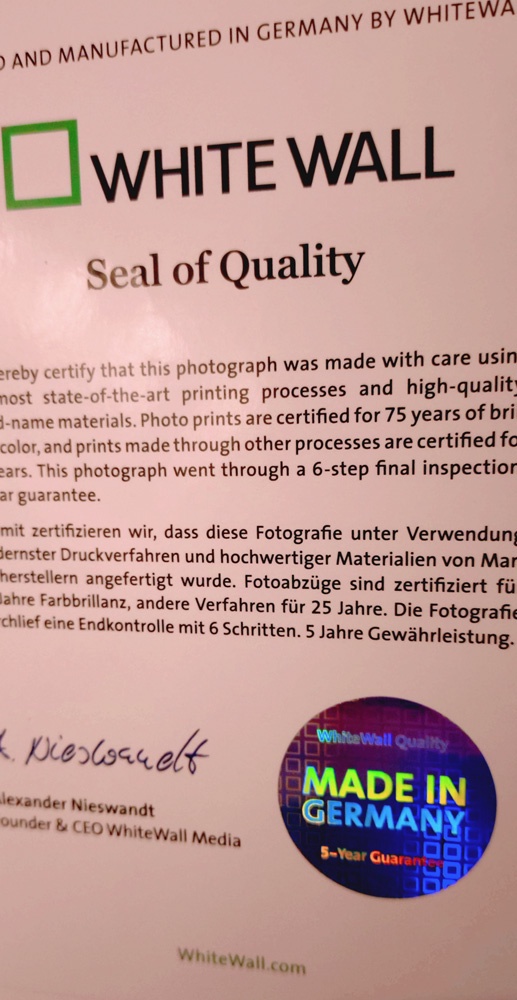
The special developing process at the WhiteWall photo lab turns your artistic black-and-white photographs into high-end baryta prints. First, the cutting-edge laser exposes your image onto the photo paper. This is followed by traditional silver halide developing, fixing, and washing.

So a traditional paper exposed via a 'laser'. I wonder if anyone has more info about this process? Is this a routine procedure commercially, or is it relatively rare?

Also - has anyone tried this company? How are the prints? I'm particularly interested in the opinion of 'traditional' darkroom printers who have also experimented with the separate avenue of 1) digitising their negatives and 2) sending them out for prints as above.
 

Nitroplait

Subscriber
Allowing Ads
Joined
Jul 13, 2020
Messages
865
Location
Europe (EU)
Format
Multi Format
I have tried it. The prints are very good but you have to understand their "improvements" and select/deselect what is relevant to you.

To make a perfect print with whitewall you may have to make a couple of test prints first. (They offer watermarked prints at a discount.)

According to my computer screen, they print a little bit darker than what I see on screen, and I need to adjust for that.
(I use a macbook pro 2024 screen for example, other hardware setups will be different)

I have the print mentioned in this thread hanging next to a print of a photo by Watabe Yukichi printed by a Japanese master printer (in 2013) using conventional darkroom methods - and tonality and texture is very similar.
 

koraks

Moderator
Moderator
Allowing Ads
Joined
Nov 29, 2018
Messages
26,143
Location
Europe
Format
Multi Format
I wonder if anyone has more info about this process? Is this a routine procedure commercially, or is it relatively rare?

It's often associated with the term 'LightJet', although that was specifically a Canadian (later taken over by a Dutch company) product intended to expose silver halide papers (color or B&W) with lasers. So yes, it's a common procedure commercially and it's essentially the same way virtually all color chromogenic prints are made today.
 

Carnie Bob

Member
Allowing Ads
Joined
Nov 5, 2023
Messages
462
Location
Toronto , Ont Canada
Format
4x5 Format
For history sakes I was the first Lab world wide to do a silver gelatin fiber base mural via Lambda exposing unit , ( others were doing this on RC Paper in the late 90's) Wiki says it was Ilford and Metro Imaging collaboration but this is a falsehood that one day I should change, There was a lab in mid west doing silver enlarged prints using a Devere digital enlarging system before me but I forget their name. I purchased the Lambda for this very reason.
 
OP
OP
albireo

albireo

Subscriber
Joined
Nov 15, 2017
Messages
1,586
Location
Europe
Format
Multi Format
Thank you all - @Carnie Bob - what is a Lambda exposing unit and where can I read more about those?

@Nitroplait that thread is really helpful. I am preparing an order for a few baryta prints. I am uploading 4000dpi scans from a few 35mm and 120 black and white negatives in .tiff format processed & exported in Gray Gamma 2.2 and will order a few 20x30cm test prints. I have deactivated their post-processing as you suggested in your post. I will report back. This might be what I've been looking for.
 

gbroadbridge

Subscriber
Joined
Nov 18, 2004
Messages
825
Location
Sydney, Australia
Format
Medium Format
Thank you all - @Carnie Bob - what is a Lambda exposing unit and where can I read more about those?

@Nitroplait that thread is really helpful. I am preparing an order for a few baryta prints. I am uploading 4000dpi scans from a few 35mm and 120 black and white negatives in .tiff format processed & exported in Gray Gamma 2.2 and will order a few 20x30cm test prints. I have deactivated their post-processing as you suggested in your post. I will report back. This might be what I've been looking for.

Get in fast as most labs with lambda are replacing with high end large format inkjet.
(which in my opinion are indistinguishable from each other anyway)
 
OP
OP
albireo

albireo

Subscriber
Joined
Nov 15, 2017
Messages
1,586
Location
Europe
Format
Multi Format
Get in fast as most labs with lambda are replacing with high end large format inkjet.
(which in my opinion are indistinguishable from each other anyway)

Thanks

Would they be distinguishable from a wet print of the same negative? Or do, for the three methods, (lambda, inkjet, wet print) operator's skills play a similarly strong role?

Also - durability - would there be significant differences in durability across the three provided they're printed on the same baryta paper?
 

koraks

Moderator
Moderator
Allowing Ads
Joined
Nov 29, 2018
Messages
26,143
Location
Europe
Format
Multi Format
Would they be distinguishable from a wet print of the same negative? Or do, for the three methods, (lambda,inkjet,wet print) operator's skills play a strong role, too?
Media choice in particular plays a major role for inkjet, so does to an extent ink setting. And then of course calibration/linearization, toning etc. Don't let anyone fool you into thinking B&W inkjet printing is necessarily easier than wet printing if you want to produce an excellent print. Inkjet is a whole lot easier if you want to produce a decent print that will be satisfactory for the great majority of people. If you aim for the top segment, both inkjet and silver halide are on the interface of science, magic and craft.

Also - durability - would there be significant differences in durability across the three provided they're printed on the same baryta paper?
It will not be the same paper, let's get that out of the way. There are inkjet baryta papers and silver halide baryta papers. They're different. Longevity of the inkjet prints will depend on esp. the specific paper used, the ink set, any finishing layers applied and storage conditions. For silver halide baryta prints it's an equivalent series of factors. The long & short of it is you can't say that either inkjet or silver halide will last longer as long as you're comparing high-end prints. In the lower segment, silver halide baryta basically doesn't exist to begin with and inkjet can be hit & miss, depending.

Sorry, there are no easy answers to this one.
 
OP
OP
albireo

albireo

Subscriber
Joined
Nov 15, 2017
Messages
1,586
Location
Europe
Format
Multi Format
Thanks @koraks - a follow up question - which type of baryta paper would be used for the 'laser' process advertised by the company I linked to? It seems they develop it, fix it and wash it as normal so I'm assuming it's silver halide baryta paper?
 
Last edited:

Carnie Bob

Member
Allowing Ads
Joined
Nov 5, 2023
Messages
462
Location
Toronto , Ont Canada
Format
4x5 Format
Ilfords digital fibre paper is actually Galerie G 4 with an extended red sensitivity, the paper I first worked on a Lambda with was Agfa Multigrade warmtone 2002 era.
 

koraks

Moderator
Moderator
Allowing Ads
Joined
Nov 29, 2018
Messages
26,143
Location
Europe
Format
Multi Format
which type of baryta paper would be used for the 'laser' process advertised by the company I linked to?
A similar kind of paper that you'd use in the darkroom, just a fixed grade fairly high contrast; see @Carnie Bob's response above. After processing I don't think you'll be able to tell the difference with a regular Ilford darkroom paper.
 

gbroadbridge

Subscriber
Joined
Nov 18, 2004
Messages
825
Location
Sydney, Australia
Format
Medium Format
Thanks

Would they be distinguishable from a wet print of the same negative? Or do, for the three methods, (lambda, inkjet, wet print) operator's skills play a similarly strong role?

Well, a custom made wet darkroom print has many variables: exposure, chemical variations, temperature variations, operator skill, etc.

Lambda and Ink jet are quite consistent based on the digital file. Minor variations are possible but less likely.

I would consider a hand made darkroom print to be 'one off', less so for any digital print.

Also - durability - would there be significant differences in durability across the three provided they're printed on the same baryta paper?

I think longevity will be answered in 50-100 years time :smile:
There are all sorts of claims floating around on both sides.

At the end of the day a poorly made darkroom print can deteriorate quite rapidly as can a cheap inkjet print.
 
OP
OP
albireo

albireo

Subscriber
Joined
Nov 15, 2017
Messages
1,586
Location
Europe
Format
Multi Format
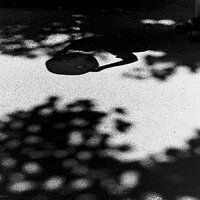
I've received my Whitewall order. Only black and white for this test order, and I explored their 2 black and white paper products: Ilford black and white paper standard, as well as baryta. In addition, I had three baryta prints framed.
  • For the three framed images, 2 were 35mm scans, one Kentmere 100 and one Fomapan 200. I had them both printed at 37,5x25cm size plus 5cm passepartout, plus frame. For the 6x6, it was an Ilford Orto 80 scan, and I had it printed 25x25 plus 5cm deep passepartout. I went for the museum-grade matte glass.
  • For the non framed images, I went for a variety of formats and shapes, and had 2 pictures printed 2 times: both in baryta, and standard Ilford B/W, to allow me to compare the two materials. All scans where from Tri-X in D76 1:1.
I prepared the files and finalised the scans as 16bit grayscale tiffs saved in Gray gamma 2.2 space. I deactivated all Whitewall enhancements, sharpening, etc in their options menu. All images were scanned using my standard workflow in 4000dpi using my Nikon Coolscan.

For 2 images, I also had available old darkroom prints done from my original negatives by a professional printer connected to the Fotoimpex shop in Berlin, who printed according to my specifications - I can't remember the paper, but I think it was Ilfospeed grade 2. This was a few years ago now.

Now on to the Whitewall order:

To say I'm satisfied with their work is an understatement. The quality is exceptional. The baryta prints are particularly beautiful: beautiful weight, thick paper, beautiful texture, and the tonality is spot-on - exactly what I had visualised on my screen at home. They absolutely nailed it. The standard Ilford black and white prints are also stunning, the most obvious difference from the baryta being that the paper is quite a bit thinner. Had I not seen or handled the baryta prints, I would have been perfectly happy with the standard black and white prints on Ilford paper.

Detail is phenomenal: I have attended hundreds of exhibitions, and I keep doing so when I can, many of which from artists printing their own work, and these prints are exhibition grade: there is no discernible difference, to the naked eye, from a darkroom print of the same material, based on my 'controls' above. I haven't checked with a magnifying glass though. The difference between these prints and some amateur inkjet prints of the same scans I had attempted to make at home on an Epson photo inkjet printer using colour inks is truly obvious. Is it mostly due to my lack of skills in digital printing? I suspect that plays a big role, yes.

For those of you who buy and collect photobooks, these prints are Steidl or Aperture-quality.

I'm sure the darkroom wizards amongst you will match or exceed the quality of these, and will derive immense enjoyement in the process of creating your own darkroom prints, but for me, as someone interested chiefly in the part of the hobby happening before pressing the shutter, this company is a godsend, and I can see myself using them again in the future. I only need to check my wallet: they are not cheap, but they are much cheaper, and possibly faster, than having a darkroom printer and a framer do this work for me to this standard (I have noticed a lot of variability in 'service' darkroom printers, at least where I live). Getting a beautifully produced and framed print directly at home within a week of placing your order is insane. My next order will be to ask them to blow a 6x9 frame from my Texas Leica up onto their biggest baryta size.

I can warmly recommend this company to other film/hybrid photographers like me who don't have the time/space/inclination to set up a darkroom but want to experience proper, beautiful prints of their work! Thank you all for advising me on barytas etc and also thank you @dokko @RalphLambrecht and @Nitroplait for your recommendations in this and in the other thread, which encouraged me to try this company.

GFAno1d.jpg
 
Last edited:

Carnie Bob

Member
Allowing Ads
Joined
Nov 5, 2023
Messages
462
Location
Toronto , Ont Canada
Format
4x5 Format
I see they claim a 75 year lifespan on their bartya prints, this is telling to me as I have made prints on a lambda in a couple of scenerios, they are using a Lambda or Lightjet in both cases laser exposure. We now know that silver prints if processed right have over 100 year lifespan because the proof is right before our eyes in our grandparents folios. So I suggest that 75 years is wrong , unless of course they are using a all machine process method which in the beginning 2006 many labs did which IMHO were not properly fixed and started staining in some cases. In my case I only used the Lambda setup for exposure and through hand process applied the proper Ilford sequence to my prints. I visited last fall a lab in New York which did it exactly the same way as I did and was very happy to. see that. Griffen Editions in Brooklyn. I would be curious how they post exposure process the paper as it does make a differnce . I supect its not hand process and I can assure you the final stages of process cannot be properly maintained unless they have superhumans watching the process and slowing down the machine for proper fix.
 

koraks

Moderator
Moderator
Allowing Ads
Joined
Nov 29, 2018
Messages
26,143
Location
Europe
Format
Multi Format
I would be curious how they post exposure process the paper as it does make a differnce
You're right; this is where the real difference is made w.r.t. archival stability. I assume this is automated and that the wash cycle is therefore on the minimal side esp. for fiber-based paper.
 
OP
OP
albireo

albireo

Subscriber
Joined
Nov 15, 2017
Messages
1,586
Location
Europe
Format
Multi Format
I see they claim a 75 year lifespan on their bartya prints, this is telling to me as I have made prints on a lambda in a couple of scenerios, they are using a Lambda or Lightjet in both cases laser exposure. We now know that silver prints if processed right have over 100 year lifespan because the proof is right before our eyes in our grandparents folios. So I suggest that 75 years is wrong , unless of course they are using a all machine process method which in the beginning 2006 many labs did which IMHO were not properly fixed and started staining in some cases. In my case I only used the Lambda setup for exposure and through hand process applied the proper Ilford sequence to my prints. I visited last fall a lab in New York which did it exactly the same way as I did and was very happy to. see that. Griffen Editions in Brooklyn. I would be curious how they post exposure process the paper as it does make a differnce . I supect its not hand process and I can assure you the final stages of process cannot be properly maintained unless they have superhumans watching the process and slowing down the machine for proper fix.

Thank you for your insights Bob. I cannot help with any of your doubts/point, as someone who literally didn't know this type of technique and company existed until last month. Maybe some other European users can chip in with info.
 
Last edited:

Carnie Bob

Member
Allowing Ads
Joined
Nov 5, 2023
Messages
462
Location
Toronto , Ont Canada
Format
4x5 Format
If you have a darkroom access and are stubborn like me you could refix , hypoclear , wash and tone these print and you will have a longer life with these prints using auto wash systems ( if indeed this is how whitewall process, I do not know)/
 
Photrio.com contains affiliate links to products. We may receive a commission for purchases made through these links.
To read our full affiliate disclosure statement please click Here.

PHOTRIO PARTNERS EQUALLY FUNDING OUR COMMUNITY:


Ilford ADOX Freestyle Photographic Stearman Press Weldon Color Lab Blue Moon Camera & Machine
Top Bottom