
• Welcome to Photrio!
    Registration is fast and free. Join today to unlock search, see fewer ads, and access all forum features.
    Click here to sign up

White Spots on Arista EDU 100

sunset.jpg

A
sunset.jpg

  • 0
  • 0
  • 8
Focus

D
Focus

  • 0
  • 0
  • 14

Recent Classifieds

Forum statistics

Threads
204,362
Messages
2,867,572
Members
102,233
Latest member
CristianSP
Recent bookmarks
0

Dan Rainer

Member
Joined
Mar 28, 2024
Messages
68
Location
Georgia, USA
Format
Multi Format
I've shot a bit of Arista 100 in 35mm with no issue. I tried it in 120 once but had the backing paper symbols show up in the exposures. I read that Arista was notorious for QC issues with medium format, and so I swore off using their 120 film.

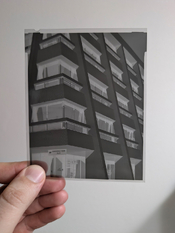
Today I developed some Arista 100 4x5 and got white dots on all of my negatives. I'd heard that their antihalation layer could cause problems (in this post they recommend pre-soaking for 20-30 mins), but I thought that issue was specific to the problematic 120.

Does this look like another Foma QC issue, or am I doing something stupid?

Developed in XTOL 1:1 with a Paterson tank 4x5 adapter. Twizzle stick for the first minute and then gentle inversion each minute after that. Running water stop with TF4 fix.
 

Attachments
  • PXL_20260210_014439541.jpg
    PXL_20260210_014439541.jpg
    254.3 KB · Views: 181
  • PXL_20260210_014428493.jpg
    PXL_20260210_014428493.jpg
    239.7 KB · Views: 160
Last edited:
To my untrained eye for trouble shooting negatives, it looks like some liquid splashed onto the film. Note the light grey halo around many of those white spots. The liquid possibly spread out a bit before it dried. Just my 2cents worth.
 
The dots are just areas of lower development. That would be bubbles, AKA air bells. Can be caused by your agitation scheme and sometimes by residual wetting agent in the tank.

I do 5-7 agitated prewashes to cut down on bubbles. Others use their wetting agent in a different tank and with film off the reels. Some people will tell you you've got to hit the tank bottom really hard on the sink.
 
The dots are just areas of lower development. That would be bubbles, AKA air bells. Can be caused by your agitation scheme and sometimes by residual wetting agent in the tank.

I do 5-7 agitated prewashes to cut down on bubbles. Others use their wetting agent in a different tank and with film off the reels. Some people will tell you you've got to hit the tank bottom really hard on the sink.

I've had air bells before, but mostly on the edge of 120. Using the twizzle stick for the initial agitation and tapping the tank hard after each inversion solved that for me.

I doubt it has anything to do with the wetting agent. The picture was taken right after the photo-flo and I'm positive it's not drying marks.

I wonder if it has something to do with the bright green antihalation layer. It doesn't appear when processing Arista 100 in 35mm. I don't typically prewash, and it's never been an issue for me, but maybe I should make an exception for this film.
 
I doubt it has anything to do with the wetting agent. The picture was taken right after the photo-flo and I'm positive it's not drying marks.

I wasn't suggesting it was drying marks. Those are definitely circles of reduced development. Have a look at this one in particular:

1770743607970.png


You can see the line pattern through it, it's just got less density. It got less development.

The wetting agent (from your previous development session, not this current one) can be one cause of bubbles that occur on the film while it's in the developer.
 
I wasn't suggesting it was drying marks. Those are definitely circles of reduced development. Have a look at this one in particular:

View attachment 417740

You can see the line pattern through it, it's just got less density. It got less development.

The wetting agent (from your previous development session, not this current one) can be one cause of bubbles that occur on the film while it's in the developer.
Oh wow. I had no idea that could be an issue. I'll clean out my tanks/reels before trying again and maybe switch to a separate wetting agent tank if the issue persists.
 
Oh wow. I had no idea that could be an issue. I'll clean out my tanks/reels before trying again and maybe switch to a separate wetting agent tank if the issue persists.
A separate vessel for wetting agent is what I do and I never put my reels in it. I shoot mainly 120, but do the same for all formats. I have a glass wide mouth clip-lid with seal that I use. I take each end of the film and seesaw it back and forth through the wetting agent (LFN) several time, hang and dry. Works well for me. I also prewash most of my films, but that's because I use a staining developer like Pyrocat-HDC.
 
I've shot a bit of Arista 100 in 35mm with no issue. I tried it in 120 once but had the backing paper symbols show up in the exposures. I read that Arista was notorious for QC issues with medium format, and so I swore off using their 120 film.

Today I developed some Arista 100 4x5 and got white dots on all of my negatives. I'd heard that their antihalation layer could cause problems (in this post they recommend pre-soaking for 20-30 mins), but I thought that issue was specific to the problematic 120.

Does this look like another Foma QC issue, or am I doing something stupid?

Developed in XTOL 1:1 with a Paterson tank 4x5 adapter. Twizzle stick for the first minute and then gentle inversion each minute after that. Running water stop with TF4 fix.

I presoak Arista film BUT not for 20-30 minutes; 5 tops. I do that to minimize dye carry over into stop and fix. It doesn't hurt to have this carry over, but it just feels sloppy to do so.
 
I presoak Arista film BUT not for 20-30 minutes; 5 tops. I do that to minimize dye carry over into stop and fix. It doesn't hurt to have this carry over, but it just feels sloppy to do so.
I start presoaking my film because I was using Xtol replenished and didn't want all the junk going back into my working jug. As to presoak time, well I never go more than three minutes. I then dump and fill my tank again and dump agin just to get the last bit out of the tank. This is with 120 and 35mm. 20-30 minutes seem a tad to long to me.
 
Could also be an area of lower sensitivity of the film. Consider the possibility that this might be from the factory. Air bells, or some leftover surfactant would need to reduce development for most of the entire development time.
My question is, has this been seen on other sheets in the box?
 
Air bubbles. Can't blame Foma for that.
You can pre-rinse 5 min with a drop of photo-flo to minimize the risk.
 
I presoak Arista film BUT not for 20-30 minutes; 5 tops. I do that to minimize dye carry over into stop and fix. It doesn't hurt to have this carry over, but it just feels sloppy to do so.
The 20-30 figure came from someone relating correspondence with a Foma rep (in this post). But it might have just been a specific recommendation for a faulty batch.
I start presoaking my film because I was using Xtol replenished and didn't want all the junk going back into my working jug. As to presoak time, well I never go more than three minutes. I then dump and fill my tank again and dump agin just to get the last bit out of the tank. This is with 120 and 35mm. 20-30 minutes seem a tad to long to me.
I normally avoid a presoak. I mostly use XTOL 1:1 as a one-shot and almost always use Ilford film, so I've never seen an advantage.
Could also be an area of lower sensitivity of the film. Consider the possibility that this might be from the factory. Air bells, or some leftover surfactant would need to reduce development for most of the entire development time.
My question is, has this been seen on other sheets in the box?
I developed some sheets earlier, but they were exposed with a sensitometer and were mostly clear as a result. This round of development had my first real test shots from this box. Having dealt with air bells in the past, I've found that even having them in the first minute or two is enough to cause uneven density. I'll try another round of test shots with a pre-soak and update with the results.
Air bubbles. Can't blame Foma for that.
You can pre-rinse 5 min with a drop of photo-flo to minimize the risk.
I've heard of people using PF with a presoak or mixed into the developer, but I've always shied away from that. If @loccdor is correct about my bubbles being caused by residual PF in my tank, wouldn't presoaking with PF just exacerbate the problem?
 
I've never had problems with air bells.

I use Matt King's Photoflo in isopropyl alcohol trick. Helps to prevent over dosing. I use Photoflo as a final rinse with RO water, on my Jobo reels, for 30 to 60 seconds, pull the film off, wash the reel and tank in hot running water.

You shouldn't have anything that creates suds or bubbles in the developer. If you're getting bubbles or suds on agitation something is wrong, contaminated.
 
If @loccdor is correct about my bubbles being caused by residual PF in my tank
I doubt if that's the case. Photoflo tends to cause foaming, but what you have here are tiny little, persistent air bubbles. I don't associate those with foaming. They're the kind of bubbles that can pretty much always happen. Usually, sufficient agitation gets rid of them. You might try photoflo in a pre-rinse bath to see if that helps any; there's a good chance this is the case.
 
Yes what Koraks said sounds right. I haven't ever developed sheet film and I'm not familiar with the specific bubble patterns sheet film a Paterson tank gets. The wetting agent bubbles I've seen in 120 do tend to cluster around the edges near the reels. Once in a rare while I've gotten bubbles more like yours in the middle of frames but I don't recall the specific conditions.
 
I doubt if that's the case. Photoflo tends to cause foaming, but what you have here are tiny little, persistent air bubbles. I don't associate those with foaming. They're the kind of bubbles that can pretty much always happen. Usually, sufficient agitation gets rid of them. You might try photoflo in a pre-rinse bath to see if that helps any; there's a good chance this is the case.

Yes what Koraks said sounds right. I haven't ever developed sheet film and I'm not familiar with the specific bubble patterns sheet film a Paterson tank gets. The wetting agent bubbles I've seen in 120 do tend to cluster around the edges near the reels. Once in a rare while I've gotten bubbles more like yours in the middle of frames but I don't recall the specific conditions.
I'm all too familiar with that awful bubble pattern on 120. Thanks for clarifying.

I think I'll shoot some tests with a 3-5 minute presoak and the same development. If the issue persists, I'll try a presoak with wetting agent. Process of elimination.
 
Yes, avoid foam in the developer.
Any PF in the pre-rinse would just be to lower the surface tension a bit so air bubbles won't stick to the film very well.
I've used 3 drops 10% PF (diluted) per liter water, It's almost an homeopathic dose.
 
I shot 6 more sheets of Arista 100 EDU in 4x5 and processed normally with an added presoak. I filled and drained my Paterson tank three times, leaving it to soak for five minutes after the second fill. On the final drain, the water ran clear.
The sheets were much better. No more bubbles, most were perfectly developed.
However, I noticed some mottling on the corner of one of the sheets (see below).
I did some digging and came across this from an old thread:
Do not eliminate the pre-soak!

Do you use a stop bath? This becomes critical as the format becomes larger!

PE

No prewet and no stop. Those are two critical factors especially with large format and hand agitated in a drum as well. It takes time for developer to spread evenly across a dry sheet of film or paper. It spreads more smoothly over a wet sheet. Same thing with stop. It takes time for water to neutralize developer evenly. Acid does it quickly.

These problems are worse at short development times. Kodak mentions that in their B&W darkroom dataguide.

PE
I've used alkaline fixer (TF4) with a running water stop bath for years with no issues, but the vast majority of my development has been with 35mm and 6x6. Is it possible that the running water is not stopping the 4x5 development rapidly enough, leading to uneven mottling where the residual developer continues to act? Should I switch to acid rapid fix with an acid stop for large format negs, or can I continue to use TF4 with my 4x5?
 

Attachments

  • PXL_20260221_232117309.jpg
    PXL_20260221_232117309.jpg
    1.6 MB · Views: 76
Dan,
TF4 is a great fixer and I've heard no complaints about its performance. Are you thinking of going with a rapid fixer with hardener to prevent the slight scratches in the corner of that shot? I don't think it makes any difference much as to what fixer if you accidentally scratch a negative. A harder will only go just so far. Nothing wrong with TF4 and I'd stick with it.
 
I routinely use a water stop for all my sheet film and have had no problems with mottle. I also use TF5 fixer, very similar to TF4, so I tend to think the problem lies elsewhere. Just my experience...
 
However, I noticed some mottling on the corner of one of the sheets (see below).
I see something that looks like held-back development due to foaming/bubbles, possibly associated with the sheet not being submerged well during part of development. There's also some scratching near the corner.

a Paterson tank 4x5 adapter.
I might have missed it, but what kind of tank and adapter are you using specifically?
 
Twizzle stick for the first minute and then gentle inversion each minute after that.

Do you invert the tank during the first minute?
Only using the twiddle stick never gave me clean negs with a Paterson tank. I would first use the stick for a few seconds, then attach the lid and invert for the rest of the first minute, and then whack the tank against the table several times. (Actually against som EVA foam after cracking one of my tanks)

Could it be that your agitation scheme is a bit too gentle to dislodge the air bubbles?
Was this neg developed with a drop of Photo Flo in the pre-rinse?
 
Looks like bad film. Not sure how one could reproduce that on good film.
 
Photrio.com contains affiliate links to products. We may receive a commission for purchases made through these links.
To read our full affiliate disclosure statement please click Here.

PHOTRIO PARTNERS EQUALLY FUNDING OUR COMMUNITY:


Ilford ADOX Freestyle Photographic Stearman Press Weldon Color Lab Blue Moon Camera & Machine
Top Bottom