
They sold over a million AE1's,..........
Actually, they sold over five million AE-1's.
Jim B.

They sold over a million AE1's,..........
When I went to school, which was admittedly was a long time ago five million was "more than a million"Actually, they sold over five million AE-1's.
Jim B.


As nice as older metal bodied SLR cameras are, they're an ergonomic nightmare, combining sharp corners, excessive weight, slippery surfaces and a lack of any serious grip. Like you, I like to look at my old SLRs more than I enjoy using them.In the end the hard-ish edged rectangular body with some weight to it (especially with the F1.4 lens) sent me elsewhere for better handhold ability.

It wasn't only the top and bottom plates of the A series canons that that were "plastic fantastic" Wayne,(actually A.B.S) but unfortunately some of the internal components like cogs and gears are are also plastic or nylon and although it's been about 27 years since they were manufactured and generally they have been remarkably reliable considering since they were made to a price for a mass market and were probably never envisaged to last this long anyway.At times I regret selling my Ftbn. The partial metering patch was so easy to bias one way or another by overlapping shadows and highlights either way. I also enjoyed the quick loading feature, and mirror lockup for flower photography. In the end the hard-ish edged rectangular body with some weight to it (especially with the F1.4 lens) sent me elsewhere for better handhold ability. I still tho have a FTb that needs a cla, and it might ride again with a single lens, but newer lighter bodies and features attracted me more regardless of the plastic fantastic.
Try it first tho.
Canon were very clever in disguising that the A series cameras were made from A.B.S. I just looked at my A1 I think you'll find that the inside of the bottom cover plate is A.B.S that has been coated to give it the appearance of metal.The bottom plate of the A cameras is metal.
Plastic, galvanized top caps were not introduced by Canon, bot Pentacon did so even 8 years earlier on their Practica.
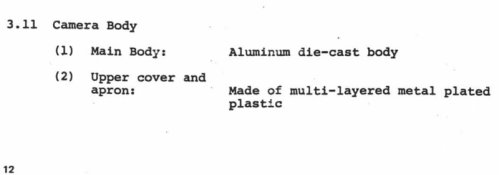
In keeping with its cost-cutting philosophy, Canon designed the AE-1 to use a significant amount of structural plastic for a lighter and cheaper camera at the expense of being less impact resistant. Canon went to great effort to disguise the use of plastic - the injection-molded acrylonitrile-butadiene-styrene (ABS) top and bottom plates were copper-electroplated and then satin chrome finished (or black enameled) to give the look and feel of metal.
I have a Canon A1 in my hands at the moment and the lens locked in the A position and the camera set for aperture priority and all I have to do is take first pressure on the shutter release with my right index finger to put the viewfinder display on and turn the wheel on the A/T control with my second finger until the required aperture appears on the L.E.D. display in the viewfinder, at no time did I have to take my eye from the viewfinder.

It's initiative to me, but I've been using mine for nearly 25 years but I must admit I've never liked it as much as my New F1-AE' s which are much more robust and workmanlike. Leicas have the same sort of rubberized silk shutter as the.A series Canon's and I have never had any problems with mine.
No need to to get defensive I didn't say it was a plastic toy on top of it.
Its no where near as convenient nor intuitive as Minolta's or Nikon's aperture priority modes where you can keep a firm grasp on the body while having a finger on the shutter release and simply twist the lens aperture ring.
The A-1 also has a cloth shutter vs Minoltas XD-11 or Nikons FE or FA metal shutter and lower speeds than the FA and FE2.
Canon were very clever in disguising that the A series cameras were made from A.B.S. I just looked at my A1 I think you'll find that the inside of the bottom cover plate is A.B.S that has been coated to give it the appearance of metal.
WikipediaMy AE-1s definitely got chromed brass bottom-plates and chromed plastic top- and front-covers.
Wikipedia
The frame was Aluminium, " but Canon went to great effort to disguise the use of plastic - the injection-molded acrylonitrile-butadiene-styrene (ABS) top and bottom plates were copper-electroplated and then satin chrome finished (or black enameled) to give the look and feel of metal ".
Looking at Wikipedia is one thing, disassembling a camera, and testing parts on materials is another. In case of doubt I would not trust Wikipedia. Another explanation would be that Canon changed materials.
| Photrio.com contains affiliate links to products. We may receive a commission for purchases made through these links. To read our full affiliate disclosure statement please click Here. |
PHOTRIO PARTNERS EQUALLY FUNDING OUR COMMUNITY:  |

