• Welcome to Photrio!
    Registration is fast and free. Join today to unlock search, see fewer ads, and access all forum features.
    Click here to sign up

When old shutter does not work beyond 1/2 sec..?

Tractor & Tulips

A
Tractor & Tulips

  • 1
  • 1
  • 34
Tree with Big Shadows

Tree with Big Shadows

  • 3
  • 0
  • 82

Forum statistics

Threads
203,458
Messages
2,855,079
Members
101,853
Latest member
DJFOX
Recent bookmarks
0

jay moussy

Member
Allowing Ads
Joined
Jun 10, 2019
Messages
1,315
Location
Eastern MA, USA
Format
Hybrid
When your old shutter does not fire reliably on slow speeds, like past 1/2-second, and an overall or cleaning would be prohibitive, do you use workarounds, possibly hand-timed Blub setting?

 
Best alternative... watercolor painting. Sorry, but any other option will likely be temporary and frustratingly unreliable.
 
Since "past" 1/2 second would be one second on pretty much any shutter, you're only missing one speed. One second is very easy to hand time. With a little practice you should be able to hand time 1/4, 1/2 and 1 second. If any of these speeds are unreliable, use a smaller aperture with a 1 to 2 second shutter.
 
I should have specified that my concern was a 1950s 35mm rangefinder camera I plan on using for fun, using the usual Ilford B&W films, in daylight. Posts #3 and 4 above seem to confirm my initial thoughts, and the possibly challenging conditions would be a good exposure strategy exercise! Watercolor, OTOH, is quite difficult to master...!
 
The bad news here is, if 1/2 and 1 don't work, there's a good likelihood B still stick either open or before opening.
 
The bad news here is, if 1/2 and 1 don't work, there's a good likelihood B still stick either open or before opening.

I was afraid of that as well, but it appears is not the case.
One the 1-second shutter setting, it says open for about seven seconds and then closes.
There are time settings beyond B: 2, 3 ,4, 8 seconds, but I have yet to find out how to set shutter beyond B. Camera has EV readings, speed-aperture are paired and I am carefully learning how to de-couple to go manual.
Extra: the camera manual is a bit odd, goes on and on explaining about EV stuff, yet, leaves you guessing other essentials. I used to work with technical writers, so I am very sensitive to how information is presented to the user! (Hint: do not let your best engineer or your nephew write or illustrate the user docs!)
 
If you're shooting people and sports and parties and most landscape and nature, you won't need 1/2 second or slower. If you do need slow speeds for landscapes in dark light, you'll also need a tripod. I wouldn't worry about 1/2 second for now. The only question right now is how do you know if speeds above 1/2 second are working accurately?
 
The only question right now is how do you know if speeds above 1/2 second are working accurately?

Obviously, you know they aren't. They'll be slow. Question is, how slow.
 
In my short experience with old shutters you can find some that are sticky and on slow times goes randomly slow offering every time a different exposure time, some others are only slow and offer delayed times but consistent. You have to test and see if the slow times are always the same and in this case use it accordingly; if times are always different you're in need of a CLA
 
What camera; what shutter... some are more amenable to “quick-fixes” than others.
 
The bad news here is, if 1/2 and 1 don't work, there's a good likelihood B still stick either open or before opening.
That seems unlikely. 1/2 and one second are particularly problematic due to the (intended) resistance of the slow speed escapement. On most shutters I've dug into, the B setting does not engage either escapement.
 
What camera; what shutter... some are more amenable to “quick-fixes” than others.

If you wish:
Blada Badessa 1b 1958 rangefinder
45mm f/2.8 Baldanar
With Prontor SVS Leaf shutter, B, 1 – 1/300 seconds
Like this example:
Baldessa-8-445x297.jpg


I think there is a web age somewhere walking through this shutter tear-down.
 
There are web pages and overhaul manuals available online. What might be an option, which will likely draw the ire of a few around here, is JUDICIOUS flushing with lighter fluid. I’d concentrate on just the escapements and levers. Then some JUDICIOUS lubrication with appropriate oil and grease. Doing this is only doing part of the job but often restores functionality for a while. That’s a nice camera... I’d really consider a full overhaul if it was mine.

also, see this if you haven’t already:
https://www.photrio.com/forum/threads/cleaning-prontor-svs-shutter.55430/
 
If B works, you should be able to time 1/4 sec accurately, maybe even more accurately than an inconsistent shutter. Musicians have to time much shorter intervals much more precisely than that, and even amateurs can do it with a precision of a few thousandths of a second.

So think of a march in your head, like “The Stars and Stripes Forever.” Marches, except for crazy circus marches, are usually played at 60 beats per minute, because that’s a good marching cadence. You can also use a watch with a second hand or a metronome to time it. There are lots of metronome apps for smartphones. Then subdivide in your head, 120 beats per minute, then 240 beats per minute. There’s your 1/4 sec.
 
If my equipment doesn't work as designed it would bother me a lot. But with that said practically I don't need shutter speed longer than 1/2 second. I rarely use them and when I do use them timing manually in B mode is fine.
 
I have a Prontor SVS tore down at the moment. DON'T DIY. The manuals available on line do not cover the coupled EV version of the shutter which has more levers and springs than the standard SVS.
This one had a dead delay timer coil tension spring and a weak cocking spring from being left cocked for a decade or more.
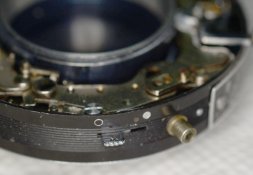
Look for a lever like this, it couples/decouples the EV.
switch.jpg
The speeds were 1 second in op; 1/2, 1/4,1/8 - 1.5 seconds; 1/15, 1/30, 1/60, 1/125, 1/300 - all 1 stop slow.

Send it to me for repair.
 
I have never met a clockwork shutter that would fail to perform well after a few drops of lighter fluid. Wet the escape mechanism and all those little gears. It works. - David Lyga
 
Older shutters that were designed to run dry actually work better with a trace of oil on the gear posts, shaft bushings, a trace of grease on sliding metal parts, and graphite/teflon on the shutter blades and controller.
A trace is a drop of oil applied to a cotton swab or felt pad, pin touched to it or a drop applied directly then wiped off with a towel, what remains is a trace.
Pop quiz... who said this, and is it correct or not?
 
Pop quiz... who said this, and is it correct or not?
From my lengthy experience I would say that this is a good statement. Emphasize 'trace' of oil, however; just enough to prevent metal on metal wear but never enough to potentially gum up the works when dry.

This small allowance, however, should not apply ever to auto aperture blades. - David Lyga
 
Me too, David... with the exception of graphite on shutter blades.
 
Prontors are straightforward, and a few drops of nafta (lighter fluid) usually loosens the gunk that forms over the decades
It is not a hard DYI fix, and as stated before modern lubricants are way better than the stuff from the 30s and even 60s; they must be used in minute amounts though. I use a hypodermic needle (tip cut) to add very small drops.

A few good service manuals for Prontors:
https://learncamerarepair.com/productlist.php?category=2&secondary=21

Testing the speed is easier with your phone, recording the sound of the leaf shutter and then using a program like Audacity to check how long the shutter is open.
 
And I use a trace of oil and grease as the shutter runs smoother and quieter than without HOWEVER I will not use lighter fluid or service anything in which lighter fluid has been used.
I leave that to you armatures.

Not all makes of shutters were designed to run dry. Ilex and Prontor are the only two I know of.
 
Last edited:
The bad news here is, if 1/2 and 1 don't work, there's a good likelihood B still stick either open or before opening.

Ah! Something I now can have an opinion on! :smile: Having serviced three separate Mamiya TLR lenses, I see the chance as 50/50. If the problem is with sticky shutter blades, you're right. But if the problem lies in the shutter timing mechanism, B will work just fine.
 
Photrio.com contains affiliate links to products. We may receive a commission for purchases made through these links.
To read our full affiliate disclosure statement please click Here.

PHOTRIO PARTNERS EQUALLY FUNDING OUR COMMUNITY:



Ilford ADOX Freestyle Photographic Stearman Press Weldon Color Lab Blue Moon Camera & Machine
Top Bottom