
• Welcome to Photrio!
    Registration is fast and free. Join today to unlock search, see fewer ads, and access all forum features.
    Click here to sign up

What???

Grill

H
Grill

  • 4
  • 0
  • 80

Recent Classifieds

Forum statistics

Threads
202,789
Messages
2,845,594
Members
101,533
Latest member
maho
Recent bookmarks
0

Gerry M

Member
Allowing Ads
Joined
Nov 14, 2005
Messages
1,290
Location
Oregon
Format
Multi Format
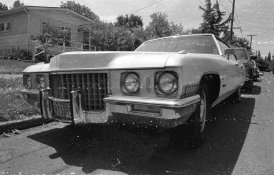
I just processed a factory roll of Arista Premium 400/TriX in (fresh) Xtol 1:1. Chem temps were 68'F. 8.75 mins per MDC. 3 inversions /min. Fixer tested OK. All frames are the same as the example shown. Body: R2A. Lens CV 25/4. I have used this film/chem combo many times w/o issues. I may have pulled the film from the cassette too fast when loading the reel, creating a static discharge. Is this likely? Any input would be appreciated.
Negative was scanned with a Coolscan V and an Epson V700, both results were the same.

Thanks,

Gerry
 

Attachments

  • 2018-06-19-0001 web.jpg
    2018-06-19-0001 web.jpg
    625.7 KB · Views: 425
I may have pulled the film from the cassette too fast when loading the reel, creating a static discharge. Is this likely? Any input would be appreciated.

It doesn't look like static discharge. That normally looks like "mini lightning bolts" on the image. This looks more like some type of chemical residue.
 
This film: Pre wash for 1 min. Developer 3 inversions/min, Ilford wash; 5,10,15 inversions per water change. Fixer for 7 min, Ilford wash. Hypo for 1 min, then Ilford wash. Foto flow for 30 sec and hang to dry.
 
Why do you put the film back into fixer (Hypo) after you fix it.?
If by chance you mean Fixer (Hypo) Clearing Agent, it looks like residue on the film. Can you see it with a magnifier?
 
Maybe I should try and rewash the film with clear water, or ???

Yes, try that. 10 minutes wash with running water, and then a 30 second soak with fresh photo-flo.

It might be worth checking how much dust you have in the surrounding air, as this may stick to the film and allow and chemical water or residue to form on it and then drip down.
 
I just processed a factory roll of Arista Premium 400/TriX in (fresh) Xtol 1:1. Chem temps were 68'F. 8.75 mins per MDC. 3 inversions /min.

Gerry

Completely unrelated to this problem I feel sure but I note that you use 3 inversions per minute for Xtol as opposed to what I think is the Kodak recommended agitation of 2-3 per 30 secs. In terms of development ( as far as one can tell from a scan) your neg looks fine which suggests that 3 inversions per minute might be OK. Can you confirm that it is definitely only 3 per min?

Thanks

pentaxuser
 
Either residue which can be rewashed, or possibly the Xtol wasn't completely mixed.
 
Completely unrelated to this problem I feel sure but I note that you use 3 inversions per minute for Xtol as opposed to what I think is the Kodak recommended agitation of 2-3 per 30 secs. In terms of development ( as far as one can tell from a scan) your neg looks fine which suggests that 3 inversions per minute might be OK. Can you confirm that it is definitely only 3 per min?

Thanks

pentaxuser

Yes, one 5 second inversion every 20 seconds.
 
Post a scan when all is said and done. It will be cool to compare the two negatives.
 
Yes, one 5 second inversion every 20 seconds.
Thanks so that is one inversion lasting 5 sec from upright to upside down and back to upright. Interesting as this is quite a slow inversion compared to the 2-5 cycles(complete inversions) every 30 secs that Kodak mentions in publication J-109. It certainly makes inversion less frenetic and just shows that agitation is much less critical than maybe it is generally thought to be.

pentaxuser
 
Thanks so that is one inversion lasting 5 sec from upright to upside down and back to upright. Interesting as this is quite a slow inversion compared to the 2-5 cycles(complete inversions) every 30 secs that Kodak mentions in publication J-109. It certainly makes inversion less frenetic and just shows that agitation is much less critical than maybe it is generally thought to be.

pentaxuser
When it comes to agitation, consistency matters the most.
If your agitation is more gentle than average, but still complete and regular, you can easily compensate with very slightly longer development times.
And to the OP, hopefully the residue isn't embedded in the emulsion. Can you tell which side of the film it is on?
I am always a bit sceptical about the Ilford Wash sequences ability to deal with clean washing in any circumstance where there may be problems with residue. I prefer the Kodak recommendations for a continuous, very slow flow.
But we don't want to get into religious arguments do we?:whistling:
 
Thanks so that is one inversion lasting 5 sec from upright to upside down and back to upright. Interesting as this is quite a slow inversion compared to the 2-5 cycles(complete inversions) every 30 secs that Kodak mentions in publication J-109. It certainly makes inversion less frenetic and just shows that agitation is much less critical than maybe it is generally thought to be.

pentaxuser

Yes on the process. I think it may come from earlier times of using Rodinal where more agitation/inversions seem to increase grain.
 
When it comes to agitation, consistency matters the most.
If your agitation is more gentle than average, but still complete and regular, you can easily compensate with very slightly longer development times.
And to the OP, hopefully the residue isn't embedded in the emulsion. Can you tell which side of the film it is on?
I am always a bit sceptical about the Ilford Wash sequences ability to deal with clean washing in any circumstance where there may be problems with residue. I prefer the Kodak recommendations for a continuous, very slow flow.
But we don't want to get into religious arguments do we?:whistling:

Matt,
After re-washing, the film strips are hanging to dry now. I have and used to use a cylindrical washer. Where we live now, the water supply has a high mineral content. Even double filtered, I could not get really clean water to the washer. I am now using distilled water in 1 gal jugs.
 
The white spots in the print are black spots on the negative or pieces of debris that completely block the light. So, the first thing to do is examine the negative carefully under magnification to determine if the problem is debris, in which case you will see crud on the negative, or if it is actually areas of increased density in the emulsion.

If the former, then cleaning may help (rewashing, maybe gentle rubbing, etc.). A somewhat common cause of this is flakes of sulfur in the fixer, which result from exhausted or too old fixer. Note that even freshly mixed fixer from concentrate that is past its prime can have this problem (sulfuring out) and even still clear film. Filtering such fixer can help, but really, any fix with sulfur particles floating around in it should be discarded. Usually sulfur particles adhere very strongly to the emulsion and are difficult if not impossible to remove.

If the problem is density in the negative itself, there's nothing you can really do to salvage the neg, but you should try to trace the cause.Usually this is caused by particles of developing agent in the developer that are not completely dissolved which attach to the negative and develop small areas faster than the rest of the neg. Did you by any chance mix your Xtol immediately before developing?

Best,

Doremus
 
The white spots in the print are black spots on the negative or pieces of debris that completely block the light. So, the first thing to do is examine the negative carefully under magnification to determine if the problem is debris, in which case you will see crud on the negative, or if it is actually areas of increased density in the emulsion.

If the former, then cleaning may help (rewashing, maybe gentle rubbing, etc.). A somewhat common cause of this is flakes of sulfur in the fixer, which result from exhausted or too old fixer. Note that even freshly mixed fixer from concentrate that is past its prime can have this problem (sulfuring out) and even still clear film. Filtering such fixer can help, but really, any fix with sulfur particles floating around in it should be discarded. Usually sulfur particles adhere very strongly to the emulsion and are difficult if not impossible to remove.

If the problem is density in the negative itself, there's nothing you can really do to salvage the neg, but you should try to trace the cause.Usually this is caused by particles of developing agent in the developer that are not completely dissolved which attach to the negative and develop small areas faster than the rest of the neg. Did you by any chance mix your Xtol immediately before developing?

Best,

Doremus

I mixed the Xtol powder about 1 month ago. I then mix the stock 1:1 at the time of processing the film. Previous films show no problems. When the rewashed film is dry, I will post another example of the same frame.
 
After re-washing and new photo flo. Better, but must be some residue imbedded on emulsion side. I will re-filter the Xtol, toss the current fixer and clearing agent. Thanks to all for your input.
 

Attachments

  • 2018-06-20-0001 rewashed web.jpg
    2018-06-20-0001 rewashed web.jpg
    578.1 KB · Views: 131
Do you put your films in the fridge before or after you exposed them?
 
How old is the clearing agent? Once mixed - even at stock solution strength - it doesn't last particularly long.
 
How old is the clearing agent? Once mixed - even at stock solution strength - it doesn't last particularly long.

The mixed batch is probably 2 or 3 months old. I just tossed it along with the mixed fixer and photo flow. I will re-filter the mixed Xtol and see how the next film turns out.
 
Photrio.com contains affiliate links to products. We may receive a commission for purchases made through these links.
To read our full affiliate disclosure statement please click Here.

PHOTRIO PARTNERS EQUALLY FUNDING OUR COMMUNITY:


Ilford ADOX Freestyle Photographic Stearman Press Weldon Color Lab Blue Moon Camera & Machine
Top Bottom