• Welcome to Photrio!
    Registration is fast and free. Join today to unlock search, see fewer ads, and access all forum features.
    Click here to sign up

What was/is Meritol?

Cigar again

H
Cigar again

  • 0
  • 0
  • 5
Rainy Day Trees

A
Rainy Day Trees

  • 7
  • 1
  • 102

Recent Classifieds

Forum statistics

Threads
203,158
Messages
2,850,734
Members
101,705
Latest member
kyuut
Recent bookmarks
3

Jerevan

Member
Allowing Ads
Joined
Nov 19, 2004
Messages
2,258
Location
Germany/Sweden
Format
Large Format
I was looking in a photographic book today, and found some chemistry recipes, one of which included Meritol. The book was reprinted in 1947, just to give a clue to its age.

I did a google on that name and came up with hexahydric alcohol, chemical name C6H14O6 and CAS 50-70-4. It seems more commonly known as Sorbitol.

Could it be this (sounds strange) or was Meritol a proprietary chemical substance?
 
The formula in my book is:

C6H4(OH)2: C6H4(NH2)2 =218

Patented by Johnson and Sons LTD. No date given.

Fine grain developer
 
According to The Focal Encyclopaedia of Photography, Meritol has the formula of C6H4(OH)2.C6H4(NH2)2, molecular weight 218.

Meritol was a proprietary developing agent made by Johnsons.
 
Thank you very much,

judging from that formula, it seems to be composed of catechol and possibly o-phenylenediamine. But I am no chemist, as you already have understood by now, just curious by nature. :smile:

The formula consists of Metol, Meritol, Sodium Sulphite and water. And in the book it's called Johnsons Meritol-Metol, for obvoius reasons...
 
I mentioned it in the recipe for MCM100 in the recipes section here:

"Meritol was a proprietary Johnson developing agent, a compound of p-Phenylenediamine (PPD) and catechol. The 16 g of Meritol can be replaced with 7 g of PPD and 9 g of catechol."

The book wouldn't happen to be Jacobson's Developing would it?

Best,
Helen
 
One of the problems with organic chemistry is that the structural formulas often don't mean much. C6H4(OH)2 could conceivably represent either hydroquinone, catechol (both photochemically active) or resorcinol (not photochemically active), the three isomers of dihydroxybenzene. Similarly, there are a few isomers of phenylenediamine that could be represented by C6H4(NH2)2.

Since it's used photographically, my guess is that Meritol is probably some kind of co-crystal of para-phenylenediamine with either hydroquinone or catechol.
 
Thanks for the clarifications - now I know what I am looking at... wasn't sure if it was o-, m- or p-phenylenediamine.

No, the book is actually "Photography by Artificial Light" by Marcel Natkin who also wrote the book "Photography without Tears". :D

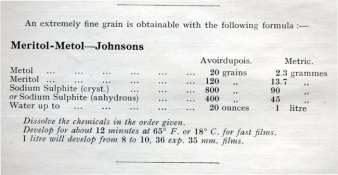
I might as well give the whole of the recipe and it is as follows, verbatim apart from the left out avoirdupois quantities:

Metol - 2.3 grammes
Meritol - 13.7 grammes
Sodium Sulphite (crystals) 90 grammes
or
Sodium Sulphite (anhydrous) 45 grammes
Water up to - 1 litre

Dissolve the chemicals in the order given.
Develop for about 12 minutes at 65 F or 18 C for fast films.
1 litre will develop from 8 to 10, 36 exp. 35 mm. films.


What constituted fast films in 1947 is probably something like ISO 160-200 today, I suppose. According to the text, extremely fine grain is obtainable with this formula.
 
No, the book is actually "Photography by Artificial Light" by Marcel Natkin

Metol - 2.3 grammes
Meritol - 13.7 grammes
Sodium Sulphite (crystals) 90 grammes
or
Sodium Sulphite (anhydrous) 45 grammes
Water up to - 1 litre

Dissolve the chemicals in the order given.
Develop for about 12 minutes at 65 F or 18 C for fast films.
1 litre will develop from 8 to 10, 36 exp. 35 mm. films.

Do you mind digging the book out and check the page no that formula is on? Or scan the page if it's not too much to ask?
I need that info for a small project i'm working on. http://bwformula.atelierelealbe.eu/index.php/JJ97
Thanks
 
Here's the complete list of Meritol formulae that Johnsons published

MCM100 was devised by a column writer for Miniature Camera Magazine just before WWII, apart from being a keen photographer and writer he was also the advertising agent for both Ilford & Johnsons so had strong ties with the photographic industry.

Johnsons is the oldest of all photographic companies still trading (as Johnsons Photopia), they supplied Silver Nitrate ect to Fox Talbot, although they closed their chemistry division in the early 1970's.

Ian
 
From "Amateur Photographer" Sept 25 1946:
"The sustance known as Meritol consists of a compound or mixture in equimolar parts of para-phenylenediamine and pyrocatechin.
The preparation is carried out as follows according to Patent Specification No.466,626 of Jun 1st, 1937:-
100 lb para-phenylenediamine is dissolved in 80 gallons of a 10 per cent solution of sodium bisulphite with the aid of heat, 2 lb decolourising carbon added, the mixture well stirred for 10 minutes and filtered hot; to this a hot solution of 100 lb of pyrocatechin in 20 gallons of a 10 percent solution of potassium metabisulphite is added; on cooling the new compound separates out in beautiful colourless prismatic crystals which melt at 110 degrees C and are remarkably stable in the air.
Similarly by substituting an equivalent quantity of pyrogallol or chlorquinol for the pyrocatechin in the above example the corresponding compounds are readily obtained."

I mention this out of interest only,NB some of these substances are highly toxic, don't try this at home!
 
Meritol was the tradename for the addition product of p-phenylenediamine and catechol. Once dissolved it dissociated into its two components. Nothing magical and not really a useful developing agent with today's emulsions.
 
I think your maybe wrong Jerry. I use Meritol based developer as a teenager and i think that a PPD-Pyrocatechin developer like Pyrocat would have great potential. I don't think I'd use 50/50 ny MW though, much less PPD so strictly it would be Meritol-Pyrocatechin.

Ian
 
Hi Ian,

Such developing agents as Meritol were a response to the thick emulsions of the time. They did provide finer grain but at the expense of sharpness and speed. Many years ago I got caught up with the search for the "holy grail" of developers. I tried several PPD developers and also solvent types such as Microdol. All yielded finer grain but with mushy images. With today's finer grain films, I see no advantage in their use. Of all the developing agents ascorbic acid seems to be closest to the ideal. Ascorbic acid produces much less infectious development than any other developing agent thereby yielding greater sharpness.
 
Unfortunately Johnson's later proprietary developer formulae have never been published. The company was poorly managed and they dropped their raw photochemical manufacturing side and then their chemistry. Their chief chemist Pip Pippard set up Photo Technology with others but they mainly specialised in Colour chemistry and made a only a small B&W range.

Johnson's had fine grain developers with excellent definition, but the key isn't Meritol, it's PPD for the fine grain and Pyrocatechin for the definition.

You could reformulate Pyrocat HD with PPD instead of Phenidone, it'd be slower but probably finer grained. I think the mistake is to think that Johnson's Meritol is a "New" developing agent, which is what they claimed. Edmund Lowe thought differently :D

Ian
 
Do you mind digging the book out and check the page no that formula is on? Or scan the page if it's not too much to ask?
I need that info for a small project i'm working on. http://bwformula.atelierelealbe.eu/index.php/JJ97
Thanks

Of course I can do that, if you still are interested. Sorry about the late reply but life (relationship breakup, new home, no darkroom, etc, etc) has come between me and APUG for the last 7-8 months.
 
Let's see if the uploaded picture is enough to read the text from the book - it's not much, just the recipe and that's it.
 

Attachments

  • Meritol.jpg
    Meritol.jpg
    130.6 KB · Views: 267
Thanks Karl-Gustaf!

Well, I guess things are coming along in the right direction again. The analogue, darkroom direction that is. :smile:
 
My references show it as a combination of one mole catechol with one mole p-phenylenediamine. The dry product was probably the adduct, but you could also probably just substitute the proper amounts of the constituents.
 
Photrio.com contains affiliate links to products. We may receive a commission for purchases made through these links.
To read our full affiliate disclosure statement please click Here.

PHOTRIO PARTNERS EQUALLY FUNDING OUR COMMUNITY:


Ilford ADOX Freestyle Photographic Stearman Press Weldon Color Lab Blue Moon Camera & Machine
Top Bottom