
• Welcome to Photrio!
    Registration is fast and free. Join today to unlock search, see fewer ads, and access all forum features.
    Click here to sign up

What to do with a f1.7 (or f1.4) lens?

Recent Classifieds

Forum statistics

Threads
202,820
Messages
2,845,933
Members
101,544
Latest member
Juergen Lossau
Recent bookmarks
0

spl

Member
Allowing Ads
Joined
Aug 12, 2021
Messages
57
Location
Dublin, Ireland
Format
Analog
I have a beautiful Canonet QL17. When I photographed with it first I was taken aback by the beauty and clarity of the images except there was a dark splodge (-2ev~) due to a mark on the rere element that I was assured by a professional wasn't fixable ... So I fixed it with 0.5 micron diamond polishing paste. The lens still has its coatings front and back and the shots are now perfect.

So my question? Given that this lens opens to f/1.7 ... what do I do with it?? I like contrast so I seek bright sunny days for Ilford FP-4 but I might as well have a f2.8 or f4 lens if I use a film more than ISO 6.

I can do Infrared with it ... and I will. But what is the advantage of a f/1.7 lens in practical terms if good lighting conditions won't let it open out to f/1.7?
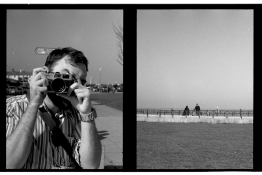
 

Attachments

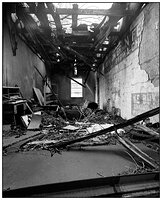
  • scan20220331_000145.png
    scan20220331_000145.png
    1,002.9 KB · Views: 128
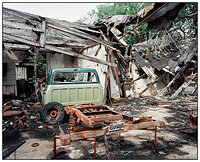
  • scan20220520_000029A.jpg
    scan20220520_000029A.jpg
    178.8 KB · Views: 116
But what is the advantage of a f/1.7 lens in practical terms if good lighting conditions won't let it open out to f/1.7?


Better performance when stopped down relative to a wide open lens at the same aperture. Sounds like you need some slower film.
 
Two advantages: first, it lets you shoot hand held in lower light or with slower film (don't forget, ISO 400 was plenty fast when those cameras were made, and Kodachrome was usually ISO 25 -- along with Panatomic-X, a popular choice in 35mm due to its fine grain). Second, if you can control the light well enough (shoot in shade, or indoors with window light, for instance) you can open up the lens and get that narrow depth of field and desirable out of focus rendition.

If film too fast for the light is keeping your lens stopped down, you might look at Lomography Kino Berlin -- it's respooled ORWO DN21 duplicating film. Super-fine, but conventional grain (no special developers needed), and ISO 12. I've got a hundred feet (minus a few cassettes) in a bulk loader, obtained from the North American ORWO distributor; you may only be able to get more than a cassette by buyin four hundred feet (120+ m), but it's great film for when you want to be able to open up your lens in the sunshine.
 
Fast lens are for what we called available light, most of the fixed lens rangefinder made in the 60s and 70s were a stop or slower at 2.8. Shooting indoors, early morning or near evening, even night shots. Other reason is render a background out of focus by shooting wide open limited depth of field, the Canon QL 1.7 has pretty good boka.
 
I have a beautiful Canonet QL17. When I photographed with it first I was taken aback by the beauty and clarity of the images except there was a dark splodge (-2ev~) due to a mark on the rere element that I was assured by a professional wasn't fixable ... So I fixed it with 0.5 micron diamond polishing paste. The lens still has its coatings front and back and the shots are now perfect.

So my question? Given that this lens opens to f/1.7 ... what do I do with it?? I like contrast so I seek bright sunny days for Ilford FP-4 but I might as well have a f2.8 or f4 lens if I use a film more than ISO 6.

I can do Infrared with it ... and I will. But what is the advantage of a f/1.7 lens in practical terms if good lighting conditions won't let it open out to f/1.7?

It still gives you a beautiful bright viewfinder image; better to compose and nail focus.
 
It still gives you a beautiful bright viewfinder image; better to compose and nail focus.

Um. The viewfinder on a rangefinder camera like the Canonet is independent of the f/1.7 lens...
 
High aperture can be used in two ways: (a) allow low light picture taking, as discussed above; (b) achieve shallow depth of field, (almost) like the ***(redacted) who spend fortunes on f:1.0 lenses. Or, in a milder form, achieve that "3D look" aka "background isolation". Say you want to take a pic at f:4 in bright sun. Have a 4-stop ND filter available (should be called ND1.2, but most often called ND16). Also, keep in mind that you can overexpose FP4 ot 400TX by several stops as long as you don't use a compensating dev that creates a marked shoulder. Don't believe? Try!
 
But what is the advantage of a f/1.7 lens in practical terms if good lighting conditions won't let it open out to f/1.7?

None, unless the lens you have is "better" than a slower lens. This is why I loved shooting my Leica R lens on a camera like a Nikon N8008s. With it's 1/8000 top shutter speed, shooting wide open even on sunny days was possible.
 
For indoor events back in the day it was pretty standard operating procedure to set the shutter speed to the lowest we could hold steady, set the aperture wide open, wait until the subject was in the best possible light, take the shot, and do the best we could with the result in the darkroom. My keeper percentage went up a lot when I left my personal camera with an f/2.8 lens at home and used the school's camera with an f/1.4 lens instead.
 
There are many features on my cameras that I don't use because they just don't fit in to my workflow.

I own many f1.7, f1.8 and f1.4 lenses. I usually shoot them around f8, because that is what works for me. On the other hand, the ability to shoot low light without flash is a nice feature to have. Narrow depth of field can be helpful in select situations.
 
-) all lenses gain image quality (2D, DOF-gain aside) by being stopped down

-) typically with F1.4 lenses the point of maximum image quality is reached at larger apertures than with F2 or F2.8 lenses. Thus the "speed" benefit remains even at stopping down
 
High aperture can be used in two ways: (a) allow low light picture taking, as discussed above; (b) achieve shallow depth of field, (almost) like the ***(redacted) who spend fortunes on f:1.0 lenses. Or, in a milder form, achieve that "3D look" aka "background isolation". Say you want to take a pic at f:4 in bright sun. Have a 4-stop ND filter available (should be called ND1.2, but most often called ND16). Also, keep in mind that you can overexpose FP4 ot 400TX by several stops as long as you don't use a compensating dev that creates a marked shoulder. Don't believe? Try!
Thanks! Could you please explain that phrase to me?
 
Thanks! Could you please explain that phrase to me?
You're welcome. In a little more detail.

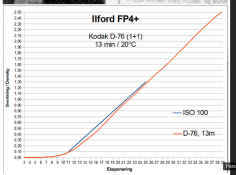
When using a film with a linear response (in density versus log(exposure) plots; D-logE) if you overexpose you just push your negative to higher densities. but the tonal relations are preserved. You may (or not) lose with coarser grain, exposure times under the enlarger will be longer (ditto for the S* thing). But the tonal relations are preserved. Get your hands on David Vestal's The Craft of Photography and see how he exposes Tri-X to ASA 1 and below.

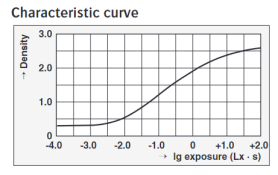
For a so-called compensating film-developer combination the D-logE curve slope decreases at high exposures, like a road approaching a summit; that is called the shoulder. This may be useful to tame the large dynamic range of a scene. A good example is Agfa APX-100 (the original stuff) in Rodinal. So, if you overexpose with such a combination, you push the mid-values up the D-logE curve into a region that was meant for highlights; the result may look dull.

Below, D-logE curves for FP4 (linear) from the fotoimport database, and for APX-100, from the Agfa datasheet.

FP4.pngAPX-100.png
 
With mention of Rodinal, I'd note that Rodinal has much more compensating effect at higher dilutions and with reduced agitation than, say, 1:25 and agitating five seconds every 30. Compensation is at least partly an effect of local exhaustion (highlights need more from the developer, and exhaust it sooner, and if the developer is mixed weak and not agitated to bring fresh solution in, the highlights will get less development than the shadows).
 
You're welcome. In a little more detail.

When using a film with a linear response (in density versus log(exposure) plots; D-logE) if you overexpose you just push your negative to higher densities. but the tonal relations are preserved. You may (or not) lose with coarser grain, exposure times under the enlarger will be longer (ditto for the S* thing). But the tonal relations are preserved. Get your hands on David Vestal's The Craft of Photography and see how he exposes Tri-X to ASA 1 and below.

For a so-called compensating film-developer combination the D-logE curve slope decreases at high exposures, like a road approaching a summit; that is called the shoulder. This may be useful to tame the large dynamic range of a scene. A good example is Agfa APX-100 (the original stuff) in Rodinal. So, if you overexpose with such a combination, you push the mid-values up the D-logE curve into a region that was meant for highlights; the result may look dull.

Below, D-logE curves for FP4 (linear) from the fotoimport database, and for APX-100, from the Agfa datasheet.

View attachment 306392View attachment 306393

Thanks so very much for this. I'm not claiming to fully understand, but I ordered Vestal's book and look forward to muddling through!
 
At one time I did a lot of night photography, so I opt for the largest f/stop that I can afford.
 
At one time I did a lot of night photography, so I opt for the largest f/stop that I can afford.

But does for instance 1.4 vs. 1.8 then actually matters? It is just 1/2 stop difference.
 
But does for instance 1.4 vs. 1.8 then actually matters? It is just 1/2 stop difference.

It's easy to play that relativist game. Half a stop here and there means a lot.
All tricks and tweaks combined can mean the difference between a good exposure and not getting anything.
 
But does for instance 1.4 vs. 1.8 then actually matters? It is just 1/2 stop difference.

Yes, even a half f/stop matters.
 
Not always (letting Helge's"adding-up"aspect aside).

Imagine that with your F 1.8 lens you are spot on full-open exposure-wise.
Then gaining a larger aperture would yield the chance to half exposure time.
However, at non-autoexposure cameras there is no 1/2 stop at exposure-time setting. At best you could half the exposure time, but by this underexposing 1/2 stop.
 
Not always (letting Helge's"adding-up"aspect aside).

Imagine that with your F 1.8 lens you are spot on full-open exposure-wise.
Then gaining a larger aperture would yield the chance to half exposure time.
However, at non-autoexposure cameras there is no 1/2 stop at exposure-time setting. At best you could half the exposure time, but by this underexposing 1/2 stop.

Push a stop. Preflash. Latensify. Even gas hyper. Use a developer (scheme) that compensates. Use a chest pod/table tripod. Etc.
A faster lens is prerequisite here.
1.7 is fine, and if you need the
DoF absolutely fine.
But 1.4 and 1.2 lenses didn’t sell for double or quadruple the price for vanity alone.
 
But 1.4 and 1.2 lenses didn’t sell for double or quadruple the price for vanity alone.

I think a lot was due to marketing. In the sense of "This lens enables you to take nigh-time exposures" (textbooks included), implying that such would not be possible with other lenses.

Even here at this forum I see quite some people not able to calculate differences between lens apertures into f-stop differences, similar for guide numbers too.
 
Push a stop. Preflash. Latensify. Even gas hyper. Use a developer (scheme) that compensates. Use a chest pod/table tripod. Etc.
A faster lens is prerequisite here.
1.7 is fine, and if you need the
DoF absolutely fine.
But 1.4 and 1.2 lenses didn’t sell for double or quadruple the price for vanity alone.

But in real life people do not have time to flash the film. Buy the largest aperture you can afford.
 
I can do Infrared with it ... and I will. But what is the advantage of a f/1.7 lens in practical terms if good lighting conditions won't let it open out to f/1.7?

Not much, if as you say you're sticking with sunny weather and fp4. Slower lenses are generally more compact and can be excellent performers too (my best lens is an f4.5) so it's a matter of taste really. As others have said, the benefits of a fast lens appear when you need the speed and don't mind the tradeoffs that the speed costs you. In your case you don't need the speed that you have, but you like the lens anyway so all's good.

It's worth experimenting with your fast lens to find its sweet spot. Given your camera is limited to 1/500 sec I'd be tempted to park an ND filter on it if you find f4.0 or f5.6 is where your lens is happiest.
 
But in real life people do not have time to flash the film. Buy the largest aperture you can afford.

We have a reliable flashing device on hand almost all the time today. A phone screen out of focus with a white (or coloured) frame.

Latensification is just about even illumination that is below reciprocity failure for build up of a significant image over a given time frame. I've used a door frame gab over 15 minutes in a bathroom successfully. Crude but effective.
 
Photrio.com contains affiliate links to products. We may receive a commission for purchases made through these links.
To read our full affiliate disclosure statement please click Here.

PHOTRIO PARTNERS EQUALLY FUNDING OUR COMMUNITY:


Ilford ADOX Freestyle Photographic Stearman Press Weldon Color Lab Blue Moon Camera & Machine
Top Bottom