

• Welcome to Photrio!
    Registration is fast and free. Join today to unlock search, see fewer ads, and access all forum features.
    Click here to sign up

What thread size these enlargers use on the lens board?

Autumn

D
Autumn

  • 0
  • 0
  • 13
Sol Infinitus

A
Sol Infinitus

  • 7
  • 0
  • 32

Recent Classifieds

Forum statistics

Threads
203,392
Messages
2,853,909
Members
101,816
Latest member
Gregg128
Recent bookmarks
0

MattAndre

Subscriber
Allowing Ads
Joined
Sep 13, 2024
Messages
11
Location
California
Format
Large Format
Durst M301 questions
I'm guessing smaller than 39mm, so the other question is; are there lensboards which fit these enlargers AND have a 39mm thread? Also, anyone know of a parts source for Durst enlargers? I got this one free but it's missing the bulb cover and the negative tray/carrier. Thanks in advance...
 
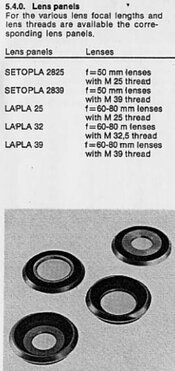
Durst flat lens boards/panels are named Lapla available in standard 25mm and 39mm thread sizes.
However, in order to print 35mm with a 50mm lens you'll need a recessed lens board.
Durst Siriopla and Siriotub should also fit.

It is possible to find or make 3d printed versions.
 
Last edited:
For parts, it will probably be easier and perhaps cheaper to find a second enlarger.
 
The manual for the M305 (not the M301) says this:
3.1.7 Lens panels
A flat lens panel (12) is supplied with the Durst M 305 to take 50 mm lenses with M39×26 tpi screw thread.
The following lens panels are available separately to order for the 35 mm and 28 mm lenses:
35 mm: NERIOTUB
28 mm: NERIOTUB
Here is that manual: http://www.jollinger.com/photo/cam-coll/manuals/enlargers/durst/Durst_M305.pdf
that link comes from the Jolllinger enlarger (and other things) manual page, found here: http://www.jollinger.com/photo/cam-coll/manuals/manuals.html
 
This is from the M601 which is the medium format version and had very similar production dates.
 

Attachments

  • Screenshot_20260302_193937_Firefox.jpg
    Screenshot_20260302_193937_Firefox.jpg
    258.5 KB · Views: 38
The most common size for enlarger lenses is M39, but I also have some in M25 & M42.
Each of these are far enough apart that they can easily be identified.
Enlargers usually have lens boards that allow multiple size lenses to be used.
 
M301 and M305 are very different enlargers, and I don't think they have any compatible parts. Anyway, I have an M301, and a few years ago I replaced the original plate with an M39 so that I could mount a Componon lens. It's neither a Lapla nor a Siriopla; it has another name, which I can't remember it right now. As soon as I pop into the house where it's kept, I can send you a photo if you haven't found it yet.
Regards
Marco
 
M301 and M305 are very different enlargers, and I don't think they have any compatible parts. Anyway, I have an M301, and a few years ago I replaced the original plate with an M39 so that I could mount a Componon lens. It's neither a Lapla nor a Siriopla; it has another name, which I can't remember it right now. As soon as I pop into the house where it's kept, I can send you a photo if you haven't found it yet.
Regards
Marco

@Ibicus ,
There is easy access on the internet to the manual for the M300. Is it similar to the M301?
 
M301 and M305 are very different enlargers, and I don't think they have any compatible parts. Anyway, I have an M301, and a few years ago I replaced the original plate with an M39 so that I could mount a Componon lens. It's neither a Lapla nor a Siriopla; it has another name, which I can't remember it right now. As soon as I pop into the house where it's kept, I can send you a photo if you haven't found it yet.
Regards
Marco

Your absolutely right.

Top left of page 9 in the French manual, NEPLA and NEDOPLA

My apologies for the misinformation.
 
I think the lens boards will be the least of his problems.
And while it's nice to try and get this M301 up and running, finding the relevant missing parts won't be quick, cheap or easy.
It may just be better to start from scratch and find an enlarger that is already complete. And perhaps also one that can print medium format, at least 6x6.
 
Are the lens boards supplied with a slightly larger hole to accommodate a 25mm thread with a lock ring?

I have a couple Schneider lenses that are the odd 25mm size. I may even still have one of the little (plastic) adapter rings.
 
There is no metric thread with a number-of-revolutions-per-inch pitch. The LEICA thread is the UN 1.535"-26 and that is an old size used with microscope projectors. The M 39 is half a hair larger nominally, the difference is so small that an M 39 × 0,976923 can be screwed together with an UN 1.535"-26.

One more time: the LEICA camera and Leitz enlarger lens mount thread is not metric.
 
There is no metric thread with a number-of-revolutions-per-inch pitch. The LEICA thread is the UN 1.535"-26 and that is an old size used with microscope projectors. The M 39 is half a hair larger nominally, the difference is so small that an M 39 × 0,976923 can be screwed together with an UN 1.535"-26.

One more time: the LEICA camera and Leitz enlarger lens mount thread is not metric.

Now that is not something I knew. That's very interesting. What's the acronym UN mean? I get 1.535"-26 threads per inch.
Thanks for the information.
 
There is no metric thread with a number-of-revolutions-per-inch pitch. The LEICA thread is the UN 1.535"-26 and that is an old size used with microscope projectors. The M 39 is half a hair larger nominally, the difference is so small that an M 39 × 0,976923 can be screwed together with an UN 1.535"-26.

One more time: the LEICA camera and Leitz enlarger lens mount thread is not metric.

That's the first time I've seen the Leica thread specified as an imperial diameter.
Quite a few sources refer to it as M39x1 (which is wrong but so close it often fits).

Leica's thread making hardware was indeed made to create imperial threads (hence the 26 tpi being correct as opposed to a 1mm pitch which would give 25.4tpi).
If 1.535" was the diameter, that was clearly picked to be as close to 39mm as practical and within the tolerances allowed in the metric specification.

FWIW I'm sure a metric 0.976923 pitch is not something ever made. Before computer controls thread making hardware would not allow that many significant figures.
 
Last edited:
Now that is not something I knew. That's very interesting. What's the acronym UN mean? I get 1.535"-26 threads per inch.
Thanks for the information.

UN stands for 'Unified' the normal american thread range. Which specifies things like the angle of the threads (60 degrees) and the nature of the tips of each (truncated) as well as the normal, fine & extra fine pitches for preferred diameters.
Unified threads are close enough to the old British Whitworth range to generally be compatible, despite Whitworth having 55 degree threads with rounded tips.
The most common tripod threads 1/4-20 & 3/16-18 are among the relatively few UN threads used outside the USA, which makes unified a strange name to pick for it (much like the 'World series') but I suppose it is more justified as The thread patterns are the same as ISO metric ones, it's just diameters & pitch that vary.
 
Last edited:
UN stands for 'Unified' the normal american thread range. Which specifies things like the angle of the threads (60 degrees) and the nature of the tips of each (truncated) as well as the normal, fine & extra fine pitches for preferred diameters.
Unified threads are close enough to the old British Whitworth range to generally be compatible, despite Whitworth having 55 degree threads with rounded tips.
The most common tripod threads 1/4-20 & 3/16-18 are among the relatively few UN threads used outside the USA, which makes unified a strange name to pick for it (much like the 'World series') but I suppose it is more justified as The thread patterns are the same as ISO metric ones, it's just diameters & pitch that vary.

In the US people of my era refer to the UN as English or Standard (or normal). I remember back in the 80's buying metric tools, being so happy that the US was going to adopt the metric system. Didn't happen. Cars are metric, everything else requires a check.

Thanks for your reply.

I'm looking for a pair of scissors, shears. Forged, Sheffield steel, 8 inch dressmakers. Any recommendations for proper British made type?
 
That's the first time I've seen the Leica thread specified as an imperial diameter.
Quite a few sources refer to it as M39x1 (which is wrong but so close it often fits).

Leica's thread making hardware was indeed made to create imperial threads (hence the 26 tpi being correct as opposed to a 1mm pitch which would give 25.4tpi).
If 1.535" was the diameter, that was clearly picked to be as close to 39mm as practical and within the tolerances allowed in the metric specification.

FWIW I'm sure a metric 0.976923 pitch is not something ever made. Before computer controls thread making hardware would not allow that many significant figures.

I noticed in the massive table of enlarger lenses that the thread was specified as 39mm OR noticeably Leica thread. Which as you've noted Leica wasn't metric. This is fascinating, great information.
 
@MattAndre ,
Don't be intimidated!
Sometimes Photrio digresses deeply into the weeds - or in this case threads - after the main body of a question has been addressed. :smile:
Unless your enlarger lens is somewhat unusual for something found used in the California market, it will most likely have:
1) standard threads that are most commonly referenced as 39mm; or
2) standard threads that are most commonly referenced as 25mm; or
3) standard threads that are most commonly referenced as 42mm,
And there are lens boards/panels around for each type.
 
Thanks everyone for all the replies and helpful information. I really appreciate you taking the time to help me out with the M301. This gives me a much better idea of what parts to look for!
 
UNC = United National Coarse

Example: 1/2" diameter 13 threads per inch is 1/2" – 13UNC


UNF = Unified National Fine

Example: 1/2" diameter 20 threads per inch is 1/2" – 20UNF


UNEF = Unified National Extra Fine

Example:1/2” diameter 28 threads per inch is 1/2" – 28UNEF. This is sometimes identified as “National Special.” An example is the threads used on the front end of the US M-16 and AR-15 rifles for attaching flash suppressors, sound suppressors (“silencers”), or blank-firing devices. The thread is 1/2" – 28 threads per inch.


UNS = Unified National Special (sometimes used for odd pitches relative to the diameter).

The “Unified” descriptor refers to the unification of the US and Metric Systems insofar as they both use 60º thread and share the same basic geometry such as root and peak form, clearances, and so forth.

The markings NC or UNC, NF or UNF, are commonly seen on threading taps and dies. The NEF or UNEF, and NS or UNS designations are often omitted.


https://en.wikipedia.org/wiki/Unified_Thread_Standard
 
Photrio.com contains affiliate links to products. We may receive a commission for purchases made through these links.
To read our full affiliate disclosure statement please click Here.

PHOTRIO PARTNERS EQUALLY FUNDING OUR COMMUNITY:


Ilford ADOX Freestyle Photographic Stearman Press Weldon Color Lab Blue Moon Camera & Machine
Top Bottom