


• Welcome to Photrio!
    Registration is fast and free. Join today to unlock search, see fewer ads, and access all forum features.
    Click here to sign up

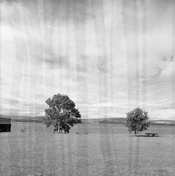
What the hell's happened here? Massive streaking stains on HP5 120.

Ferns

H
Ferns

  • 0
  • 0
  • 24
between takes

H
between takes

  • Tel
  • Mar 21, 2026
  • 3
  • 0
  • 43

Recent Classifieds

Forum statistics

Threads
202,868
Messages
2,846,776
Members
101,578
Latest member
Reaton
Recent bookmarks
1

Spiny Norman

Member
Allowing Ads
Joined
Feb 10, 2023
Messages
12
Location
UK
Format
35mm
Anyone got any idea what's caused these awful marks?
I took my Bronica S2 out today and the film has these stripes all along it, beginning to end.

The only thing that's different is the batch of HP5. Same dev, same dev tank, same technique I've been using for years, I've developed literally thousands of films and I've never seen anything like this before. I like to think I know what I'm doing but we can all screw up from time to time.
It's along the length of the film and it's not drying marks, I've rewashed the film 3 times and I've never had drying marks before, I live in a soft water area,
To me they look like dev staining but how? Or could they be marks from the backing paper or some other fault in the film? I did notice the film was quite 'clingy' when I loaded it into the reel but it went on OK. HP5 dated 2027, been in the fridge.
Any guesses?
 

Attachments

  • img053 (Custom).jpg
    img053 (Custom).jpg
    1.1 MB · Views: 181
Strange! If no one has a better idea, you could post part of the roll and the backing paper to Ilford for analysis. They might be able to determine whether this was a chemical reaction with the backing paper.

Mark
 
Seems like liquid mark to me. Think it comes from condensation?
 
I got this on a sheet of 8x10 that I pre-soaked in tempered water before developing (even though Ilford recommends against it). This was about 15 years ago. The streaks were on the back of the sheet. The back had a slight sticky feel to it. The next sheet I developed sans pre-soak, was fine.
 
Were your tanks and reels completely dry before loading? If any water drips onto the film before pouring your presoak or developer, that'll cause the emulsion to swell in those areas which will then be overdeveloped when you introduce the developer.
I've seen this happen, but it'd have to be a significant amount of moisture to cause it along the entire length of the roll.
Condensation is another possibility if the film was still cold when loaded into the back.
 
It's along the length of the film

Are you having unusually humid weather, resulting in unusually long drying times of the film?
I'd expect to see this kind of effect if you have water running down in streamers along the emulsion as the film is hung vertically, and the water takes a long time to dry up.

Do you use a wetting agent? This tends to break the surface tension of the water so that it doesn't form these distinct streamers - at least less so.

Condensation etc. I find a little hard to match with how the defect looks. I'd expect more of a spotty pattern, not distinct longitudinal streamers.

I'd contact Harman/Ilford and send them an example.
 
If you still can get the backing paper out of the bin and keep it for potential evidence. But to me it doesn't look like drying marks but looks kind of like the backing paper or emulsion getting damp and/or heat at some point, perhaps an extended time in the camera, a long time in the camera bag, or more particularly not being unfrozen enough before being unwrapped and loaded.
 
Were your tanks and reels completely dry before loading? If any water drips onto the film before pouring your presoak or developer, that'll cause the emulsion to swell in those areas which will then be overdeveloped when you introduce the developer.
I've seen this happen, but it'd have to be a significant amount of moisture to cause it along the entire length of the roll.
Condensation is another possibility if the film was still cold when loaded into the back.

Everything was bone dry when I loaded the film, the weather here is warm (for Scotland lol) but not particularly humid. I don't use a wetting agent, I've never felt the need, I never get drying marks normally.

Your last point has me wondering though. I thought I gave it enough time from the fridge to loading into the camera back, but maybe 20-30 mins wasn't enough.
I'll try another roll from the same batch in the same camera and give it overnight to adjust the temperature and see how that turns out.
 
I got this on a sheet of 8x10 that I pre-soaked in tempered water before developing (even though Ilford recommends against it). This was about 15 years ago. The streaks were on the back of the sheet. The back had a slight sticky feel to it. The next sheet I developed sans pre-soak, was fine.

Did the streaks clean off of the back of the film?

That's a seemingly rare confimation of hte wisdom of the Ilford recomendation. Hmmmm. :smile:
 
Anyone got any idea what's caused these awful marks?
I took my Bronica S2 out today and the film has these stripes all along it, beginning to end.

The only thing that's different is the batch of HP5. Same dev, same dev tank, same technique I've been using for years, I've developed literally thousands of films and I've never seen anything like this before. I like to think I know what I'm doing but we can all screw up from time to time.
It's along the length of the film and it's not drying marks, I've rewashed the film 3 times and I've never had drying marks before, I live in a soft water area,
To me they look like dev staining but how? Or could they be marks from the backing paper or some other fault in the film? I did notice the film was quite 'clingy' when I loaded it into the reel but it went on OK. HP5 dated 2027, been in the fridge.
Any guesses?

When you loaded the film was it still partly frozen?
 
Did the streaks clean off of the back of the film?

That's a seemingly rare confimation of hte wisdom of the Ilford recomendation. Hmmmm. :smile:

Nope. It was "in" the back.
 
Well, I quickly blasted off another roll and it turned out exactly the same, so that's 8 rolls of HP5 gone in the bin. I suppose I could try and get free replacements from Ilford but there's no point for a film I've totally lost confidence in.
I did notice a very strong smell of glue when I pulled the film apart to develop it, like junior's first attempt at an Airfix kit, I've never noticed that before on any film ever. Maybe a dud batch of backing paper who knows. Off to buy some TMax 400 now...

General question, is film nowadays not made to the same standards as it used to be? I had problems with a known fauly in Fomapan 200 120 a year or two ago, but when film was all there was I don't rememberf ever getting a bad one.
 
There are a myriad number of reasons to advise Harman of your problem. It could very well be related to distribution issues, and your giving them a heads up will help others.
The standards are the same or better from the major manufacturers, but their control over extraneous factors is not as effective as it once was. Things like shipping and handling issues are much more likely than when they had large refrigerated trucks sending film directly to the climate controlled storage used by the retailers.
The vastly lower volumes also mean that the constituent components are much more likely to come from third parties, and the relatively small size of their orders from them mean that the film manufacturers are just one customer in a queue of others, many of which have much larger orders.
 
Ilford roll films seem to have a nice odour, that reminds me of my candy cigarette smoking days. But like Matt said, I would let Harman know.
 
Get ahold of Ilford they should know, save them a bigger problem. And watch out for Dinsdale!!!
 
For entirely selfish reasons I'd certainly like to know what Ilford says. I'm a HP5+ 120 user myself and also U.K. based. I seem to see more of this kind of a thread detailing a 120 problem than I used to or maybe it just seems that way

pentaxuser
 
I was hoping this one would have been OK which would have meant that it was my own fault for not letting the film warm up enough after it came out the fridge. I've never had any bother with putting a chilled 35mm film into a camera but then they don't have backing paper to stick to.
I could contact Ilford but since the remaining films have been thrown out I can't give them a batch number or anything, I can't even remember where I got them so it'll be of little use I suspect.
tbh I never liked HP5, always preferred TriX or if I really needed a fast B&W film I found FP4 would go to 400 with only a little increased grain, in fact FP4 at 400 looked very much like TriX the way I did it back in the day!
 
Film in a refrigerator or freezer should ideally be stored in a film canister or ziplock bag and allowed to warm up before the bag is opened, only then open the bag (exposing it to the more humid room air) and put it in a camera.

Put an empty glass in the fridge, let it cool, take it out and set it on the counter. If condensation appears and it starts to sweat, that's also happening to your film.

Regardless of whether that is the problem, the edge marks on your developed film might be of assistance to Harman in identifying the batch.
 
Update/closure on this.
FWIW I did contact Ilford and I must say a lady called Sue was extremely helpful and by the sound of it involved a few other tech boffins in the company but unfortunately we couldn't reach a conclusion. There were no similar faults recorded on HP5 so it'll have to remain a mystery.
 
Spiny, if you have the backing paper or a roll you no longer trust, carefully roll out the backing paper and look at the numbered side using either a very bright spot light or the sun as a means to detect if the paper's lacquer contains the same pattern. These could be break-lines or streaks in the lacquer that is applied over the white paper and printing. Any discontinuity of the paper's back side can emboss the film's surface with a similar pattern that will lead to differential development and variations in density.

If the paper is not showing discontinuities, then you should look at other means of how the emulsion side my be getting wetted and swelling before you start the development - or having developer remaining on the film leading to streaking when the developer is being emptied. In conveyance processors, ineffective sqeegeeing or air knives can lead to developer carry-over which can have similar, but shorter, appearance. The goal should be to have every grain given the exact same amount of develper and time or development...so dumping and delaying the next chemistry can lead to streaking or spotting - depending on the system you are using.
 
Photrio.com contains affiliate links to products. We may receive a commission for purchases made through these links.
To read our full affiliate disclosure statement please click Here.

PHOTRIO PARTNERS EQUALLY FUNDING OUR COMMUNITY:


Ilford ADOX Freestyle Photographic Stearman Press Weldon Color Lab Blue Moon Camera & Machine
Top Bottom
