
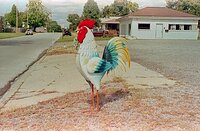
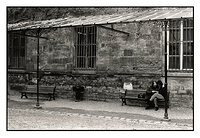
Having some idle time I decided to fool around with a developer(s) experiment. Started with a 36 exp. roll of Agfa APX100. Set up the tripod, chose a bright sunlit scene with a pure white and a hard black, lots of vegetation, some shadows, measured the exposure and fired off 36 before the light could change.
Went into the darkroom, sliced the roll into four pieces and developed each according the mfrs. tech data in D-76, HC-110, Rodinal, and T-Max.
Printed one neg from each strip at the same enlarger exposure. Result: after a lot of examination of densities, grain, midtones, I couldn't see any significant differences, density or otherwise, between the 76, 110 and Rodinal. The T-Max had a higher density and I had to print it down +1/3 stop more to be in the same density range as the rest. This possibly explains the speed increase touted by T-Max users.
I kept hoping for some significant advantage/difference (highlight separation, mid-tone separation or shadow detail) or a 'look' between the developers, but I and my wife couldn't point at anything at all that jumped out.
My empirical conclusion: these developers are virtually the same; the major differences being whether they are liquid or powder and the convenience of dilutions, use, etc.
Everyone talks about the 'look' of Rodinal, I couldn't see it. I couldn't choose one print that looked better than any other.
Did I miss something here?
Went into the darkroom, sliced the roll into four pieces and developed each according the mfrs. tech data in D-76, HC-110, Rodinal, and T-Max.
Printed one neg from each strip at the same enlarger exposure. Result: after a lot of examination of densities, grain, midtones, I couldn't see any significant differences, density or otherwise, between the 76, 110 and Rodinal. The T-Max had a higher density and I had to print it down +1/3 stop more to be in the same density range as the rest. This possibly explains the speed increase touted by T-Max users.
I kept hoping for some significant advantage/difference (highlight separation, mid-tone separation or shadow detail) or a 'look' between the developers, but I and my wife couldn't point at anything at all that jumped out.
My empirical conclusion: these developers are virtually the same; the major differences being whether they are liquid or powder and the convenience of dilutions, use, etc.
Everyone talks about the 'look' of Rodinal, I couldn't see it. I couldn't choose one print that looked better than any other.
Did I miss something here?
Last edited by a moderator:


 This is something that each B&W photographer has to learn for him-/herself at some point in our darkroom careers.


