
• Welcome to Photrio!
    Registration is fast and free. Join today to unlock search, see fewer ads, and access all forum features.
    Click here to sign up

What kind of toning process is this?

Recent Classifieds

Forum statistics

Threads
203,199
Messages
2,851,176
Members
101,718
Latest member
ClassyJ
Recent bookmarks
4

Mainecoonmaniac

Member
Allowing Ads
Joined
Dec 10, 2009
Messages
6,295
Format
Multi Format
Hi APUGers.

I've been doing this toning process off and on for over 10 years. While I was assisting, I learned this process where you take a BW print that printed darker than normal, then it's "toned" in a solution of potassium Ferricyanide and potassium bromide. The print is bleached to a certain point. I then wash the bleached print then re-expose it in bright sunlight. The image comes back a brownish. It looks sort of like a lith print. Is this a toning process? How toxic is the solution of potassium Ferricyanide and potassium bromide? Thanks in advance.
 
I would think after you get the desired effect, do your fix , hypo clear and wash sequence again.
 
Not needed

I would think after you get the desired effect, do your fix , hypo clear and wash sequence again.

I've had prints that are 10 years old and there wasn't any fixing after toning the prints. Just a wash to remove any residual toner.
 
Both potassium bromide and potassium ferricyanide are not very toxic just don't eat them. Usually when you bleach a print you refix it to remove the bleached silver.
 
Does exposure to sun get convert the bleached siver?

Both potassium bromide and potassium ferricyanide are not very toxic just don't eat them. Usually when you bleach a print you refix it to remove the bleached silver.

I'm just curious, does exposure to bleached silver on a print convert it to a form that is stable when exposed to sunlight? It seems that when I expose the print bleached in the solution of potassium bromide and potassium ferricyanide, the image comes back brownish which is pretty stable.
 
I'm just curious, does exposure to bleached silver on a print convert it to a form that is stable when exposed to sunlight? It seems that when I expose the print bleached in the solution of potassium bromide and potassium ferricyanide, the image comes back brownish which is pretty stable.

Well it's the same principle as a POP, light converts the Silver Bromide (in this case) to Silver, it'll be a far weaker image than if you'd used Thiourea or Sulphide toner.

Unlike POP you are giving a full fogging exposure. There no need to fix, in fact the silver grains are so fine a fixer would bleach the image. A plain Sodium thiosulphate bath would work very dilute, but a modern rapid fixer would remove the image quickly.

Ian
 
Sounds like a neat process. I imagine the print is exposed to sunlight after it has dried after bleaching and rinsing.

The print should be stable, though it may continue to darken if the sunlight didn't convert all the silver-halide.

I wouldn't fix the print or do any other wet process to it after it has been exposed to sunlight to print-out.
 
Ideally for permanence it should be toned, Gold & Platinum were used historically, without it has very little protection from environmental influences and is more susceptible than most other processes.

Ian
 
Hey thanks Ian and Nicholas. I learned the "secret" process many years ago. I don't know if other photographers are doing it. I'll scan a print I made and post it on this thread.
 
It's not exactly a secret process :D

In the Art of Photography exhibition 1989 shown US the Uk and Australia to celebrate 150 years of photography there were many older POP images, they ahd to be viewed in very subdued light due to their impermanence.

Early photographers soon found the images degraded and began using toners to give protect and give images a longer life.

Ian
 
I tried silver prints with bleach back and without toning the prints did fade,
I assumed they needed to be fixed and washed again.
I like the look , what toners other than sepia would make this permanent?

It's not exactly a secret process :D

In the Art of Photography exhibition 1989 shown US the Uk and Australia to celebrate 150 years of photography there were many older POP images, they ahd to be viewed in very subdued light due to their impermanence.

Early photographers soon found the images degraded and began using toners to give protect and give images a longer life.

Ian
 
I tried silver prints with bleach back and without toning the prints did fade,
I assumed they needed to be fixed and washed again.
I like the look , what toners other than sepia would make this permanent?

Weak plain Sodium Thiosulphate fixer followed by Gold toner even a plain fix will take a percentage of the silver.

Needs more thought & some experimenting.

Ian
 
This differs from traditional printing-out in that the excess silver has already been removed. Exposure to light shouldn't cause the print to go uniformly dark as happens with POP/proof prints.

Bob, when you say you saw fading - was that fading to a dark print or fading to a light print?
 
I'm just curious, does exposure to bleached silver on a print convert it to a form that is stable when exposed to sunlight? It seems that when I expose the print bleached in the solution of potassium bromide and potassium ferricyanide, the image comes back brownish which is pretty stable.

When the silver image is bleached with ferricyanide in the presence of potassium bromide. it is converted to silver bromide. This is once again sensitive to light and the print will soon darken unless the print is refixed. A brown color to the image is caused by the smaller size of the silver grains. Years ago photographers gave out "proofs" on printing out paper. They were easy to make since they were not fixed and would darken on exposure to light. This guaranteed that the photographer would get paid. You can get all sorts of interesting colors by exposing photographic paper to light and not developing and fixing it. However, once in the fixer the colors are lost.
 
Memory serves me correct , fading to light
This differs from traditional printing-out in that the excess silver has already been removed. Exposure to light shouldn't cause the print to go uniformly dark as happens with POP/proof prints.

Bob, when you say you saw fading - was that fading to a dark print or fading to a light print?
 
Memory serves me correct , fading to light

The problem is that without a fixing stage there's still Silver Bromide present in the emulsion, as it's insoluble washing isn't sufficient.

How ever it should be possible to tone then fix, one of the alternative processes uses this sequence.

The issue of leaving spent halides in an emulsion is that they can reverse, bleaching, that's how some reversal B&W papers and now discontinued films work.

Ian
 
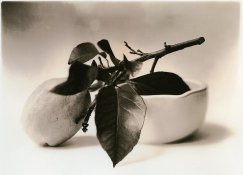
Here's a scan of the print tone in the solution of potassium bromide and potassium ferricyanide. As you can see, it looks very organic. The process is very unpredictable. I also love the imperfections of spots from the process. The print after bleaching is re-exposed while it's still wet. If I squeegee toner from the print, it will have less mottling.
 

Attachments

  • lemon.jpg
    lemon.jpg
    232.3 KB · Views: 116
It looks like you got a little solarization on the leaf. It's nice. I know you can get solarization by heavily flashing the print when re-developing (after the rehalogenating bleach). It works sometimes in lith developer, I don't know about others. But it looks like you have a little there.
 
I just like the look

It looks like you got a little solarization on the leaf. It's nice. I know you can get solarization by heavily flashing the print when re-developing (after the rehalogenating bleach). It works sometimes in lith developer, I don't know about others. But it looks like you have a little there.

I like the look of the process. It's unpredictable as I mentioned. So is my soup of potassium ferricyanide and potassium bromide a rehalogenating bleach?
 
You aren't using any toner :D Just the bleach, if you bleached in the darkroom in subdued/low light and washed before re-exposure you'd probably cure the imperfections.

Ian
 
But that's what I love about it

You aren't using any toner :D Just the bleach, if you bleached in the darkroom in subdued/low light and washed before re-exposure you'd probably cure the imperfections.

Ian

I'm looking for the perfect flaw :wink:
 
Photrio.com contains affiliate links to products. We may receive a commission for purchases made through these links.
To read our full affiliate disclosure statement please click Here.

PHOTRIO PARTNERS EQUALLY FUNDING OUR COMMUNITY:


Ilford ADOX Freestyle Photographic Stearman Press Weldon Color Lab Blue Moon Camera & Machine
Top Bottom