
• Welcome to Photrio!
    Registration is fast and free. Join today to unlock search, see fewer ads, and access all forum features.
    Click here to sign up

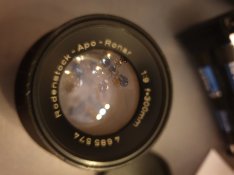
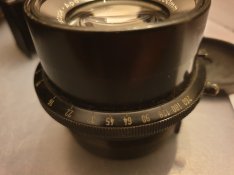
What is this lens?

Recent Classifieds

Forum statistics

Threads
202,848
Messages
2,846,426
Members
101,564
Latest member
swedafone
Recent bookmarks
0

swchris

Subscriber
Allowing Ads
Joined
Mar 22, 2010
Messages
261
Location
Bavaria
Format
Multi Format
I've received this lens from a friend today. He said something like "enlarger lens".

But this seems not to be correct. f/9 doesn't seem to be that fast, and which enlarger lens needs to be stopped down to f/260??

What is the use of such a lens?

regards,
chris
 

Attachments

  • l2.jpg
    l2.jpg
    254.1 KB · Views: 220
  • l1.jpg
    l1.jpg
    65.5 KB · Views: 208
What makes it special is that is of absolute symmetrical design. In contrast to enlarger lenses.
 
Ok. Thanks. But maybe I need to rephrase my question:

I understand "macro work" and see the general usefulness of being able to stop the lens down to such insanely small apertures. Is this one reason for these small apertures? And doesn't diffraction work against picture sharpness then?

But what exactly is a "process lens" or "process work" ?

regards,
chris
 
Process Work means Repro Photographie in a print shop
 
Process Work means Repro Photographie in a print shop
And for that, one needs excellent flat field performance at close focus distances.
 
Ok. Thanks. But maybe I need to rephrase my question:

I understand "macro work" and see the general usefulness of being able to stop the lens down to such insanely small apertures. Is this one reason for these small apertures? And doesn't diffraction work against picture sharpness then?

But what exactly is a "process lens" or "process work" ?

regards,
chris
Your lens is at the short end of the scale. Most horizontal process cameras were immense. Small ones took 16x20 film, bigger 3x4 foot film and larger.
https://en.wikipedia.org/wiki/Process_camera

1706-Camera.jpg
 
And for that, one needs excellent flat field performance at close focus distances.

Yes, but process lenses typically are optimized for scale 1/1, enlarger lenses typically are not optimized for 1/1 and this lens is advised for 1/1-infinite.
 
Ok. Thanks. But maybe I need to rephrase my question:

I understand "macro work" and see the general usefulness of being able to stop the lens down to such insanely small apertures. Is this one reason for these small apertures? And doesn't diffraction work against picture sharpness then?

But what exactly is a "process lens" or "process work" ?

regards,
chris

hi chris
might as well use it and see how you like it :smile:
a lot of people who do LF work use GClaron enlarger lenses. they fit in one of the copal shutters directly ( I think copal 1? )
and I think I remember reading over the years people love them so much they have created "casket sets". ( a barrel with a bunch of interchangeable
GClaron elements to give a variety of different focal lengths ) .. if you ever have to do copy work ( rephotographing things like objects, maps or papers or prints or negatives )
your lens will be great too... I use a tominon 127mm lens which was originally on some sort of polaroid copy/process camera all the time. it was sold as the taking lens
on the speed graphic I bought back in the day and it works great..
have fun with your new lens !
John
 
Photrio.com contains affiliate links to products. We may receive a commission for purchases made through these links.
To read our full affiliate disclosure statement please click Here.

PHOTRIO PARTNERS EQUALLY FUNDING OUR COMMUNITY:


Ilford ADOX Freestyle Photographic Stearman Press Weldon Color Lab Blue Moon Camera & Machine
Top Bottom